
Why oh why, does Spelling (it looks more doomful with a capital letter) feel like an unsolvable riddle sometimes? The word “dyslexia” has to be one of the most discouraging entries in the dictionary. Besides being just an ugly word to look at, the poor word conjures up visions of kids staring at pages like they’re written in ancient Sumerian with a lone tear trickling down their cheek. Meanwhile, we parents are over here googling “reading therapy” at 2 a.m. and wondering if a fish oil supplement will help. To make matters worse, there isn’t just one type of dyslexia, and it isn’t just “words wiggling” or letter reversals. It’s a whole Easter basket of struggles in (sometimes) hilarious ways. Here are some of the types we struggle with around here:
1. Phonological Dyslexia: The Sound Scrambler
This is the classic, most well-known type. Kids with phonological dyslexia struggle to connect sounds to letters. They can hear the difference between “bat” and “but,” but when it comes time to spell them, it’s like trying to remember the 400-digit Wi-Fi password at a hotel
2. Orthographic (surface) Dyslexia: The Rule Breaker’s Nightmare
English is a mostly phonetic language, but not entirely. (Looking at you, “colonel.”) People with surface dyslexia can sound out words just fine—until they hit an irregular word like “yacht.” Then their brains short-circuit. When they can’t rely on phonics, they get frustrated. If you’ve got a kid writing a word five times in a row… and still spelling it differently each time, you might be dealing with this one.
3. Rapid Naming Deficit: The Brain’s Slow Typist
Ever tried to recall someone’s name and your brain just gives you elevator music? That’s what happens to kids with a rapid naming deficit all the time. Their brains take a beat too long to retrieve letters and sounds, making reading feel like wading through molasses in January.
I’m not sure what the answer is. We’ve had great success with vision exercises, right-brained strategies, and a heavy emphasis on the science of reading/Orton-Gillingham (so there are as few exceptions as possible). I’m currently neck deep (mid-year deep?) in writing my own spelling curriculum that combines all my favorite things and cuts out the things I think are dumb. But I have to admit that was rather ambitious and cocky. Turns out what works for one kid, doesn’t work for the other kid, and despite all my attempts to make it fun and manageable, I still have kids hitting brick walls.
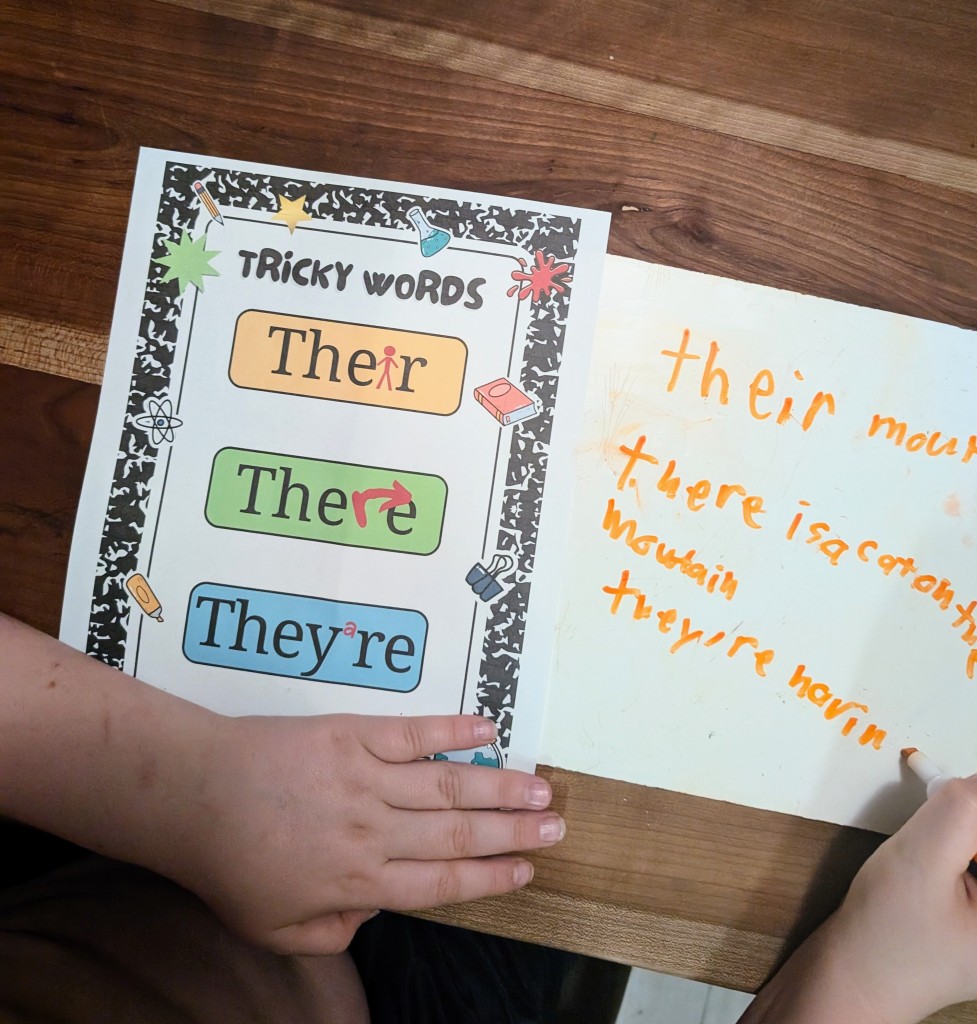
But we are making progress! It helps to put all the spelling rules to music. I have hope that we will figure it out, but in the meantime, if you have a child mixing up “their, there and they’re”, here’s a little visual memory hook to help. You can download it here.
 Scholar Forge