From Maple Leaves to Northern Lights! Memorizing and Learning Canada

Every year, I try to put myself in the head of a middle schooler and figure out new ways to help them wrestle with geography and cartography. It’s no easy task to memorize drawing and labeling the whole world by heart. Some might even question the necessity (and sanity) of doing so (since let’s be honest, most kids are probably going to forget a lot of it anyway… and what are they going to use it for, answering a Jeopardy question at 40?), but I had to memorize and draw the world by heart as a young teenager, and not only did it make history and politics much easier to follow, it was also like an executive function super course. Taking a big project, breaking it down into chunks, and figuring out ways to remember everything is a huge skill that transfers over to so much of adulthood.

That said, there are certain “hacks” to help information stick in your brain…colors, novelty, music, pegging, mnemonics etc. I try to have my kids and students brainstorm with me, and so here’s this year’s fresh crop of new ideas. Homeschoolers these days have so many more creative tools at their fingertips than I did in the 90s. It’s not fair!

What we’ve come up with for helping to memorize Canada’s provinces and territories:

Big Alps Sing Many Quiet Old Nursery Poems Near Naptime to Young Northern Nomads.
British Columbia, Alberta, Saskatchewan, Manitoba, Quebec, Ontario, Newfoundland, Prince Edward Island, Yukon, Northwest Territories, and Nunavut.

Save, print, laminate, cut into cards, and keep around the table while you’re drawing and labeling. Try memorizing and chanting to jump rope, cups, clapping, hop scotch, tango dancing or…you get the idea.

So that helps with the visual working memory, but it doesn’t include the capitals. For that we need a good old fashioned sea shanty. Here’s a song with all of Canada’s provinces, territories and capitals, including Ottawa! (for some reason, kids seem to skip that one).

You can download that here:

It very intentionally matches the same order as the acrostic mnemonic, but be careful! The Canadian provinces and capitals might get stuck in your head.

As always, you can find my other Cartography resources here:

Challenge A Cartography workbook

Map drawing tutorials

Happy Homeschooling!

Reluctant Artists and a Printable Nature Journal

Whether you’re an avid Charlotte Mason homeschooler, a die-hard Classical mom, or a free-spirited unschooler… we all want our children to spend more time outside, soaking in God’s nature, and of course the holy grail would be if they actually drew/painted and wrote down what they observed.

If you’re reading this and are thinking, yeah? What’s the big deal? My kids already do that. Then this blog post is not for you. But if you’re down here in the valleys fighting the monsters of “I’m hot and this is boring,” and “can we be done yet?” or the dreaded siren call of electronics, then know you’re not alone.

So if you have kids with ADHD, or who dislike writing/drawing, or who act like they’re allergic to being outside, here are some things that may help (or at least maybe baby steps in the right direction).

1) Set clear expectations. “We’re going outside for 30 min” is better than the abstract, full Sound of Music, “The hills are alive with the sound of music” vibe where you picture you and your children picturesquely traipsing through meadows with butterflies, sketchbooks in hand, and pencils ready to go.

2) If you have a perfectionistic artist, switch to a pen and tell them it’s a magic pen where mistakes are not only allowed, but encouraged. They don’t need to draw and erase five thousand times with a pencil while they get more and more frustrated.

3) If you have a child with dysgraphia, have them treat the outdoors like a rough draft. The messy handwriting, random keywords, and stick figures are great! Let them come in and trace and type later when they’re ready. If they saw a bird they thought was cool, have them trace a simple generic bird outline from the internet, and then fill in the details and colors on their own.

4) If you have boys or kids who like competition, turn it into a game. “Can you find a leaf you’ve never seen before?”, “Person who finds the craziest bug wins”, “Silent game and see who can hear the most bird calls”.

5) And last but not least, give them the freedom to research and sketch something crazy. Yes, you want them to be inside, but sometimes kids just want to research man-eating crocodiles in Australia, or a cute, nearly extinct red panda bear, and that’s ok too. I think sometimes we forget that the goal is to fan the flame of intellectual curiosity, observation, and research, and that doesn’t always fit into our idyllic homeschooling ideals.

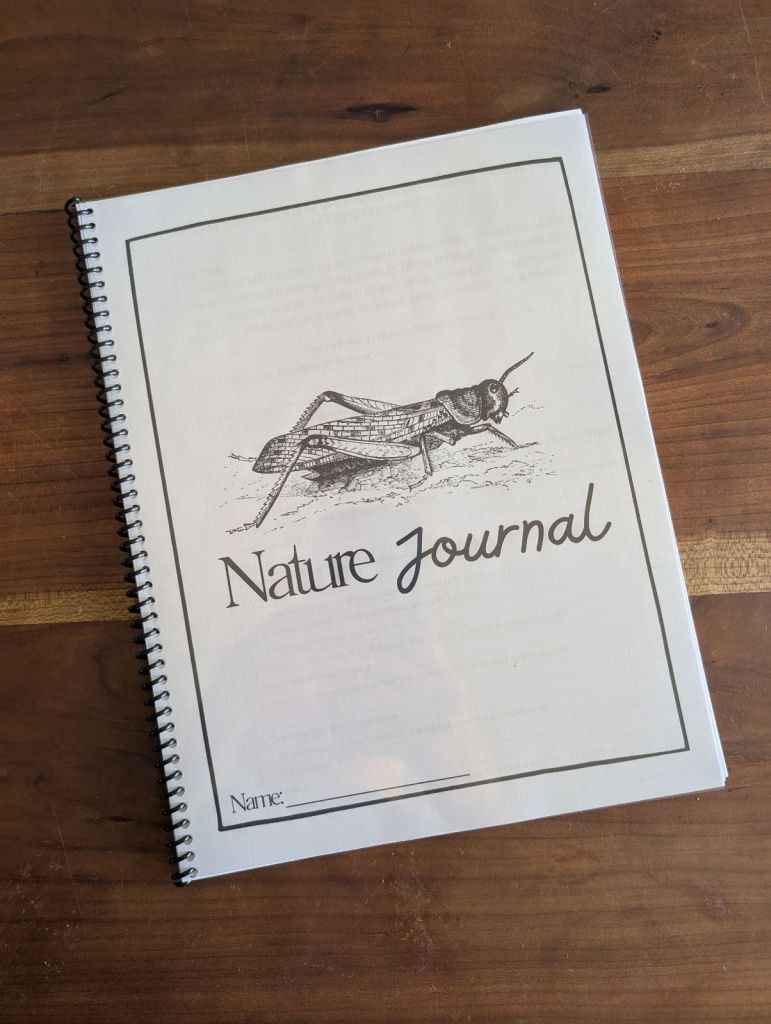
And if you’re one of those folks with a good printer and a speaking relationship with it, here’s a printable Nature Sketch Journal you can download for free:
1) Nature Journal w/Butterfly Cover
2) Nature Journal w/Grasshopper cover

It has space for both drawing and writing, and it’s formatted so your child can read their writing/notes, while their listeners can see their drawing.

If you need any other reluctant middle-school or Challenge A help (if you’re in Classical Conversations), you can find an ADHD friendly Latin workbook here. Or a traceable cartography workbook with drawing tutorials here. Or an anatomy workbook for kids who are strongly in the dialectic phase and like to argue and be opinionated here.

Meanwhile, I’m off to shoo my crew outside and pretend like we’re super chill about poison ivy and ticks! Ahem.

Anatomy Curriculum & Giving the “Birds and the Bees” Talk (Science Freebie)

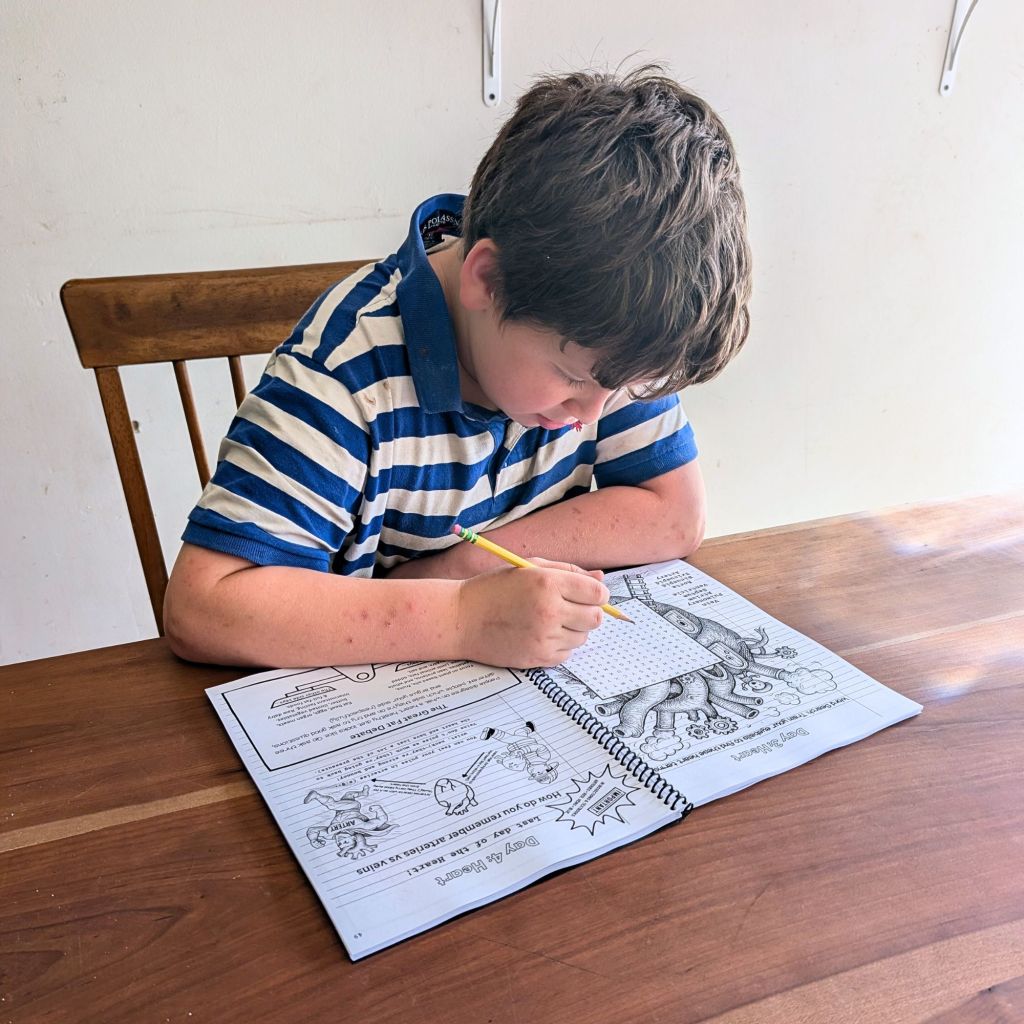
I should have done this a long time ago. I wrote a whole Anatomy Workbook/Curriculum! Between four kids who love science, a mom who is a nurse and loves human anatomy, and my years as a Challenge A Director, I’ve spent the last several months compiling all of my favorite experiments, dialectic questions, simpler drawings, and all the crazy memory hacks my mom used when I was little to help us memorize everything. It was one of those projects where I felt like I could have kept writing it forever, adding new interesting research and information I dug up, but I also wanted to make it doable. An independent, open-and-go curriculum with an easy answer key that wasn’t online and was screen-free. I also tried to tap into middle schoolers’ natural desire to form opinions and argue with everyone around them. Ahem.

You can find the printable digital version here.
Or…
You can find the printed and mailed-to-you version here.

And now, on to the thing that sparked this whole adventure. I think THE TALK is a universally dreaded conversation to have with your kids, and it always seems to be in capital letters in one’s head. And the worst part (at least in our family) is that when you finally muster up the courage to have the conversation, you forget that your kid has an auditory processing problem, and you make it so low-key and chill that they promptly forget the whole thing, leaving you to experience Groundhog Day. Good times. The internet is chock-full of all kinds of books, instructional material, and helpful advice, but it can be daunting and overwhelming, and thus we disassociate until another day and hope we don’t wait too long, or heaven forbid, give it too soon (where are my pearls to clutch).

So don’t take this as advice or a strong opinion, but if you’re looking for a plain, factual lesson, I’ve got you covered. For those who have visual learner kids, but don’t want something super graphic and are looking for a more science-friendly approach, here’s the Reproductive System Lesson from the workbook. A freebie science printable, as they say. You can hand it over, or do it alongside them, or edit it, or use it as a starting point to build with more information as they get older and more mature (or perhaps less mature in the case of middle schoolers). Enjoy!

Or you know, you can always go the super expensive route and buy a homestead and have animals, and then the reproductive education (mostly) takes care of itself!

Freebie: Medieval Math Cards and Synesthesia

Do numbers have personality and gender to you? Fueds, family trees, romances…sibling squabbles? Or are they just numbers?

This question came up in my Challenge A class, and out of six kids and a few adults, only one kid and one mom didn’t do this. Since I’ve done this for as long as I can remember…involuntarily with both notes/music notation and math/numbers, I sort of assumed everyone did it to some extent (except for Jim because he’s one of those weird spreadsheet people). Obviously, 0 is the patriarch and 1 is his firstborn son who’s been such a disappointment to him. 2 is the matriarch… 7 is the perfect child who drives his siblings crazy because he really shouldn’t be…etc etc etc.

Turns out that’s an actual thing called Ordinal-Linguistic Personification, which is a form of synesthesia. A large percentage of kids do it, but they usually outgrow it. Only 1% of the adult population has Ordinal-Linguistic Personification, so I guess Jim’s not the weird one after all. There are other types of synesthesia too! Some of them I’ve never even heard of:


Grapheme-color synesthesia – associating letters or numbers with specific colors.

Ordinal-linguistic personification (OLP) – attributing personalities or genders to numbers, letters, or days of the week.

Chromesthesia – hearing sounds and involuntarily seeing colors.

Lexical-gustatory synesthesia – associating words with specific tastes.

Auditory–Tactile Synesthesia – Hearing a sound causes a feeling somewhere on your body.

So now I’m super curious about who else is a closet synesthete. 👀


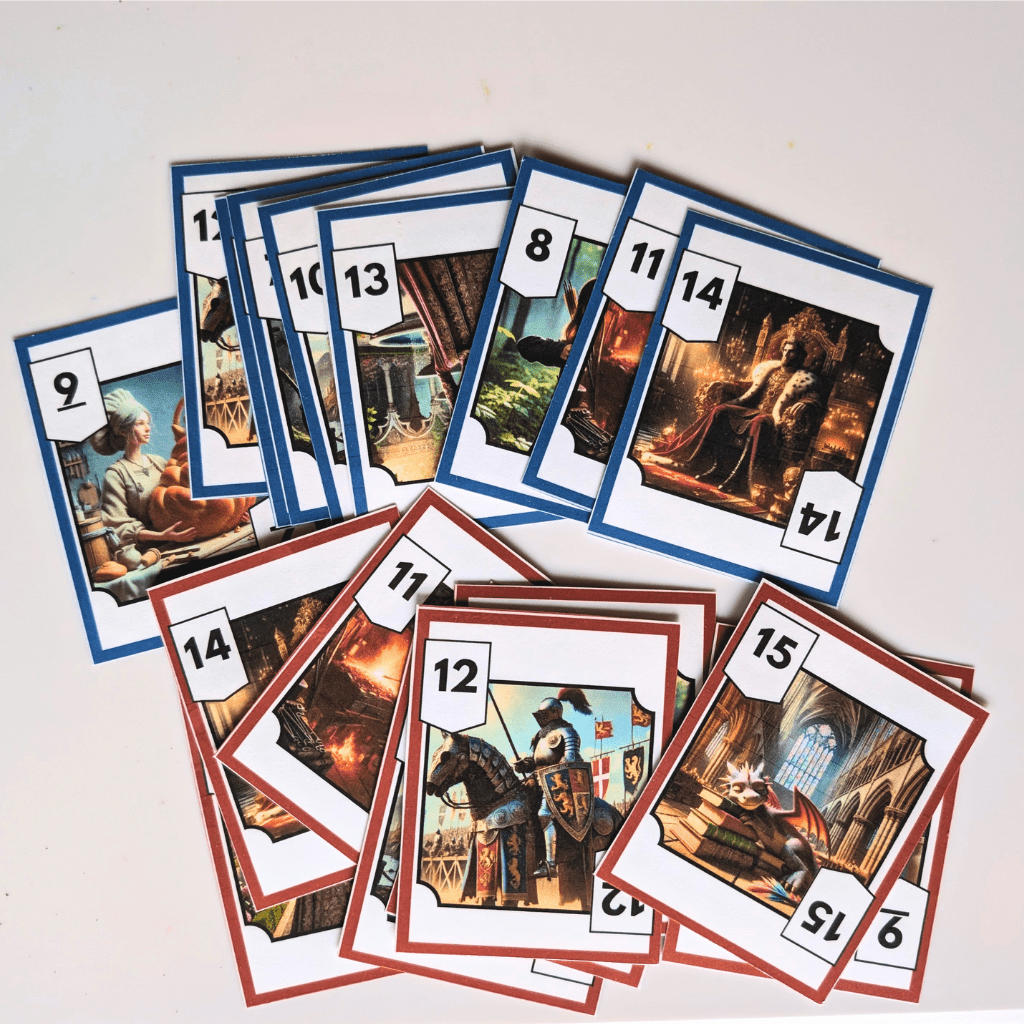
But back to math, this whole number personification thing has made math discussions in class and at home so much more interesting. I was listening to the math map podcast and Dr. Gilpin recommended making your own number cards for quick arithmetic games…it’s hard sometimes to remember what numbers kings and queens are and if we decided aces were high or low. Plus, it would be nice if the cards went up to 15 like we do with skip counting.

Soooo, thanks to the power of the internet and a little late-night insomnia, here are some personified number cards for all your little creative math geniuses (or right-brained ADHD-prone kids). If you want four suites like regular playing cards, print two sets. (make sure you select “fit to page” otherwise your printer will chop off the color). You can make blue cards negative numbers and red cards positive numbers…you can add the red and minus the blues…or multiply and divide. The sky is the limit! (I included a whole list of quick, fast medieval-themed math games that will tempt even the most dysgraphic sensitive kid into doing math…perhaps even liking it)
Enjoy.

(and if you’re looking for other screen-free homeschooling help like Challenge A survival Latin or Cartography, you can find them here.)

Teaching kids to be thinkers: Fallacy Flipbook

The world right now feels a bit like a flamingo trying to put on pantyhose in the dark. Lots of staggering involved. Maybe it’s because I have one kid going through the Fallacy Detective right now, or maybe we’re just in a new season of family dinners where varying opinions, debates, and conversations are flying on a more “oh hey look my kids are actually mini adults now” level and not the old days of “Please put your underwear back on, and no you cannot stick beans up your nose.”

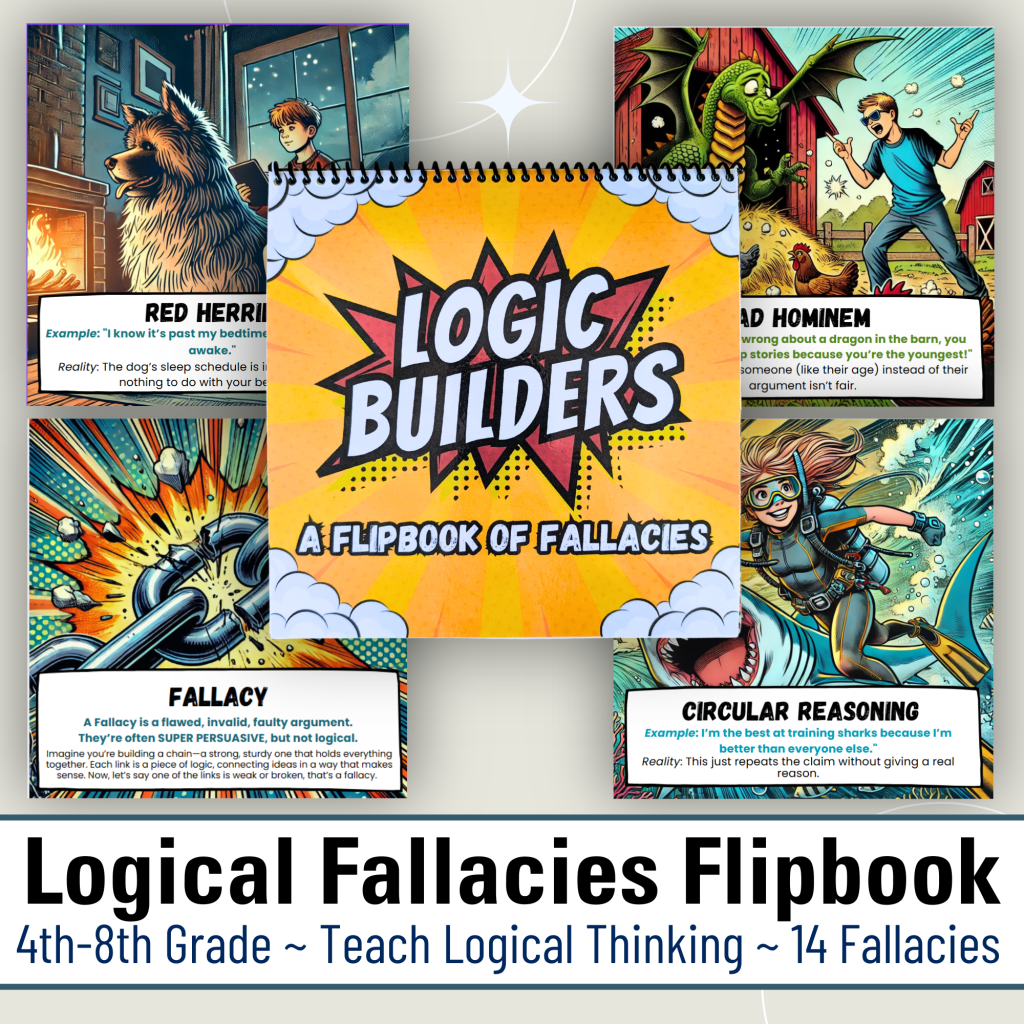
So all that to say, we’re on a logical fallacy kick around here. We find them in movies and ads, we catch each other doing them and we find them in spades on the internet and news. Whether your kids are homeschooled, private schooled, public schooled, or meet under a waterfall in some Waldorf-inspired space, I think it’s safe to say raising discerning thinkers is a high priority for all of us. Equipping them with the tools to think, discern, and pursue truth is like a broken record on the to-do list.

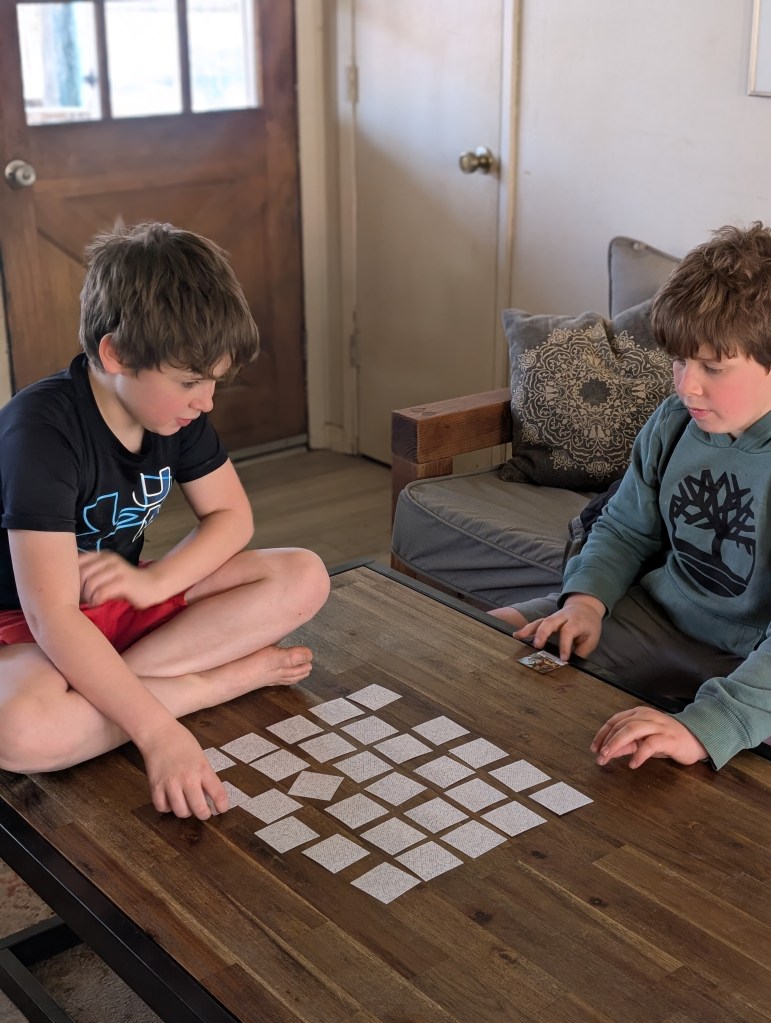
Not that I have anything remotely close to the answer, since persuasive rhetoric is supercharged these days, and we’re just as susceptible as the next person. So this is not a promise for “life-changing” results, but we’ve been enjoying these cards and matching game which you can download here. It’s led to lots of great conversations and I like that the youngest is catching up quicker than his older siblings did.

Or if you feel like supporting a small business, (mine!) you can download the full flipbook for a few dollars here. I made them to be neuro friendly and brain “sticky” in all the ADHD/Dyslexia ways. Even my older kids are picking it up and reading through them….which….let’s just say I’ll take that as a win!

Types of Dyslexia and a Freebie Spelling Poster

Why oh why, does Spelling (it looks more doomful with a capital letter) feel like an unsolvable riddle sometimes? The word “dyslexia” has to be one of the most discouraging entries in the dictionary. Besides being just an ugly word to look at, the poor word conjures up visions of kids staring at pages like they’re written in ancient Sumerian with a lone tear trickling down their cheek. Meanwhile, we parents are over here googling “reading therapy” at 2 a.m. and wondering if a fish oil supplement will help. To make matters worse, there isn’t just one type of dyslexia, and it isn’t just “words wiggling” or letter reversals. It’s a whole Easter basket of struggles in (sometimes) hilarious ways. Here are some of the types we struggle with around here:

1. Phonological Dyslexia: The Sound Scrambler

This is the classic, most well-known type. Kids with phonological dyslexia struggle to connect sounds to letters. They can hear the difference between “bat” and “but,” but when it comes time to spell them, it’s like trying to remember the 400-digit Wi-Fi password at a hotel

2. Orthographic (surface) Dyslexia: The Rule Breaker’s Nightmare

English is a mostly phonetic language, but not entirely. (Looking at you, “colonel.”) People with surface dyslexia can sound out words just fine—until they hit an irregular word like “yacht.” Then their brains short-circuit. When they can’t rely on phonics, they get frustrated. If you’ve got a kid writing a word five times in a row… and still spelling it differently each time, you might be dealing with this one.

3. Rapid Naming Deficit: The Brain’s Slow Typist

Ever tried to recall someone’s name and your brain just gives you elevator music? That’s what happens to kids with a rapid naming deficit all the time. Their brains take a beat too long to retrieve letters and sounds, making reading feel like wading through molasses in January.

I’m not sure what the answer is. We’ve had great success with vision exercises, right-brained strategies, and a heavy emphasis on the science of reading/Orton-Gillingham (so there are as few exceptions as possible). I’m currently neck deep (mid-year deep?) in writing my own spelling curriculum that combines all my favorite things and cuts out the things I think are dumb. But I have to admit that was rather ambitious and cocky. Turns out what works for one kid, doesn’t work for the other kid, and despite all my attempts to make it fun and manageable, I still have kids hitting brick walls.

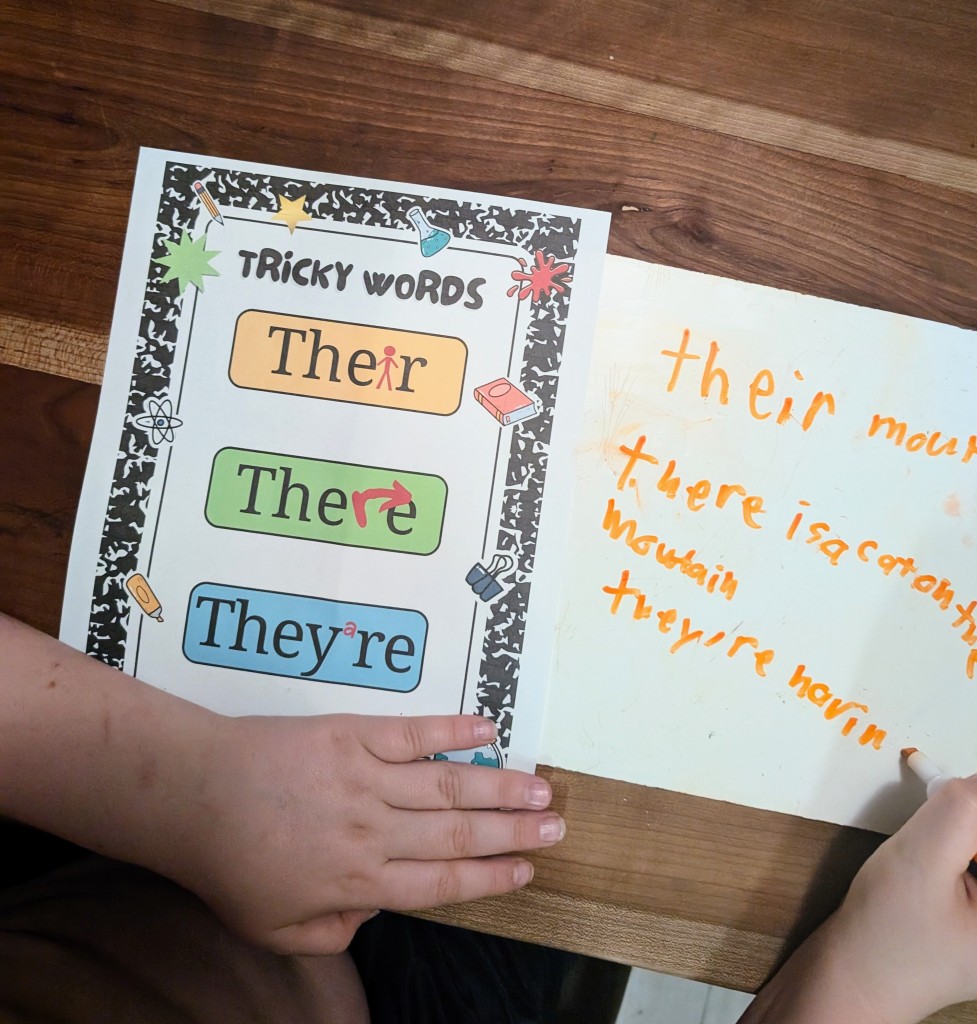
But we are making progress! It helps to put all the spelling rules to music. I have hope that we will figure it out, but in the meantime, if you have a child mixing up “their, there and they’re”, here’s a little visual memory hook to help. You can download it here.

This image has an empty alt attribute; its file name is pxl_20250228_035153719.jpg

The Secret Hack To Getting Your Kids Through Their Schoolwork

I’m loathed and embarrassed to even use such a clickbaity title, but I stumbled upon this method quite by accident and either it’s an anomaly for my kids/friends kids/students or it really is magical.

In all my spare time, I (try to) read books on neuroscience and listen to podcasts on all the latest cognitive strategies (hello Huberman), but there’s a difference between absorbing parasympathetic systems and dopamine receptors, and the real strategies for down-in-the-trenches help. So if I were to analyze this method dispassionately, I would say it’s the adrenaline and dopamine receptors that are kept guessing, that make this strategy so effective, but enough of the navel-gazing…. what is this?

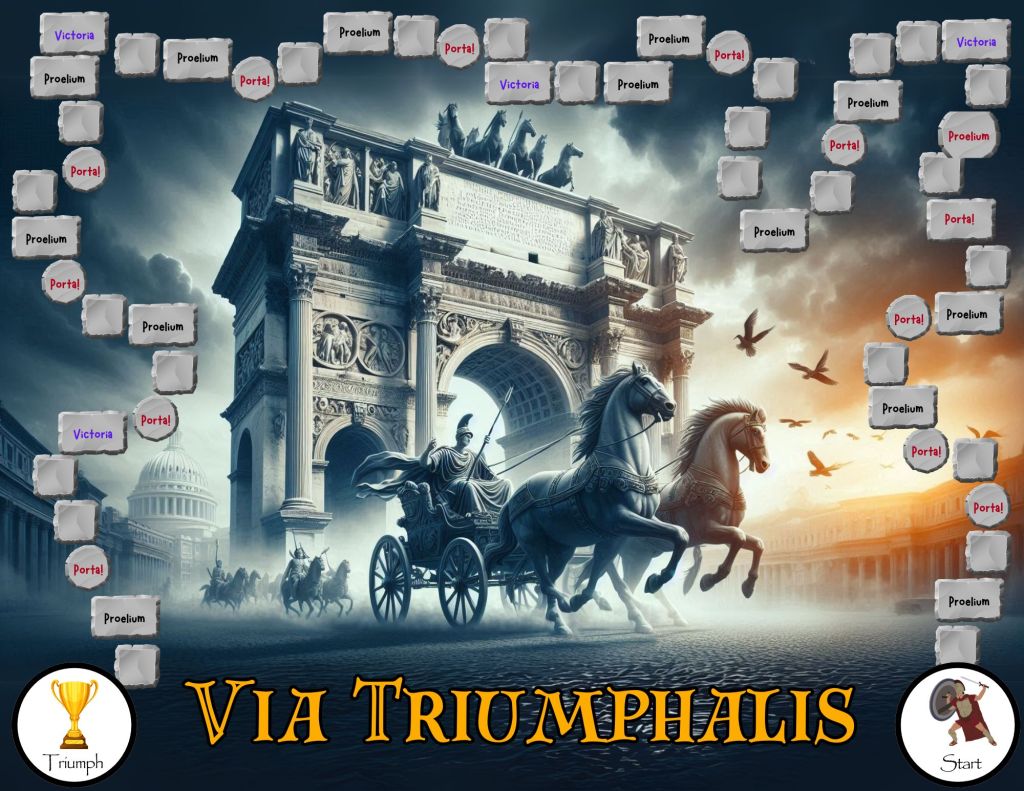
A printable board game and a few dice. I’m not joking. I can literally get my kids and my cottage school kids to do anything with this game. Math? done. Latin? done. Spelling? done. If you only have one kid, you’ll have to play with them as you need at least two players. Sometimes I do their work alongside them to show that even moms have to do school too, and sometimes I have them assign me my own “school work” like switching the laundry or starting lunch. After all, fair is fair, and if I’m asking them to do half a math worksheet, then they can assign me peanut butter and jelly sandwiches (little do they know, that I need the ADHD motivation hack too).

I named it “Via Triumphalis” which means “The Road of Triumph” in Latin. But don’t worry, you don’t need to understand Latin to play this game beyond knowing that “Proelium” means battle, and “Porta” means gate. You also need dice, and dry-erase markers (or a penny or something to move across the board…we use dry-erase markers). I have two versions, a simple one for younger kids, and a more complex one with character cards if your older kids get bored of the simpler version.

Word of caution though, don’t use it too much….act reluctant…only pull it out every two or three times they ask for it, otherwise (like with all things) the novelty wears off.

Here is the simple one, and here is the more complex one with character cards. Enjoy! Hopefully it’s not one of those things that only works magically for me.

P.S.
Not just for homeschooled kids, works great for getting any kid through homework.

Math Notation Flashcards

We’re on winter break, “enduring” the prettiest, gentlest snowstorm, and enjoying everything being canceled. Back last Summer when it was 100 degrees with 100% humidity I started (what I thought) was going to be the simple task of making math notation flashcards for myself and my kids. I got about halfway through when the school year officially started and we all feel like we’ve been tipped off a cliff or tossed off a high dive. Since then it feels like it’s been a thousand years with a few battles with the Balrog, but finally, I came face to face with enough time to finish those soul-sucking math notation flashcards. Definitely a labor of love. Ten out of ten do not recommend. Trying to figure out how to make logarithms and formulas on Canva is definitely not my idea of a good time. The only thing that kept me going was that I couldn’t use the normal ones. The ones CC sells are double double-sided, i.e. they put answers and questions on both sides, so both sides of the card criss-cross and contain both a question and an answer to the other side. It’s brilliant really. Nobody wants to carry around an enormous stack of flashcards and this cuts the stack in half. They’re great flashcards, well done…high quality…fit perfectly in the little flashcard boxes at Walmart/Target. You can purchase them here.

My eyeballs literally can’t handle them though. No matter how many times I tell myself this x has nothing to do with the “geometric mean”, it’s like my brain takes a picture and it’s stuck in there permanently the wrong way.

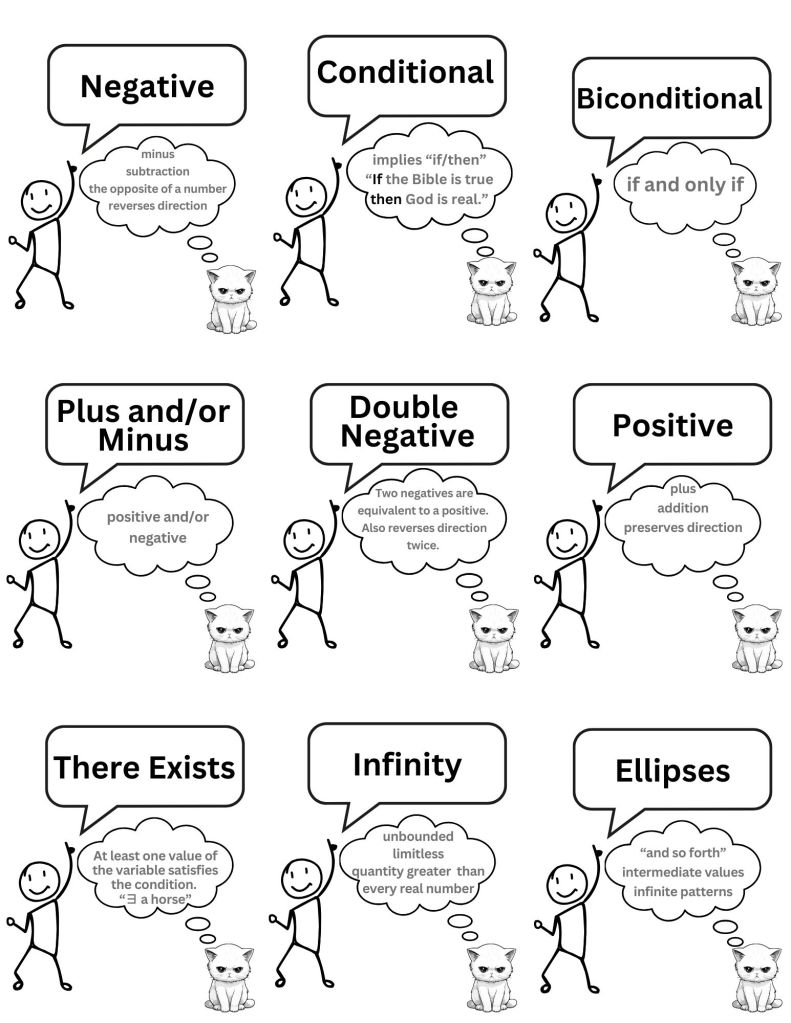
So for those who are also visual learners…have ADHD…or dysgraphia, here is a PDF of all the flashcards with just one notation and answer(s) on each card. I made them humorous and satirical with a grumpy cat and an over-enthusiastic stick figure. I also added some Latin explanations (couldn’t help myself)

Please, for the love of all the things that got neglected in my house to make these (the mud tracked in, wood shavings everywhere, cats hiding behind water heaters), use them if you need them. Hopefully, they do someone else some good too.

Now I’ll return to working on writing, spelling, and Latin curriculum, where letters mean their actual letters and not points of an angle.

It’s February, and it’s ok to feel like Frodo on the side of Mt. Doom, right? Right. (Also, can you tell what Snowday books/movies we’ve been consuming?) ahem.

If you’re looking for other neuro-helpful stuff:
Here’s a fun, electronic-free, comic-book style Latin workbook that goes along with Henle and Challenge A.
Here are some colorable Latin Flashcards that use mnemonics and puns to help them stick.
Here’s a simplified Anatomy workbook with body systems and guided research that is more accessible for dysgraphia/dyslexia.

Draw the world. Trace the world. Paint the world…Whatever your heart desires.

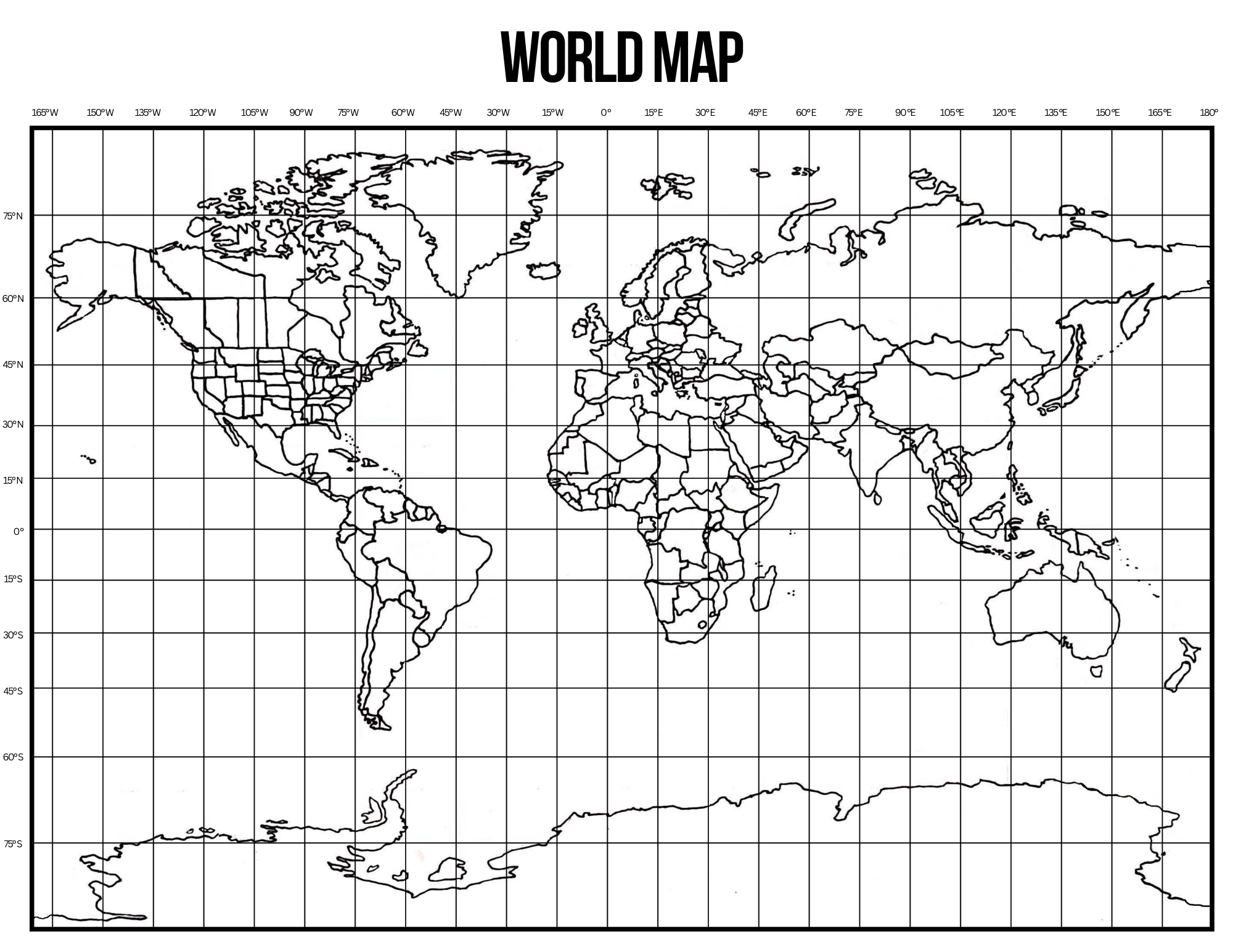
Don’t tell me if someone has already done this, but I finally drew an accessible world map. Straddling the GenX/Millenial line means I know how to use electronics better than a Zoomer, but not as well as a true dyed-in-the-wool GenX. Consequently, I have been struggling to find the perfect whole world map for nigh on 7 years now. You’d think it would be easy, but it needed to:

A) Be easily photocopiable and printable (you’d be shocked at how many maps have weird gray areas or water that don’t copy well).
B) Have the longitude and latitude lines go OVER the countries. This is super important to be able to draw it using the grid method.
C) Be the least garbled Mercator projection so the grids are in straight lines.
D) Have nice thick, easily traceable lines so it could be put on a window or lightbox.
E) Fit on a standard 8.5×11, but also be printable in bigger sizes.

It has been driving me crazy for years because I’m sure it exists somewhere and I didn’t need to draw one myself, but I couldn’t find one I liked. But I really didn’t want to make one myself because drawing the whole world takes time and effort…two things in short supply when you have 4 kids and a million other responsibilities and priorities taking up one’s time (like reading historical fiction till 2am…cough cough). I tried several times, but someone always spilled something on it, or I couldn’t get the perspectives and lines right. It was my own personal Sisyphean task…every time I worked on it, I somehow found myself back at the beginning.

So even though it feels rather anti-climatic at this point (faint drumroll), here is a fully traceable, fully drawable, fully expandable world map that may or may not be totally accurate. (I used Google Maps for the most up-to-date borderlines, but the world isn’t exactly stable and black and white right now):

There’s even a matching blank grid included. I think drawing and familiarizing kids with the world is incredibly important, especially these days. Once when I was working as a server, I had a table of customers who were from Kyrgyzstan. They asked me if I even knew where their country was. Not only could I tell them where it was, I could also tell them every country that bordered it. In all fairness, they didn’t realize how many years I’d been teaching middle schoolers how to draw the world by heart. But seriously, world news and issues make so much more sense if you have a working mental picture of the world.

I’ll get off my soap box now. I figure at the very least I made an exceptionally time-intensive free art page. Heck, you could even print it super large, paint it with your color scheme, and frame it… or color all the places with missionaries you pray for…or color in a new country every day and do a unit study…or…or… I’ll stop now.

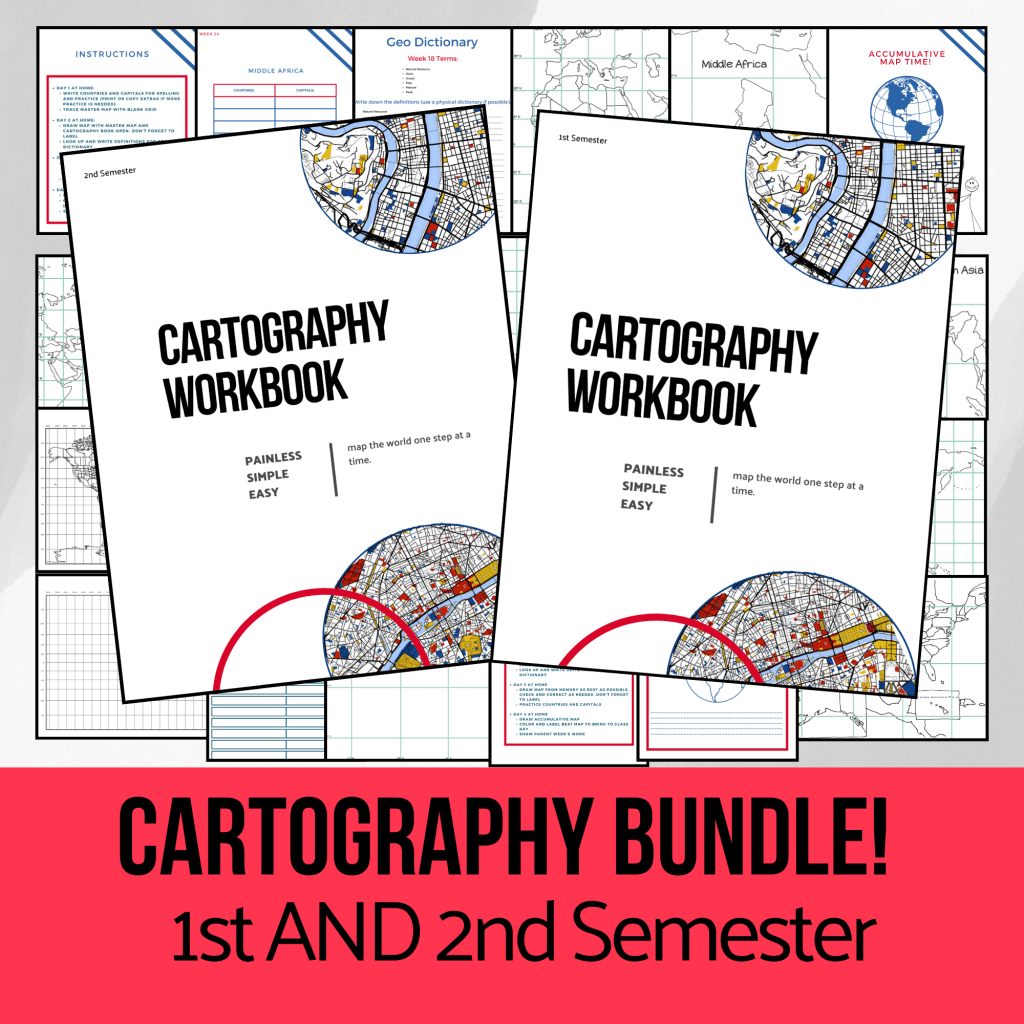
If you are inspired to have your kids learn to draw the whole world by memory, you can find the sum of all my labors here: https://www.etsy.com/listing/1185775539/cartography-workbook-challenge-a-now-1st


Life from the blind Tilt-A-Whirl and Grumpy Cat Math Notation flashcards

I thought tutoring Challenge A this year was going to be easy because I’ve done it so many times. I remember the ol days when students circled typos in It couldn’t just happen, backline maps were in the back of the guide and the math map wasn’t even a gleam in anyone’s eye.

Then I got a corneal ulcer from some sort of death ray staph/mrsa which in my imagination looks like the eye of Sauron erupting on the top left side of my left iris. It’s not only taken out a good bit of my vision, but it also makes my eye spasm like I’m on some sort of hellish carnival ride with strobe lights. All of my dreams for a smooth school start have come crashing down, but in some ways it’s good, the kids are all pitching in and my 3rd born may turn out to be my most independent Challenge A kid yet.

Of course if I could have chosen a year to have this happen, I wouldn’t have chosen The-Year-Of-The-Math-Map to be a director, but here we are. Our class is slowly sampling and nibbling at this advanced math feast, and I think good conversations and connections are being made. But holy wow, I cannot handle the math notation flashcards. I don’t know if it’s because I’m half blind, or it’s my ADHD or what, but my brain cannot handle the double-sided flashcards with the definition matching the opposite side. I look at it over and over, confusing myself even more and more.

In a fit of internal angst…over so many things, I made Grumpy Cat Math Notation flashcards. Since Math symbols can have a variety of definitions, I put the main on in the speech bubble, and all the extra information in Grumpy Cat’s thought bubble. First tour students can work on the speech bubble level, and more advanced folk can memorize the extra information.

Since It really is quite difficult to see (especially a computer screen…this blog entry is being typed with my eyes closed and shoutout to Grammarly), I only have the first 4 weeks done (15 pages total, so if you do one page a week you should have them memorized by Christmas and can start over and review in the 2nd Semester).

That said, here they are! Enjoy.

If you’d like an update when I have the rest of them done, you can give me your email here and I’ll let you know when they’re all up.

Go back

Your message has been sent

Warning

P.S. If you aren’t in Classical Conversations and have no clue what I’m talking about, thank your lucky stars. Although if you think it sounds fun to teach your child the definition of a radix point or the Greek phi (not to be confused with pi), then by all means feel free to include them in on the fun. Math is for everyone! We’re in our math era.

Printing tips: Print black and white and save ink and toner if you’re printing on thin paper otherwise you can kind of see the answers. Select “double sided” or “print on both sides” and then select “head to head” or “flip on long edge”. Make sure the orientation is set to “portrait” and hit print!

.