We only have three weeks of school left, the green baby leaves have finally outnumbered the gray tones, and I’m sitting in my living room wallowing in jello-like humidity (which I know is only a whisper of what’s to come, but in comparison, it’s for sure a hearkening). Clearly, Summer is almost here.
I’ve been mulling over what we want to do this summer: Hopefully, lots of gardening, river floating, and playing football or basketball in the morning after we’ve slept in, eaten homemade crepes, and read books together (one can dream, right?). But when I was thinking back to what has worked in previous summers I realized there is a clear winner that has threaded its way through all of our summers since my oldest was a wee lad.
Yeah, I know it’s kind of old school at this point, but I swear it really does painlessly teach fast arithmetic facts. I’ve always called it their “summer vitamin” and no one has really balked at it much, although that may be because it takes less than 10 minutes and has a clear beginning and end.
I don’t like to use it during the school year because Saxon takes so long that even ten more minutes feels like a duel-worthy insult, but I like to pull Xtra Math out in the summer just to keep everyone’s minds sharp.
And if we don’t get to it because we’re camping or picking ticks off, well then…that’s ok too.
Taking uninterested children to museums and field trips is BRUTAL. On one side you tell yourself that your children need to be educated and cultured and have their horizons expanded, on the other side you have the students/children themselves who are loudly protesting how much they hate said field trip. And then you have all the older responsible folk who are all “when I was a kid, we didn’t complain about…”.
And while you’re trying to internally juggle all the things, you’re also trying to pretend that you have nothing else in the world to do than make everyone happy. You’re not also wondering how you’re going to grade papers, get dinner on, feed the dog, schedule the orthodontist appt etc. I mean, I don’t know about you, but I live for bridging the gap between cranky docents who think “children should be seen but not heard” and said children who are convinced the world is devoid of food and fun.
Now that I think about it, I’m not being sarcastic…that’s literally what I live for. I think I may genuinely enjoy bridging that gap between the old and the new.
But I digress.
I happen to so privileged as to live within bike-riding distance of where the Little House On the Prairie series was written. That’s right. The real Laura Ingalls Wilder herself, wrote the famous books not a stone’s throw away from my house. Consequently, my children have been once…or twice…or several…ok many times to the original homestead tours and museum. So when our CC group had a field trip there, I knew I was going to walk that fun tightrope between the out loud “of course we’re going!” and the intense hushed “yes we are going and you are going to be polite and listen to the tour guide and say “yes ma’am and thank you”.
As I was agonizingly doing math with the youngest beforehand, in an attempt to get school done “early”, I realized I was going to need a backup plan. Having been before, I was mentally imagining a bunch of elementary-aged boys (and girls) trying to squeeze into the tiny 120-year-old kitchen filled with priceless artifacts. AND they were successfully supposed to not move or touch anything. Lord have mercy. So I came up with a “scavenger hunt”.
Now granted, I know this is harder to do if you’re traveling and don’t know what you’re getting into, but I think it’s really a fantastic plan. Kids like goals. Kids like tangible things. Sometimes their brains are too underdeveloped to match the grammar with the rhetoric, so they need a bridge. The bridge in this case was an orange wet-erase marker and a laminated sheet of notebook paper. I scribbled down 15 things for them to find and answer, and I evenly divided the tasks between the exhibits and the museum. The reward was a stick of “Penny candy” that now costs 40 cents. Ho hum. Economics lesson aside, I would happily pay 40 cents per kid in order to not get permanently banned from a museum. Of course, the plan did backfire on me when the kids were SO EXCITED to see Pa’s fiddle and to see where Laura lost the money for her homestead, that they went in like a drove of invasive grasshoppers, and promptly got their butts set down by an elderly docent. By the time I sauntered in (a few moments behind them), she was already wrapping up the “don’t make noise, don’t touch anything, don’t breathe on anything” lecture and was ready to launch into the “how to be a responsible chaperone lecture.” What she didn’t know, was that I am happy to take one for the team, in fact, I’d be happy to have her come lecture my children every morning, but she didn’t seem interested in that. Shocking.
After the field trip was over, my kids said it was the best field field trip ever. So. much. fun.
The key really was the “scavenger hunt” (and maybe the presence of their friends, but who’s counting). Everyone needs a job or a mission, and I totally get it! When I was in Paris, I had a mental checklist of everything I wanted to see, and learn, and understand. Why would kids be any different? They just need a little abstract hand-holding.
I’m going to start doing this every time I find myself chaperoning a field trip where I know I’m going to be in over my head. However next time I’m going to have a chat with the Gift Shop Lady first, and I’m also not going to forget all my scavenger hunt stuff on the table. I’m wondering, should I go back and get my pens and paper? Cut my losses? Save face? or chalk it up to a good laugh?
Also, if you ever come to visit, I will happily show you where Laura and Almanzo’s secret cold spring is, and tell you all the “exclusive conspiracy theory” stories.
Geography is one of those lost arts that is so smothered in a sea of fake/unhelpful/wannabe books, games, workbooks, and curriculum that sometimes you can’t see the forest for the trees. It’s one of those instantly marketable items. Slap a map and the word “Geography” or “Educational” on the front of it, and we parents are quick to snap them up off of Amazon, library clean-out sales, hand-me-downs, or the thrift store like they’re desperate promises to our future selves (I mean, surely I’m not the only one with visions of perfectly curated themed bookshelves and travel themed unit studies). And don’t even get me started on the geography-themed games and flashcards…
But all that geography stuff usually is so colorful and well-designed, that you don’t realize it’s kind of shallow and unengaging (and oftentimes downright full of errors). Consequently, the problem isn’t that there aren’t tons of options for Geography, but that it’s a struggle to find stuff you’ll actually use.
And Geography is one of those subjects that packs so much bang for its buck. Not only is it math, history, art, and science all in one parcel, but it’s also visual processing, concrete/abstract processing, spatial processing, executive functioning… all the things. It’s basically a custom-designed torpedo pod of academics and therapy all tied up into one perfect package. The only thing that might beat it at all those things is the violin, but that’s a post for another day.
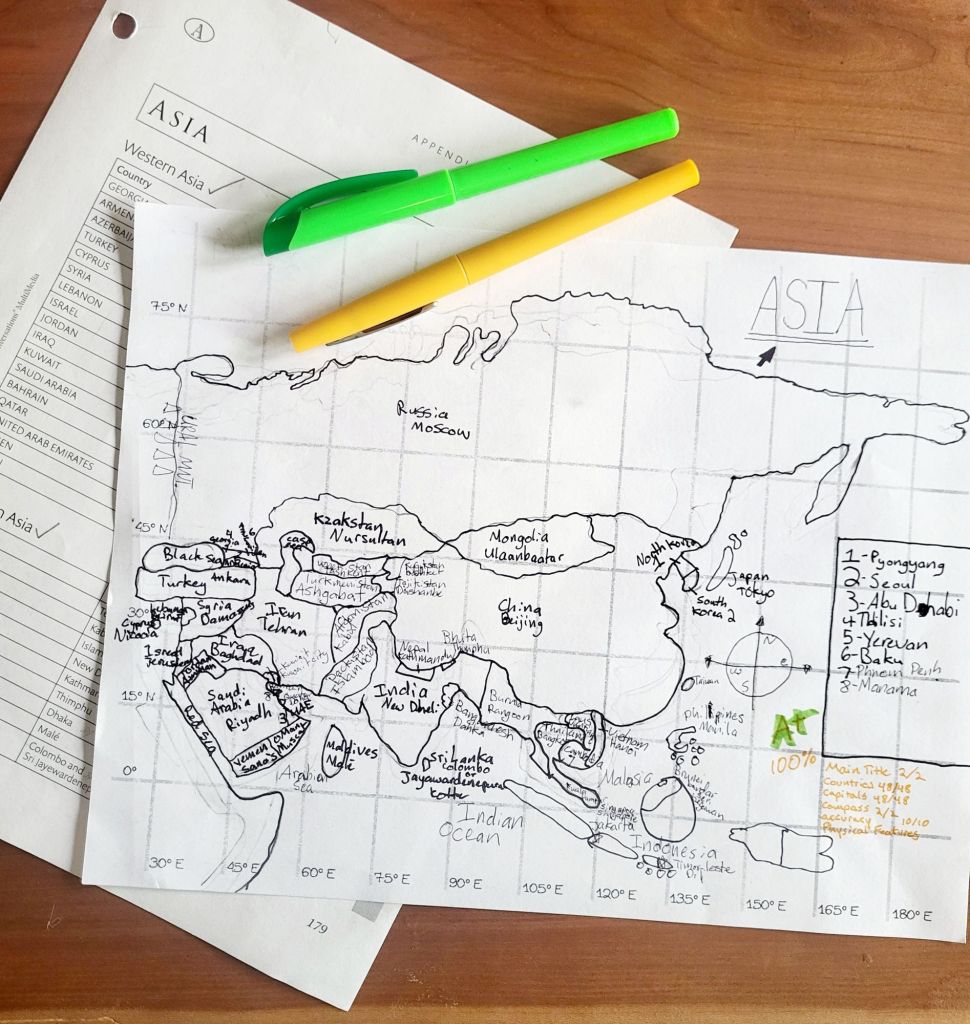
The problem is if you dive in and dig deep and engage with it…drawing and pronouncing, and wrestling with longitude and latitude, various sizes and projections, and whatnot, it’s hard. Sometimes extraordinarily hard, depending on how your kid’s brain is wired (or your brain), but I’ve seen profoundly dyslexic eyes thrive, and dysgraphia fingers map the whole world from heart (I can’t read it, but still…). Not going to lie, I’ve also seen kids cry and I’m not above bribes (and paint…and music…but mostly lots of paint). But seeing their minds grow and the connections made, I feel like it’s worth it to find your way through it.
And I don’t just say that because I wrote a cartography workbook which you can find here (insert cheesy infomercial music). Or made a bunch of fun, silly videos to help memorize and draw the world by heart which you can watch here (feel free to judge me, but don’t knock it til you try it…it works).
In the end, it doesn’t matter, pull out the colorful Costco Walmart Geograph specials, and just have fun with it…but maybe Google fact-check the stuff that doesn’t pass the sniff test. Really, this is an ode to how much I love geography. 😍
Full disclosure, I was one of those kids. Notice I said ‘was”, because along with my black thumb, and fear of talking to strangers, time really does heal all things (or most things). While I won’t be winning any Nobel prizes in astro physics, nor becoming a horticulturist or the next Malcolm Gladwell, I have mastered all those things to the point where I don’t start panicking and breaking out in hives when I have to do trinomial equations or save the butternut squash from the vine borers. (Well mostly there’s no panicking, I do still occasionally turn bright red when talking to strangers).
Part of it is some kids just don’t like numbers, or maybe it would be more accurate to say, that numbers don’t like them (I’m looking at you Dyscalculia). I mean, there’s nothing wrong with their brains, numbers are just slippery bits of squiggly lines that go in one ear and fall right out the other. I didn’t realize I could do math until I met geometry and propositional logic. Put interesting concepts and theories in His Royal Majesty the King’s English and suddenly it all makes sense.
But now that I’ve taught math both in the classroom and at home for fourteen years now, I’ve made some observations. There’s a group of kids who seem like they’re bad at math, or maybe it takes them forever to get through a lesson, but it’s not because they have the aforementioned Houdini number problem. They usually have really good number sense…too good. And that’s their hangup. For kids who have more abstract brains (Ne or Ni for the Myers Briggs nerds), their mind has to do a lot of sorting and thinking and connecting while they’re doing math. They can’t just be told how to do something. They tend not to trust it, and they second guess themselves constantly because nobody gave them all the puzzle pieces and they’re missing connector pieces that would bring the whole picture together. Now obviously there is a brand of math lover who is both abstract, loves arithmetic, is good with numbers, and is super fast…but we’re not talking about those unicorns. We hate those people (just kidding…and if any of my brothers are reading this, no I really am jealous proud of your ridiculously impressive math skills). For the math sloths, the problem isn’t that they can’t do math, the problem is they’re climbing a mountain in their head where you can’t see, and then having a meltdown like Mt. St. Helens because they’re sure they’re the worst math student the world has ever seen and they’re never going to understand it (middle schoolers are especially dramatic about math…ask me how I know).
At this point, I think I have bought and tried every math curriculum on the market, including but not limited to Singapore, Math U See, Saxon, Horizon, Bob Jones, Abeka, Rod and Staff, The Good and The Beautiful, Teaching Textbooks, Life of Fred, Right Start, Houghton Mifflin, Beast Academy, and Shormann. Whew.
The only one I truly hate is Saxon, which ironically is also the one we are currently using. I only hate it because it’s what I used as a kid and spent too many hours fantasizing about ways to burn it, but my kids seem to be thriving with it, so here we are (Mom, you can feel very vindicated right now).
If I had to pick my favorite combinations, it would be to use RightStart for the younger years (love that program). But it’s pretty teacher-intensive, so I like to use it alongside Rod&Staff which has very simple black-and-white consumable workbook pages. Perfect for days when you need to help the older ones more or you just can’t fit the raison d’etre RIghtStart in your day (seriously, the thing is a beast). Then for the older kids, I used to recommend Shormann, until I figured out that most teenagers can hack that thing with their eyes shut and get an “A” without actually learning a blessed thing. So now I prefer Nicole the Math Lady, who uses Saxon but actually explains everything like a normal person.
But my biggest piece of advice for the slow-hiking, Mt. St. Helen math kids, is to set a timer and scale. Acknowledge and praise them for the invisible rabbit burrows they’ve dug all through their brain. Encourage them that they are good at math (because they truly are). Set a timer for 60 min, and assign odds or evens. But don’t let them stay at camp happy-go-lucky. They really do need to get to a normal speed eventually. I mean, I don’t know what project engineers do when a bridge needs to be finished and everyone is waiting on them, but I imagine nobody is happy to sit around wasting money while their engineer gazes off into the distance making math connections. So at home, while you still have the chance, make some achievable goals for speeding up and pushing themselves a little.
Easy + One is what I always say.
And hug a kid who says they hate math, chances are they will eventually love it.
Sometimes I feel like Wendy with the lost boys around here. Homeschooling on most days feels like a battle, but somehow we tarry on. One of the main reasons I chose Classical Education was because it focuses on teaching kids how to learn, instead of what to learn. Sounds great, but turns out teaching a house full of wild boys how to learn, is way easier said than done. If you’ve hung around Classical education circles at all, then you’ve read or heard about Dorothy Sawyer’s essay titled “The Lost Tools Of Learning”. (it’s a quick read and I highly recommend it). In it, she basically does her version of “Back in the good ol days…”. But I’ll admit, it’s a compelling if laughably unattainable goal. I first read it when my kids were in diapers, and so incredibly naively optimistic that I mentally raised my hand and said “Yes! Pick me! Let’s do this!”. She’s a very persuasive lady. Ahem.
Then I had one boy after the other who struggled with writing, reading and everything in between…basically poster children for those who do NOT do Classical education. My personality gravitates more naturally to the Charlotte Mason school of thought (and I still like it in theory and intuitively teach that way), but I was too unstructured of a mom to use it well. Classical Conversations is where we ended up, which is like the McDonald’s of the Classical education world. Franchised and systematized. Not going to lie though, it’s been a struggle. Nothing about homeschooling has come easy. When one of my kids memory-mastered for the first time, it was a whole ordeal. The kind of ordeal that includes blood, sweat, and tears. I googled ways to make things stick, I sat with him for hours, we tried all of the tricks. Over the years I’ve read enough books to fill a library on how to utilize working memory, how to work with kids with dyslexia, apraxia, auditory processing disorder, ADHD etc. One of these days maybe I’ll write my own curriculum with all of the things I’ve picked up from a hundred therapists, books, and research, but for now… if anyone feels like they try to explain a concept to their child a dozen times and it’s not sticking, or if you’re in CC and have a kid who is struggling to memorize their grammar work, here are a few things that work around here.
Flashcards with stick figures and pictures. This was the game-changer last year. Last year I had to sit down and figure out where all of the holes and struggles were and then make up silly mnemonics and draw them onto flashcards or whiteboards. The three rules are: It has to be colorful. It has to be silly/funny. It has to be IN and ON the words themselves and not above it or beside it (i.e. “The Progressive Era” gets turned into a car with a giant ear riding on it).
Laminate things that need to be memorized. Homeschooling moms are like Monica Gellar when it comes to laminators. We will laminate anything. We love laminating. It’s more satisfying than picking dried glue off your hands. Add some wine and a few friends and it’s my ideal party. Laminating memory work was the game changer this year. Then my kids can take it outside, on a skateboard, in the mud, in the shower or in a box with a fox. Since my kids are all super active, this is really what made a difference. Once kids learn how to memorize, everything in life becomes easier (and not just school things, it’s like their working memory and prefrontal cortex can function a lot better across the board).
Cross the mid line. With younger kids you can do this with hand motions. With older kids, you either have to sit down with them and learn a bunch of Fortnite dance moves, or do those hand slappy things… or bribe them. Whatever the case, taking a drink of water then breaking memory work into moves that cross the mid line really works. And don’t ask me why the water thing is really important, but it’s a scientific thing. Those youtube kids yoga videos work great too. It’s like it unlocks something and the right brain and left brain stop fighting each other and start working together.
I’m so proud of my kids and their small victories. I remember when my oldest finally figured out how to teach himself things and it’s almost better than the moment a kid is truly potty trained…almost.
Jim and I were both homeschooled. Of course, hindsight being 20/20 we’ve forgiven our parents the cruel cruel torture of not going to public school, and can now laugh at the fact that we were homeschooled in the 80s and 90s. That was back when you had to hide from truant officers and lie to the grocery cashier (kidding not kidding). But when we were newly married and still going through our “We’re not going to do anything like our parents” stage, we were both determined that our son would get to play high school football, and our son would get to have an actual GPA and real transcripts to go to college, and our son would get to take the cheerleader to prom. Hahahah…ahem. Then that son made his debut… early…and lived in the NICU. Then those NICU days turned into endless appointments with specialists and therapists and those dreams of high school football, turned into dreams of just surviving toddlerhood. I remember talking to a therapist and his early intervention preschool teacher, and they asked if we’d considered homeschooling. The audacity. They said they thought he’d thrive better with one-on-one attention than he would in the public school system. You’ve never seen such flummoxed parents. We had to give up all that angst and start over from scratch.
How were we going to homeschool? We were from the era of homeschooling where you got to choose between Abeka or Bob Jones, and Saxon was what all the new cool moms were using. We knew how to play in a homeschool band, quote large swaths of the Bible in Old King James, and wear a denim jumper (well that was just me), but we’d never even heard of Charlotte Mason, Classical Conversations, or Unschooling. So glad though, in the end, we wouldn’t trade it for anything. Even four boys and a host of learning challenges later, we’re so grateful for that early intervention preschool teacher for not seeing our child as a cog in the system, but as someone who deserved something different.





 Scholar Forge