Donuts and Crystals: An Economics Lesson for Highschoolers

I am loving this school year so much. 9th graders are so much easier than 7th graders (although full confession, I feel like middle school is probably my calling in life). Middle schoolers are like the toddlers of the teenage years. They’re so cute, but kind of a lot.

However… (and that’s a big however). I don’t know if it’s post-covid, or a Gen Z thing or what, but I guarantee you your average high schooler has the ability to break any object lesson or activity that has worked for decades. There is nothing Gen X or Millenial teachers and parents can come up with that Gen Z can’t hack in a nanosecond.

Case in point: We did an “Inflation Game” today with very specific instructions. I was supposed to use beans and candy, but beans are boring and candy is for kids, so I took some floral rock-crystal-things I had and a cheap bag of hostess donuts (don’t judge). I handed out 5 crystals to each student and then offered to “sell” a donut for 10 crystals. This is supposed to be unsuccessful. According to my instructions no one is supposed to be able to buy a donut, thus proving that when money supply is low, inflation is low. You can imagine how well that went.

When I was prepping this activity a few days ago, I dryly predicted to Jim that it would take less than a second for two kids to combine their “money” and buy a donut since a half donut is better than none. I was correct. What I didn’t predict was that kids would start trading their snacks with each other for crystals, thus creating a bartering system outside of my controlled system (I feel like there’s a lesson there).

But it didn’t stop there. For the second part of the activity, I was instructed to give each student several handfuls of “money” (without counting to see who got more or less) and then start an auction for the donuts. As expected (and carefully explained in the directions), the extra money supply drove up inflation. What I didn’t expect is that monopolies quickly formed and two kids were in danger of getting absolutely every single one of the donuts before anyone else got a single one. So the rest of the class banded together and blocked them.

Strong feelings and opinions flew back and forth. At one point they discussed mobbing me and just taking the bag of donuts. I felt the weight of a thousand dictators weighing on my soul. It was dicey for a few moments.

All that to say, I think we learned more about economics in fifteen minutes than we have from any book. And if you try this…don’t say I didn’t warn you.

The Three Personality and Mindset Methods I Use the Most

People hate on personality tests and paradigms, but I unabashedly love them. Sure, I get it.  Are they perfect? No. Are they backed by Science? Maybe a few of them…kinda sorta. Do people use them to excuse all kinds of bad behavior? I’m definitely not guilty of that…ahem. 

The reason I think they’re helpful though, is because the human brain can’t help but see patterns. And then we’re like If You Give A Mouse A Cookie. Once we start seeing patterns, we start separating things into categories, and then we start mentally building projections. If those predictions are right, we start to build whole systems. I genuinely think we can’t help it. Most of us do it subconsciously. Of course they aren’t ever going to be perfect systems because humans are infinitely complex, but they sure help navigate life. And I don’t think I could navigate classes, kids, and meetings without them. 

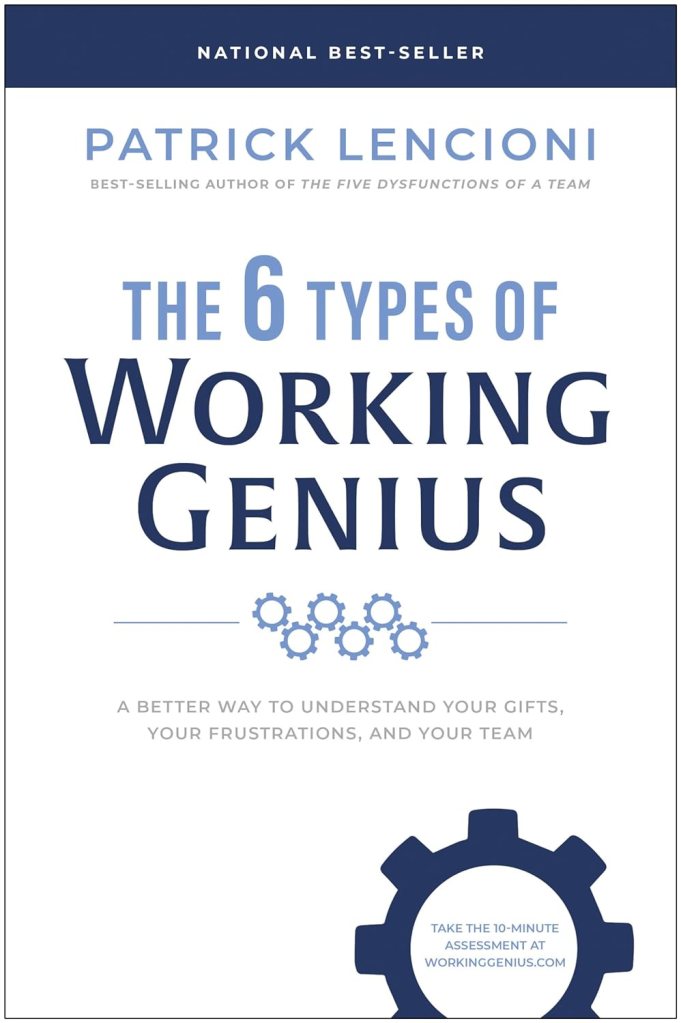
  1. The 6 Types of Working Geniuses. This is the number #1 book that changed my outlook on life last year when I was super discouraged and felt like I was swimming uphill with two swimsuits and concrete boots on (was that enough mixed metaphors?…maybe add a Sysphyian rock). Yes, it’s a business book, but sometimes those have the best crossover takeaways. This one helped me figure out how to work with families, students, tutors, and my own kids, because instead of being a personality book that’s more about you, it’s more about how a group works to get things done. Some people hate the “story” format, others love it. I was more in the former category but it wasn’t so bad I couldn’t get through it to get to the good stuff. It’s also a super quick listen on Audible if that’s more your thing. (If you read or listen to it, I’m dying to know what your geniuses are)

    2. Myers Briggs Cognitive Functions. This goes beyond your basic “extrovert/introvert/judging” dichotomy. If you’ve ever heard someone criticize Myers Briggs because they don’t want to be boxed in, or there’s no way there are only sixteen types of people in the world, “cognitive functions” is the key they’re missing. There are a million books on the topic, but I like this internet article, along with a little interactive chart that tells you what the various function stacks are. This helps on a more practical level with kids and learning styles. I notice my students/kids’ dominant functions pretty quickly and then can modify or customize the learning for them. 

    3. Gorilla Mindset. This book is definitely in the “Dude-Bro” category, but I’m including it here because he has more practical and tangible ways to have a growth mindset instead of the more esoteric theoretical stuff. I’ve used it to help multiple kids work through meltdowns and it’s especially helpful for the kids who are perfectionists and spiral. The ones who go from “I can’t do this math problem” to “What’s the point of life, I’m the worst/stupidest/dumbest kid ever” in a nanosecond. I don’t agree with everything he says, so don’t just hand it to a kid, without reading it first, but it has some useful tips. 

      I always feel leery talking about this kind of stuff in public, because it generates such strong opinions from people. So if you’re the type of person who likes things to be black and white, or finds this sort of thing super obnoxious, or thinks that business books are actually written by aliens that Elon Musk has hired to take over the world…then definitely just hit “skip”. I’m more of a “glean and use what you can” kind of thinker. 

      But of course I’d say that because I’m an ENFP. 

      Cycle 3 Latin/English John 1

      Putting this here to prove to my future self I’m not crazy when (if) it changes again.

      You know you’ve been in Classical Conversations a long time when they’ve switched the memory work on you multiple times, and you feel gaslit by an otherwise charming and lovely curriculum. lol

      It’s not CC’s fault… well it is, but it’s understandable. They occasionally update their curriculum and it’s not their fault I was in my 20s and had two kids when I started CC and I’m now in my 40s with four kids (and the kid who started CC as a 5-year old is now an adult). There were some good old days back there when I was a Foundations tutor and pregnant with my third and would have to run for the nearest trashcan while a kind mom took over my class for a minute. Now I’m just a cranky old Challenge director giving highschoolers the stink eye when they eat snacks through a heart-rending discussion about the Scarlet Letter.

      All that to say, Andria and I could NOT figure out the Cycle 3 Latin this year. We wrote an entire workbook to make Latin accessible for ready-to-quit families, but couldn’t figure out the English translation for Foundations. Thankfully the Vulgate never changes, so at least we got that part right.

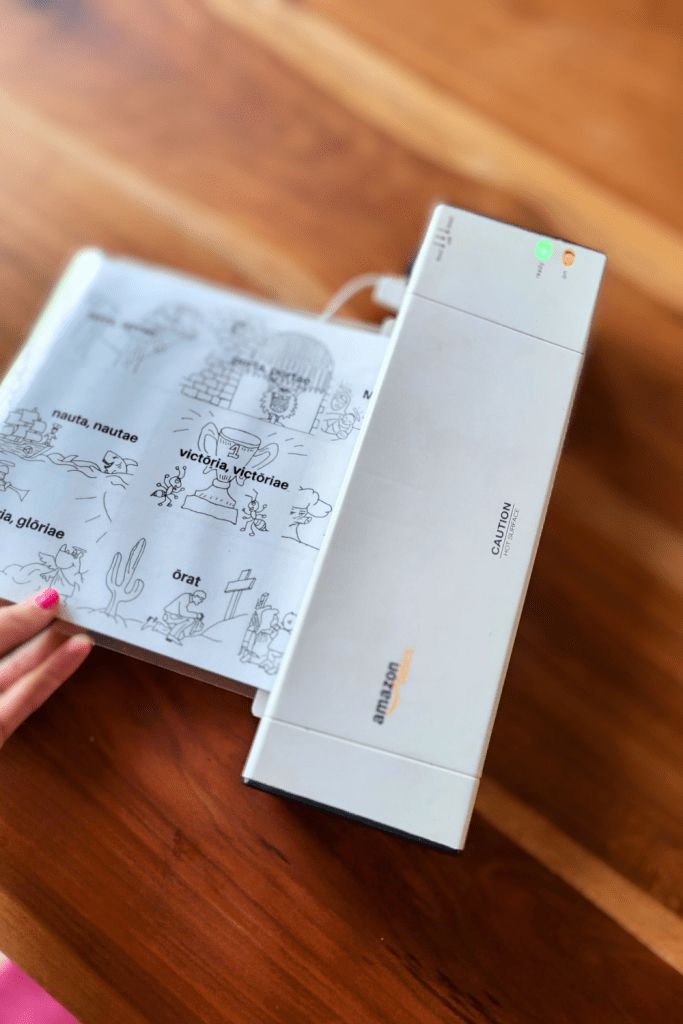
      We printed these sheets, laminated them, and we sing them every morning of Cottage School so the kids have them down pretty good by now although the English is so different from the regular translations we’re used to, that we’re still messing that part up. I think the idea was to pick a translation that more matched the Latin, but if you’re a Challenge director, you will find yourself explaining that half the words are wrong from what they’ll be told in Challenge A, but whatcha gonna do. This is why people have dedicated their whole lives to translating Scripture.

      …also we included some tracing sheets for fun.

      The Evil Charts & Worksheets 

      This is a small story that features a few homeschooling moms doing life together and me eating my words.

      I teach high school Latin at our little cottage school and I’m not going to lie, it’s rough going some days. I occasionally (jokingly!) wonder what I did in a past life to deserve loving Latin so much. Like why couldn’t I have been a surfing instructor? Or teach kids to ride horses? I get jealous of the kids’ jiujitsu instructor. They absolutely love her. The tougher she is on them, the harder they work and the more they respect her. But jiu-jitsu is way cooler than Latin. It’s really not fair. I mean, how did I get stuck trying to impart the love of dead languages to the next generation? It’s like I chose this life or something. 

      My esteemed prodigies really have learned a lot though this year, and I’m proud of the trenches we’ve slogged through. So proud that I got a teeny tiny bit defensive on their behalf when Andria brought in an entire booklet of charts for them to work on. They’re doing great! They don’t need charts! Away with the charts! In her defense, she just got a spiral binding machine and if that was me, I would be printing and spiral binding everything in sight (right after I laminated it). 

      After I passionately and eloquently pleaded the case against repetitive charts, she brought out the big guns by invoking the name, “Mrs. Owen”. She basically has homeschooling sainthood status in our house at this point. Back in the early days of cottage school, back when we lived in California, and the boys were wee young lads, she was the one who got everyone doing brain training exercises. She was the one who pushed us to help our kids learn to read when we were ready to give up. She was the one who refused to give up on what seemed like hopeless cases. And she was the one who had our 9-year-old boys writing out verb anatomy charts and noun cases like they were second nature. Charlie knew his English and Latin verb tenses better at ten years old than I did as a middle-aged woman. Even today I’m pretty sure you could pull a fire alarm, shine a flashlight in his face, drag him out of bed in the middle of the night, and say “Conjugate laudo/laudare in all 6 indicative tenses” and he would churn them out without even opening his eyes. Andria did the same with the kids and math facts. 

      So they clearly work. 

      I don’t know why I fight them so hard sometimes. I guess because they truly are unpopular these days and I want to be like the cool kids. I also think that for some kids they don’t work as well, and they shouldn’t take too big a chunk of the “learning” pie graph. They don’t replace good conversations, deep understanding, and different kinds of learning, but they definitely add to it. They also are great time fillers for one kid to do while you’re working with another kid.

      For me, my kids aren’t the fastest workers in the world, so we don’t always have time to finish all the charts, but that’s the beauty of doing school with other homeschoolers, you balance out each other’s weaknesses. 

      When Andria reminded me of Mrs. Owen and how our kids thrived under her reign of charting, I had to cede the field. I probably will never love charts, but I see their place in life. Some of my kids actually like doing charts and all of my kids probably need to do some more repetitive memorization. When you know something so quickly and easily that it’s almost second nature, it frees up your brain to make all kinds of more abstract connections. It makes understanding things much easier, and innovation follows shortly on its heels (even if that innovation involves figuring out how to write only half your math problems down).  

      Really this is an ode to the Mrs. Owens and Mrs. Tallmans of the world. Thank you for not throwing the baby out with the bath water. Thank you for holding the line. Thank you for investing in my children. 

       (but I still probably will only do half of the charts). 

      Shakespeare- Taming of the Shrew Coloring Pages

      The struggle has been real. I have the best Challenge 1 class (9th grade), but except for a few kids, they just aren’t really feeling Shakespeare this semester. I’ve brought in costumes, instruments, treats, and even a Shakespearean insult generator. Granted, they have been good sports, but combine awkward English (that makes Yoda sound coherent), old vocabulary, and some super sketchy scenes and I feel like I’m the only one laughing and enjoying myself.

      Most weeks we popcorn read, or draw characters out of a hat, so imagine a strapping 15-year-old boy donning a flower tiara as the charming Bianca, and other less-than-impressed teenagers trying to flip hats, guitars and golden robes back and forth as they attempt to keep everyone straight. We’re all trying to juggle characters playing multiple parts and remember who is impersonating who in Taming of The Shrew and it isn’t pretty. Then you have their college-educated tutor who really understands only half of what she’s reading herself, and the half she does understand…she’s not sure if she should explain in plain English.

      Really it’s fine. We’re all fine…learning so much you unmuzzled sheep-biting cod-piece.

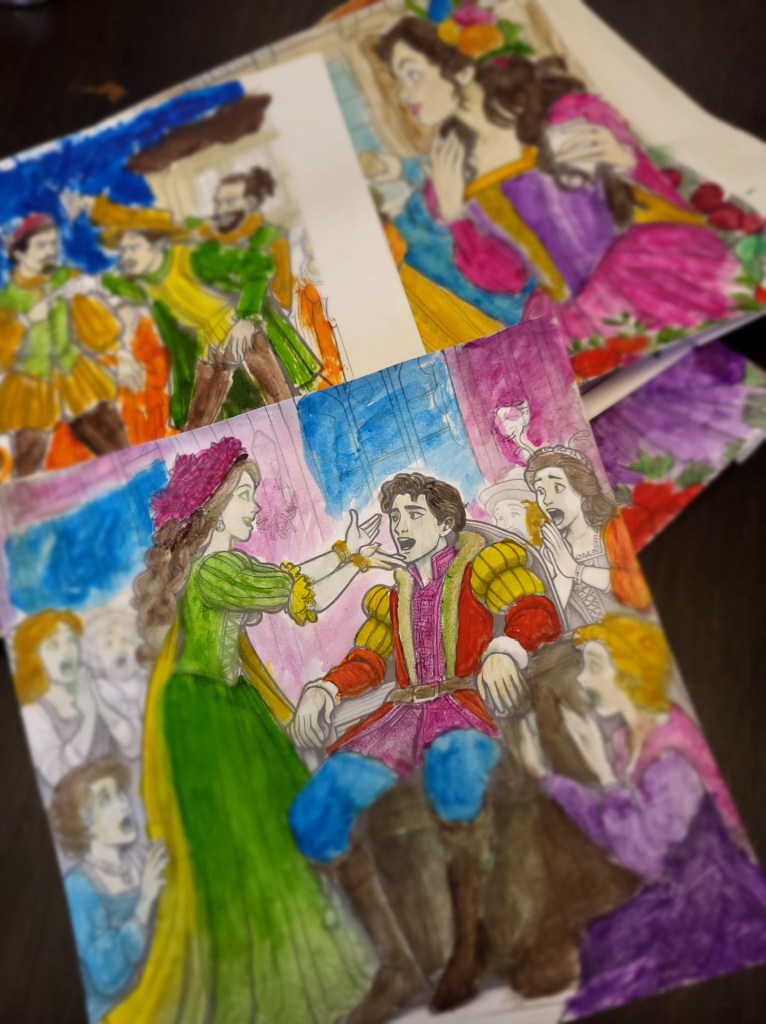
      Last night as I was scrolling through Pinterest, hoping inspiration would hit, I had a truly Gen Z epiphany. I couldn’t find what I was looking for, so I turned to Bing Image Generator and ai’d my way to custom “Taming of the Shrew Coloring Pages”. We painted them in class today as we read aloud and I have to say it was a winning combo. The fact that the coloring pages are ridiculous and sport extra arms and legs only makes them more awesome.

      Not that there are a ton of people in the world looking for Taming Of The Shrew Coloring pages, but if you are, you’re welcome.

      Free Multiplication Flashcards (That go up to the 15’s)

      Multiplication flashcards for you! And multiplication flashcards for you! 

      Because what everyone needs in their life is MORE flashcards…obviously. 

      No, but seriously, these aren’t your standard Target dollar bin flashcards. These go up to 15×15’s which is like the Moby Dick of the flashcard world. You can find up to the 10’s and sometimes the 12’s, but the 13’s, 14’s and 15’s are pretty much impossible to find anywhere (and for good reason, those 13’s and 14’s are pure evil). The only reason I allow such a thing in my house is because CC does them in Foundations, and requires them for Memory Master.  Yes, my older children tell me that it is way easier to do algebra and upper-level math if you see those higher patterns easily. And yes I’ve noticed that the kids with their times tables memorized get through their math faster and with fewer tears. And yes, my 9-year-old uses them to count sheep, chase away werewolves, and ward off bad dreams at night, but you can never convince me that 13×14=182 is anything less than nauseating.  

      Classical Conversations bookstore sells a beautiful set of laminated math flashcards that go all the way up to the appropriate 15s, but there are two problems with them.  One they are double-sided, with equations and answers on both sides. A genius solution if you don’t want to carry a mountain of flashcards everywhere, but a real problem when you’re trying to sort out which ones your student knows, and which ones they still need help with. Also, smart kids with photographic memory tendencies, have a habit of remembering the answers for the other side. The other problem is that like all flashcards, they are prone to being chewed on by pets (or baby siblings), used as a bookmark, or lost in the depths of mom’s purse because she naively and optimistically packed them to the dentist. I am embarrassed to admit how many sets I have bought over the years. 

      So I finally caved and made my own, mostly so I could print replacement cards whenever I lost one.  

      In case you are like me, here you go. My gift to you. Single-sided commutative law flashcards that go up to the 15’s. Now you too can drown in an absolute sea of multiplication flashcards. 

      You can download them for free here.  

      Or if you feel like supporting my Etsy shop, you can buy them for 99 cents here.  

      Also (because once I got going, I couldn’t stop), I made a matching game out of them for all you matching game lovers out there. You can download that here (or it’s also included as a freebie in the Etsy set).

      May your printer smile upon you (and I strongly recommend printing in black-and-white with “save toner” selected. Hope this helps!

      Thoughts About Geography, Cartography, Therapy and Homeschooling

      “Let me count the ways I love thee…”

      Geography is one of those lost arts that is so smothered in a sea of fake/unhelpful/wannabe books, games, workbooks, and curriculum that sometimes you can’t see the forest for the trees.  It’s one of those instantly marketable items. Slap a map and the word “Geography” or “Educational” on the front of it, and we parents are quick to snap them up off of Amazon, library clean-out sales, hand-me-downs, or the thrift store like they’re desperate promises to our future selves (I mean, surely I’m not the only one with visions of perfectly curated themed bookshelves and travel themed unit studies). And don’t even get me started on the geography-themed games and flashcards…

      But all that geography stuff usually is so colorful and well-designed, that you don’t realize it’s kind of shallow and unengaging (and oftentimes downright full of errors). Consequently, the problem isn’t that there aren’t tons of options for Geography, but that it’s a struggle to find stuff you’ll actually use.

      And Geography is one of those subjects that packs so much bang for its buck. Not only is it math, history, art, and science all in one parcel, but it’s also visual processing, concrete/abstract processing, spatial processing, executive functioning… all the things. It’s basically a custom-designed torpedo pod of academics and therapy all tied up into one perfect package.  The only thing that might beat it at all those things is the violin, but that’s a post for another day. 

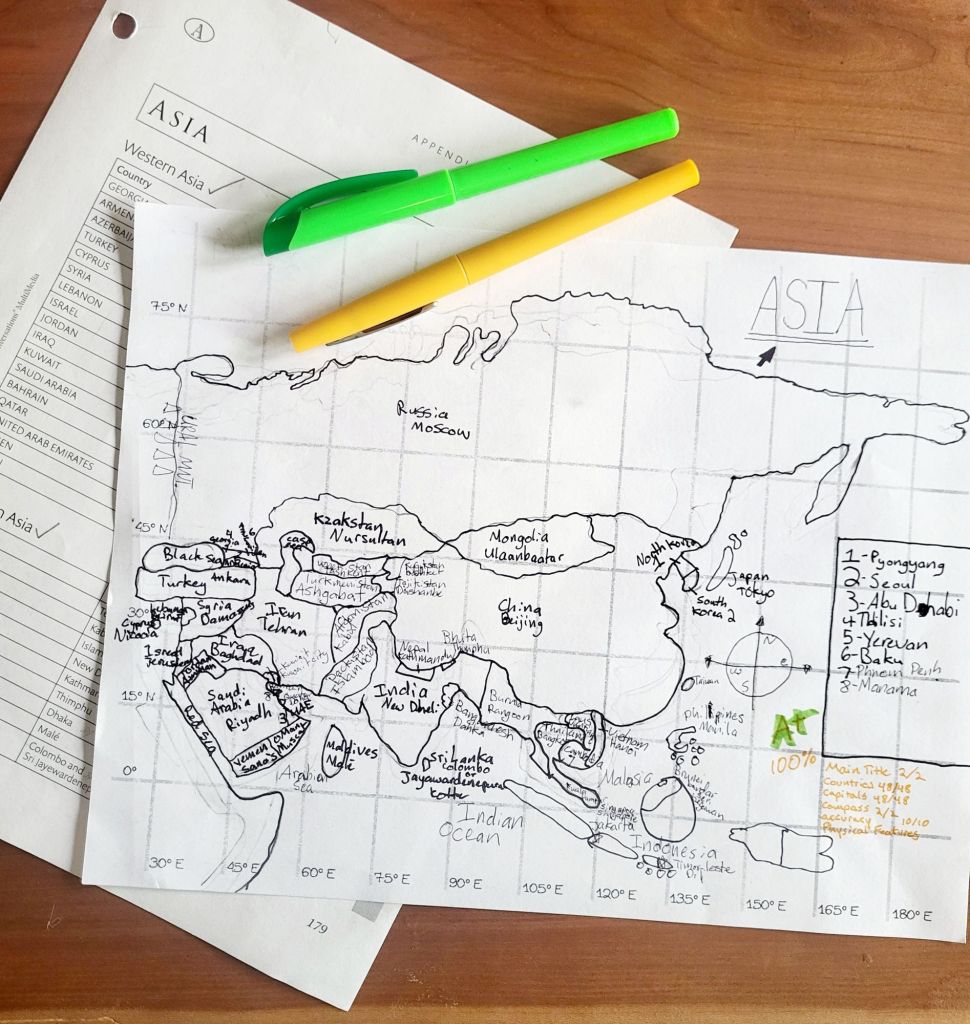
      The problem is if you dive in and dig deep and engage with it…drawing and pronouncing, and wrestling with longitude and latitude, various sizes and projections, and whatnot, it’s hard. Sometimes extraordinarily hard, depending on how your kid’s brain is wired (or your brain), but I’ve seen profoundly dyslexic eyes thrive, and dysgraphia fingers map the whole world from heart (I can’t read it, but still…). Not going to lie, I’ve also seen kids cry and I’m not above bribes (and paint…and music…but mostly lots of paint). But seeing their minds grow and the connections made, I feel like it’s worth it to find your way through it. 

      And I don’t just say that because I wrote a cartography workbook which you can find here (insert cheesy infomercial music).  Or made a bunch of fun, silly videos to help memorize and draw the world by heart which you can watch here (feel free to judge me, but don’t knock it til you try it…it works). 

      In the end, it doesn’t matter, pull out the colorful Costco Walmart Geograph specials, and just have fun with it…but maybe Google fact-check the stuff that doesn’t pass the sniff test. Really, this is an ode to how much I love geography. 😍

      Kindergarteners, Sensory Input and the Story of Mr. Thomas of a CC

      Sometimes teaching life feels like an episode of Iron Chef, but instead of making tacos out of shrimp, manzanita berries, and Irish peas, it’s trying to keep your class fun and educational on thrift store donations, calcifying craft supplies, and a packet of dry-erase makers. 

      I recently read Stories That Stick by Kindra Hall, which isn’t meant for educators, but I’ve found that the business world often has the best (not new) but reframed ideas for home and classroom. It reminded me of back in my Foundations days, when I was an Abecedarian tutor (the little guys in the Classical Conversations world). Homeschooling always attracts a mixture of kids who run the gamut from reciting the entire periodic table of elements at four, to hiding under their desks at co-op or class days pretending to be a gorilla (and oftentimes they’re the same kid). And not that I’m not totally on board with CC’s policy of having the moms in the room on class days, but to be honest, kids listen a lot better when their Nannie McPhee teacher tries to get them to skip count the threes, than when their mom tries to cajole them into participating…at least that was my experience with the younger ages. Honestly, though, I loved every minute of it. I think four and five-year-olds are hilarious, even when they’re painting their neighbor’s frilly pink dress in black shoe polish from their Dore art projects. 

      But I digress… Our CC campus at the time also happened to be my home church, and so I sometimes helped clean things out or went through stuff people donated for the nursery, and that’s how I stumbled across Mr. Francis of a CC. He was one of those giant teddy bears kind of like the ones they used to sell at Costco. He was very much not disinfectable for the nursery, but I couldn’t bear to let him go (pun intended…ha). He had so much potential! So I moved him to my CC classroom and I’m telling you, I’ve never had so much success getting preschoolers and kindergarteners to do stuff!

       “Let’s sing the Latin Noun Declensions more loudly and see if we can wake Mr. Francis up!” 

      “Mr. Francis is waiting for everyone to sit down quietly before he can chant irregular verbs with us”

      “Having a meltdown? Go lay on the giant stuffed teddy bear and give him the tightest hug you can”

      “Can’t sit still or keep your hands to yourself? Go jump on the giant teddy bear.”  

       The kids loved him. We created all sorts of make-believe stories and narratives about him and used him for all types of pretend play. It was my best Abecedarian year ever. 

      I was sad when I moved on to the older kids the next year and didn’t take Mr. Francis with me.  I don’t know whatever happened to him, I think he ended up finally retiring to a thrift store where I’m now imagining all kinds of Toy Story endings for him. But I think the magic of Mr. Francis lives on and can be recreated in an infinite variety of ways, one just needs two things. 

      Sensory input and stories. 

      The very large nature of Mr. Francis and the proprioceptive input kids got from jumping on something or falling into something big and soft, was very calming, and the stories and characterization made him real and gave them a reason to not eat their boogers, or helped them stand up tall and straight for their presentations. But really anything works. At that age, you can take playdough and stick googly eyes on it and name it Mr. Slimy Pants or something. Teenagers are a bit harder because they still need the sensory input and stories, but they’re not quite as willing to look silly, but that’s a different blog post for a different day.  

      For now, I would just like to say “Rest in peace Mr. Frances of a CC you were well loved, and may your life lessons live on.“

      Also, I need a giant Appa in my life. Like this, but way way bigger.

      3 Things Every Homeschooling Mom Needs

      1. A good printer that doesn’t cost an arm and a leg in ink. 
      2. A laminator that won’t “eat” your beautiful school stuff. 
      3. A shoe organizer repurposed as a flashcard holder so all the kids can find what they need. 

      No lie, I think I love my printer more than I like some of my friends (I kid, I kid), but sometimes I feel like I need to put “Marked Safe From My Laminator”. That thing is going to be the death of me. I love it dearly but I never know when it’s going to mess up and destroy something…usually something I printed in color at Office Depot and drove over an hour to pick up. So if anyone has any suggestions for a laminator they love, please tell me. I need to break up with mine (It’s me, not you dear laminator, I promise…ahem). The shoe organizer was a brilliant stroke of genius (aka, I saw it on Pinterest). I probably need to get a new one, because this one is looking a little like it’s had a few too many late nights and days in the sun…or rather moved multiple times and been handled by dozens of children. But it’s lasted years and it’s one thing in our homeschool life we use constantly. I probably need two at this point.

      What mom homeschooling things am I missing?

      Homeschool laminator Classical Conversations Latin Henle