How To Have Fun And Learn Things On Field Trips (Bonus: Everyone Survives)

I think I’ve finally hacked it….maybe.

Taking uninterested children to museums and field trips is BRUTAL. On one side you tell yourself that your children need to be educated and cultured and have their horizons expanded, on the other side you have the students/children themselves who are loudly protesting how much they hate said field trip. And then you have all the older responsible folk who are all “when I was a kid, we didn’t complain about…”.

And while you’re trying to internally juggle all the things, you’re also trying to pretend that you have nothing else in the world to do than make everyone happy. You’re not also wondering how you’re going to grade papers, get dinner on, feed the dog, schedule the orthodontist appt etc. I mean, I don’t know about you, but I live for bridging the gap between cranky docents who think “children should be seen but not heard” and said children who are convinced the world is devoid of food and fun.

Now that I think about it, I’m not being sarcastic…that’s literally what I live for. I think I may genuinely enjoy bridging that gap between the old and the new.

But I digress.

I happen to so privileged as to live within bike-riding distance of where the Little House On the Prairie series was written. That’s right. The real Laura Ingalls Wilder herself, wrote the famous books not a stone’s throw away from my house. Consequently, my children have been once…or twice…or several…ok many times to the original homestead tours and museum. So when our CC group had a field trip there, I knew I was going to walk that fun tightrope between the out loud “of course we’re going!” and the intense hushed “yes we are going and you are going to be polite and listen to the tour guide and say “yes ma’am and thank you”.

As I was agonizingly doing math with the youngest beforehand, in an attempt to get school done “early”, I realized I was going to need a backup plan. Having been before, I was mentally imagining a bunch of elementary-aged boys (and girls) trying to squeeze into the tiny 120-year-old kitchen filled with priceless artifacts. AND they were successfully supposed to not move or touch anything. Lord have mercy. So I came up with a “scavenger hunt”.

Now granted, I know this is harder to do if you’re traveling and don’t know what you’re getting into, but I think it’s really a fantastic plan. Kids like goals. Kids like tangible things. Sometimes their brains are too underdeveloped to match the grammar with the rhetoric, so they need a bridge. The bridge in this case was an orange wet-erase marker and a laminated sheet of notebook paper. I scribbled down 15 things for them to find and answer, and I evenly divided the tasks between the exhibits and the museum. The reward was a stick of “Penny candy” that now costs 40 cents. Ho hum. Economics lesson aside, I would happily pay 40 cents per kid in order to not get permanently banned from a museum. Of course, the plan did backfire on me when the kids were SO EXCITED to see Pa’s fiddle and to see where Laura lost the money for her homestead, that they went in like a drove of invasive grasshoppers, and promptly got their butts set down by an elderly docent. By the time I sauntered in (a few moments behind them), she was already wrapping up the “don’t make noise, don’t touch anything, don’t breathe on anything” lecture and was ready to launch into the “how to be a responsible chaperone lecture.” What she didn’t know, was that I am happy to take one for the team, in fact, I’d be happy to have her come lecture my children every morning, but she didn’t seem interested in that. Shocking.

After the field trip was over, my kids said it was the best field field trip ever. So. much. fun.

The key really was the “scavenger hunt” (and maybe the presence of their friends, but who’s counting). Everyone needs a job or a mission, and I totally get it! When I was in Paris, I had a mental checklist of everything I wanted to see, and learn, and understand. Why would kids be any different? They just need a little abstract hand-holding.

I’m going to start doing this every time I find myself chaperoning a field trip where I know I’m going to be in over my head. However next time I’m going to have a chat with the Gift Shop Lady first, and I’m also not going to forget all my scavenger hunt stuff on the table. I’m wondering, should I go back and get my pens and paper? Cut my losses? Save face? or chalk it up to a good laugh?

Also, if you ever come to visit, I will happily show you where Laura and Almanzo’s secret cold spring is, and tell you all the “exclusive conspiracy theory” stories.

Donuts and Crystals: An Economics Lesson for Highschoolers

I am loving this school year so much. 9th graders are so much easier than 7th graders (although full confession, I feel like middle school is probably my calling in life). Middle schoolers are like the toddlers of the teenage years. They’re so cute, but kind of a lot.

However… (and that’s a big however). I don’t know if it’s post-covid, or a Gen Z thing or what, but I guarantee you your average high schooler has the ability to break any object lesson or activity that has worked for decades. There is nothing Gen X or Millenial teachers and parents can come up with that Gen Z can’t hack in a nanosecond.

Case in point: We did an “Inflation Game” today with very specific instructions. I was supposed to use beans and candy, but beans are boring and candy is for kids, so I took some floral rock-crystal-things I had and a cheap bag of hostess donuts (don’t judge). I handed out 5 crystals to each student and then offered to “sell” a donut for 10 crystals. This is supposed to be unsuccessful. According to my instructions no one is supposed to be able to buy a donut, thus proving that when money supply is low, inflation is low. You can imagine how well that went.

When I was prepping this activity a few days ago, I dryly predicted to Jim that it would take less than a second for two kids to combine their “money” and buy a donut since a half donut is better than none. I was correct. What I didn’t predict was that kids would start trading their snacks with each other for crystals, thus creating a bartering system outside of my controlled system (I feel like there’s a lesson there).

But it didn’t stop there. For the second part of the activity, I was instructed to give each student several handfuls of “money” (without counting to see who got more or less) and then start an auction for the donuts. As expected (and carefully explained in the directions), the extra money supply drove up inflation. What I didn’t expect is that monopolies quickly formed and two kids were in danger of getting absolutely every single one of the donuts before anyone else got a single one. So the rest of the class banded together and blocked them.

Strong feelings and opinions flew back and forth. At one point they discussed mobbing me and just taking the bag of donuts. I felt the weight of a thousand dictators weighing on my soul. It was dicey for a few moments.

All that to say, I think we learned more about economics in fifteen minutes than we have from any book. And if you try this…don’t say I didn’t warn you.

The Three Personality and Mindset Methods I Use the Most

People hate on personality tests and paradigms, but I unabashedly love them. Sure, I get it.  Are they perfect? No. Are they backed by Science? Maybe a few of them…kinda sorta. Do people use them to excuse all kinds of bad behavior? I’m definitely not guilty of that…ahem. 

The reason I think they’re helpful though, is because the human brain can’t help but see patterns. And then we’re like If You Give A Mouse A Cookie. Once we start seeing patterns, we start separating things into categories, and then we start mentally building projections. If those predictions are right, we start to build whole systems. I genuinely think we can’t help it. Most of us do it subconsciously. Of course they aren’t ever going to be perfect systems because humans are infinitely complex, but they sure help navigate life. And I don’t think I could navigate classes, kids, and meetings without them. 

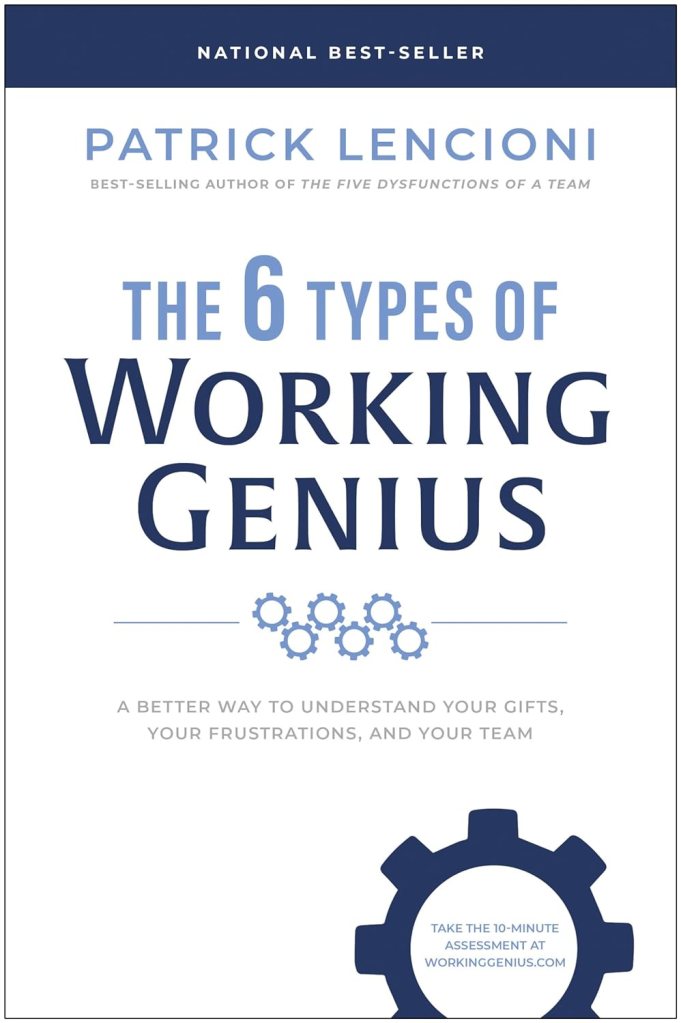
  1. The 6 Types of Working Geniuses. This is the number #1 book that changed my outlook on life last year when I was super discouraged and felt like I was swimming uphill with two swimsuits and concrete boots on (was that enough mixed metaphors?…maybe add a Sysphyian rock). Yes, it’s a business book, but sometimes those have the best crossover takeaways. This one helped me figure out how to work with families, students, tutors, and my own kids, because instead of being a personality book that’s more about you, it’s more about how a group works to get things done. Some people hate the “story” format, others love it. I was more in the former category but it wasn’t so bad I couldn’t get through it to get to the good stuff. It’s also a super quick listen on Audible if that’s more your thing. (If you read or listen to it, I’m dying to know what your geniuses are)

    2. Myers Briggs Cognitive Functions. This goes beyond your basic “extrovert/introvert/judging” dichotomy. If you’ve ever heard someone criticize Myers Briggs because they don’t want to be boxed in, or there’s no way there are only sixteen types of people in the world, “cognitive functions” is the key they’re missing. There are a million books on the topic, but I like this internet article, along with a little interactive chart that tells you what the various function stacks are. This helps on a more practical level with kids and learning styles. I notice my students/kids’ dominant functions pretty quickly and then can modify or customize the learning for them. 

    3. Gorilla Mindset. This book is definitely in the “Dude-Bro” category, but I’m including it here because he has more practical and tangible ways to have a growth mindset instead of the more esoteric theoretical stuff. I’ve used it to help multiple kids work through meltdowns and it’s especially helpful for the kids who are perfectionists and spiral. The ones who go from “I can’t do this math problem” to “What’s the point of life, I’m the worst/stupidest/dumbest kid ever” in a nanosecond. I don’t agree with everything he says, so don’t just hand it to a kid, without reading it first, but it has some useful tips. 

      I always feel leery talking about this kind of stuff in public, because it generates such strong opinions from people. So if you’re the type of person who likes things to be black and white, or finds this sort of thing super obnoxious, or thinks that business books are actually written by aliens that Elon Musk has hired to take over the world…then definitely just hit “skip”. I’m more of a “glean and use what you can” kind of thinker. 

      But of course I’d say that because I’m an ENFP. 

      Thoughts About Geography, Cartography, Therapy and Homeschooling

      “Let me count the ways I love thee…”

      Geography is one of those lost arts that is so smothered in a sea of fake/unhelpful/wannabe books, games, workbooks, and curriculum that sometimes you can’t see the forest for the trees.  It’s one of those instantly marketable items. Slap a map and the word “Geography” or “Educational” on the front of it, and we parents are quick to snap them up off of Amazon, library clean-out sales, hand-me-downs, or the thrift store like they’re desperate promises to our future selves (I mean, surely I’m not the only one with visions of perfectly curated themed bookshelves and travel themed unit studies). And don’t even get me started on the geography-themed games and flashcards…

      But all that geography stuff usually is so colorful and well-designed, that you don’t realize it’s kind of shallow and unengaging (and oftentimes downright full of errors). Consequently, the problem isn’t that there aren’t tons of options for Geography, but that it’s a struggle to find stuff you’ll actually use.

      And Geography is one of those subjects that packs so much bang for its buck. Not only is it math, history, art, and science all in one parcel, but it’s also visual processing, concrete/abstract processing, spatial processing, executive functioning… all the things. It’s basically a custom-designed torpedo pod of academics and therapy all tied up into one perfect package.  The only thing that might beat it at all those things is the violin, but that’s a post for another day. 

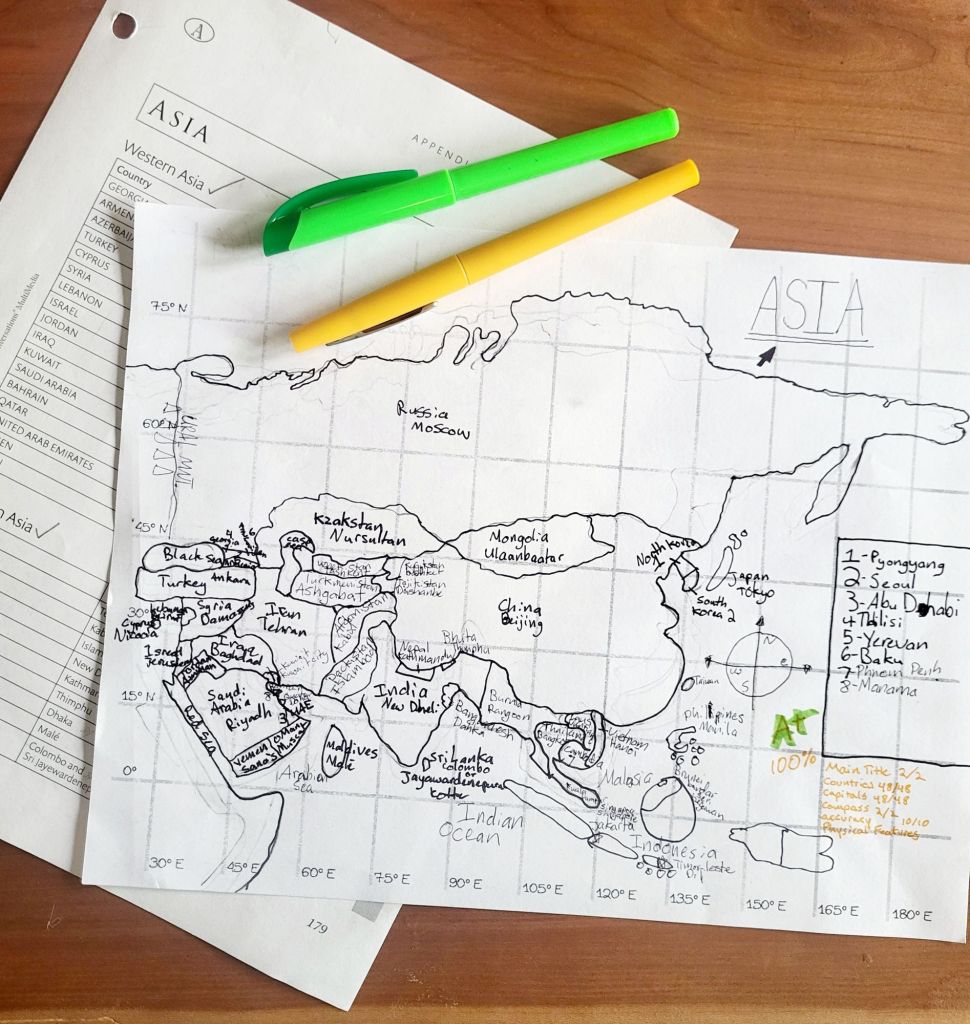
      The problem is if you dive in and dig deep and engage with it…drawing and pronouncing, and wrestling with longitude and latitude, various sizes and projections, and whatnot, it’s hard. Sometimes extraordinarily hard, depending on how your kid’s brain is wired (or your brain), but I’ve seen profoundly dyslexic eyes thrive, and dysgraphia fingers map the whole world from heart (I can’t read it, but still…). Not going to lie, I’ve also seen kids cry and I’m not above bribes (and paint…and music…but mostly lots of paint). But seeing their minds grow and the connections made, I feel like it’s worth it to find your way through it. 

      And I don’t just say that because I wrote a cartography workbook which you can find here (insert cheesy infomercial music).  Or made a bunch of fun, silly videos to help memorize and draw the world by heart which you can watch here (feel free to judge me, but don’t knock it til you try it…it works). 

      In the end, it doesn’t matter, pull out the colorful Costco Walmart Geograph specials, and just have fun with it…but maybe Google fact-check the stuff that doesn’t pass the sniff test. Really, this is an ode to how much I love geography. 😍

      Kindergarteners, Sensory Input and the Story of Mr. Thomas of a CC

      Sometimes teaching life feels like an episode of Iron Chef, but instead of making tacos out of shrimp, manzanita berries, and Irish peas, it’s trying to keep your class fun and educational on thrift store donations, calcifying craft supplies, and a packet of dry-erase makers. 

      I recently read Stories That Stick by Kindra Hall, which isn’t meant for educators, but I’ve found that the business world often has the best (not new) but reframed ideas for home and classroom. It reminded me of back in my Foundations days, when I was an Abecedarian tutor (the little guys in the Classical Conversations world). Homeschooling always attracts a mixture of kids who run the gamut from reciting the entire periodic table of elements at four, to hiding under their desks at co-op or class days pretending to be a gorilla (and oftentimes they’re the same kid). And not that I’m not totally on board with CC’s policy of having the moms in the room on class days, but to be honest, kids listen a lot better when their Nannie McPhee teacher tries to get them to skip count the threes, than when their mom tries to cajole them into participating…at least that was my experience with the younger ages. Honestly, though, I loved every minute of it. I think four and five-year-olds are hilarious, even when they’re painting their neighbor’s frilly pink dress in black shoe polish from their Dore art projects. 

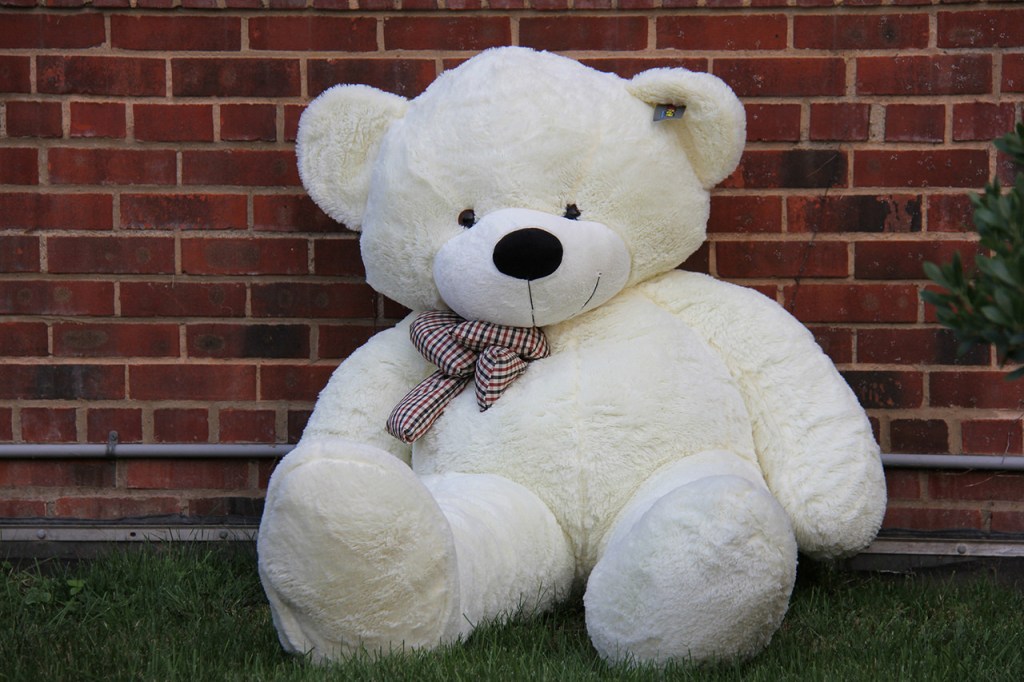
      But I digress… Our CC campus at the time also happened to be my home church, and so I sometimes helped clean things out or went through stuff people donated for the nursery, and that’s how I stumbled across Mr. Francis of a CC. He was one of those giant teddy bears kind of like the ones they used to sell at Costco. He was very much not disinfectable for the nursery, but I couldn’t bear to let him go (pun intended…ha). He had so much potential! So I moved him to my CC classroom and I’m telling you, I’ve never had so much success getting preschoolers and kindergarteners to do stuff!

       “Let’s sing the Latin Noun Declensions more loudly and see if we can wake Mr. Francis up!” 

      “Mr. Francis is waiting for everyone to sit down quietly before he can chant irregular verbs with us”

      “Having a meltdown? Go lay on the giant stuffed teddy bear and give him the tightest hug you can”

      “Can’t sit still or keep your hands to yourself? Go jump on the giant teddy bear.”  

       The kids loved him. We created all sorts of make-believe stories and narratives about him and used him for all types of pretend play. It was my best Abecedarian year ever. 

      I was sad when I moved on to the older kids the next year and didn’t take Mr. Francis with me.  I don’t know whatever happened to him, I think he ended up finally retiring to a thrift store where I’m now imagining all kinds of Toy Story endings for him. But I think the magic of Mr. Francis lives on and can be recreated in an infinite variety of ways, one just needs two things. 

      Sensory input and stories. 

      The very large nature of Mr. Francis and the proprioceptive input kids got from jumping on something or falling into something big and soft, was very calming, and the stories and characterization made him real and gave them a reason to not eat their boogers, or helped them stand up tall and straight for their presentations. But really anything works. At that age, you can take playdough and stick googly eyes on it and name it Mr. Slimy Pants or something. Teenagers are a bit harder because they still need the sensory input and stories, but they’re not quite as willing to look silly, but that’s a different blog post for a different day.  

      For now, I would just like to say “Rest in peace Mr. Frances of a CC you were well loved, and may your life lessons live on.“

      Also, I need a giant Appa in my life. Like this, but way way bigger.