From Maple Leaves to Northern Lights! Memorizing and Learning Canada

Every year, I try to put myself in the head of a middle schooler and figure out new ways to help them wrestle with geography and cartography. It’s no easy task to memorize drawing and labeling the whole world by heart. Some might even question the necessity (and sanity) of doing so (since let’s be honest, most kids are probably going to forget a lot of it anyway… and what are they going to use it for, answering a Jeopardy question at 40?), but I had to memorize and draw the world by heart as a young teenager, and not only did it make history and politics much easier to follow, it was also like an executive function super course. Taking a big project, breaking it down into chunks, and figuring out ways to remember everything is a huge skill that transfers over to so much of adulthood.

That said, there are certain “hacks” to help information stick in your brain…colors, novelty, music, pegging, mnemonics etc. I try to have my kids and students brainstorm with me, and so here’s this year’s fresh crop of new ideas. Homeschoolers these days have so many more creative tools at their fingertips than I did in the 90s. It’s not fair!

What we’ve come up with for helping to memorize Canada’s provinces and territories:

Big Alps Sing Many Quiet Old Nursery Poems Near Naptime to Young Northern Nomads.
British Columbia, Alberta, Saskatchewan, Manitoba, Quebec, Ontario, Newfoundland, Prince Edward Island, Yukon, Northwest Territories, and Nunavut.

Save, print, laminate, cut into cards, and keep around the table while you’re drawing and labeling. Try memorizing and chanting to jump rope, cups, clapping, hop scotch, tango dancing or…you get the idea.

So that helps with the visual working memory, but it doesn’t include the capitals. For that we need a good old fashioned sea shanty. Here’s a song with all of Canada’s provinces, territories and capitals, including Ottawa! (for some reason, kids seem to skip that one).

You can download that here:

It very intentionally matches the same order as the acrostic mnemonic, but be careful! The Canadian provinces and capitals might get stuck in your head.

As always, you can find my other Cartography resources here:

Challenge A Cartography workbook

Map drawing tutorials

Happy Homeschooling!

Anatomy Curriculum & Giving the “Birds and the Bees” Talk (Science Freebie)

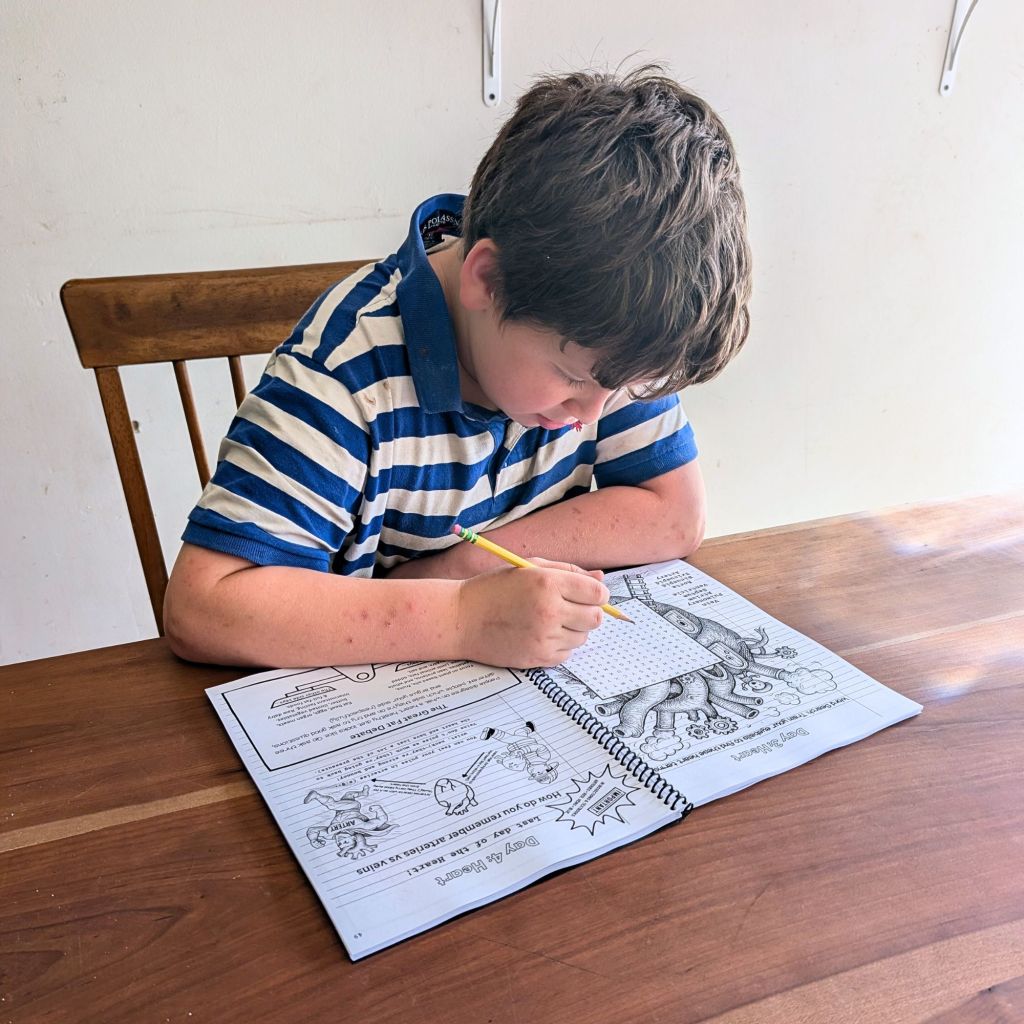
I should have done this a long time ago. I wrote a whole Anatomy Workbook/Curriculum! Between four kids who love science, a mom who is a nurse and loves human anatomy, and my years as a Challenge A Director, I’ve spent the last several months compiling all of my favorite experiments, dialectic questions, simpler drawings, and all the crazy memory hacks my mom used when I was little to help us memorize everything. It was one of those projects where I felt like I could have kept writing it forever, adding new interesting research and information I dug up, but I also wanted to make it doable. An independent, open-and-go curriculum with an easy answer key that wasn’t online and was screen-free. I also tried to tap into middle schoolers’ natural desire to form opinions and argue with everyone around them. Ahem.

You can find the printable digital version here.
Or…
You can find the printed and mailed-to-you version here.

And now, on to the thing that sparked this whole adventure. I think THE TALK is a universally dreaded conversation to have with your kids, and it always seems to be in capital letters in one’s head. And the worst part (at least in our family) is that when you finally muster up the courage to have the conversation, you forget that your kid has an auditory processing problem, and you make it so low-key and chill that they promptly forget the whole thing, leaving you to experience Groundhog Day. Good times. The internet is chock-full of all kinds of books, instructional material, and helpful advice, but it can be daunting and overwhelming, and thus we disassociate until another day and hope we don’t wait too long, or heaven forbid, give it too soon (where are my pearls to clutch).

So don’t take this as advice or a strong opinion, but if you’re looking for a plain, factual lesson, I’ve got you covered. For those who have visual learner kids, but don’t want something super graphic and are looking for a more science-friendly approach, here’s the Reproductive System Lesson from the workbook. A freebie science printable, as they say. You can hand it over, or do it alongside them, or edit it, or use it as a starting point to build with more information as they get older and more mature (or perhaps less mature in the case of middle schoolers). Enjoy!

Or you know, you can always go the super expensive route and buy a homestead and have animals, and then the reproductive education (mostly) takes care of itself!

Freebie: Medieval Math Cards and Synesthesia

Do numbers have personality and gender to you? Fueds, family trees, romances…sibling squabbles? Or are they just numbers?

This question came up in my Challenge A class, and out of six kids and a few adults, only one kid and one mom didn’t do this. Since I’ve done this for as long as I can remember…involuntarily with both notes/music notation and math/numbers, I sort of assumed everyone did it to some extent (except for Jim because he’s one of those weird spreadsheet people). Obviously, 0 is the patriarch and 1 is his firstborn son who’s been such a disappointment to him. 2 is the matriarch… 7 is the perfect child who drives his siblings crazy because he really shouldn’t be…etc etc etc.

Turns out that’s an actual thing called Ordinal-Linguistic Personification, which is a form of synesthesia. A large percentage of kids do it, but they usually outgrow it. Only 1% of the adult population has Ordinal-Linguistic Personification, so I guess Jim’s not the weird one after all. There are other types of synesthesia too! Some of them I’ve never even heard of:


Grapheme-color synesthesia – associating letters or numbers with specific colors.

Ordinal-linguistic personification (OLP) – attributing personalities or genders to numbers, letters, or days of the week.

Chromesthesia – hearing sounds and involuntarily seeing colors.

Lexical-gustatory synesthesia – associating words with specific tastes.

Auditory–Tactile Synesthesia – Hearing a sound causes a feeling somewhere on your body.

So now I’m super curious about who else is a closet synesthete. 👀


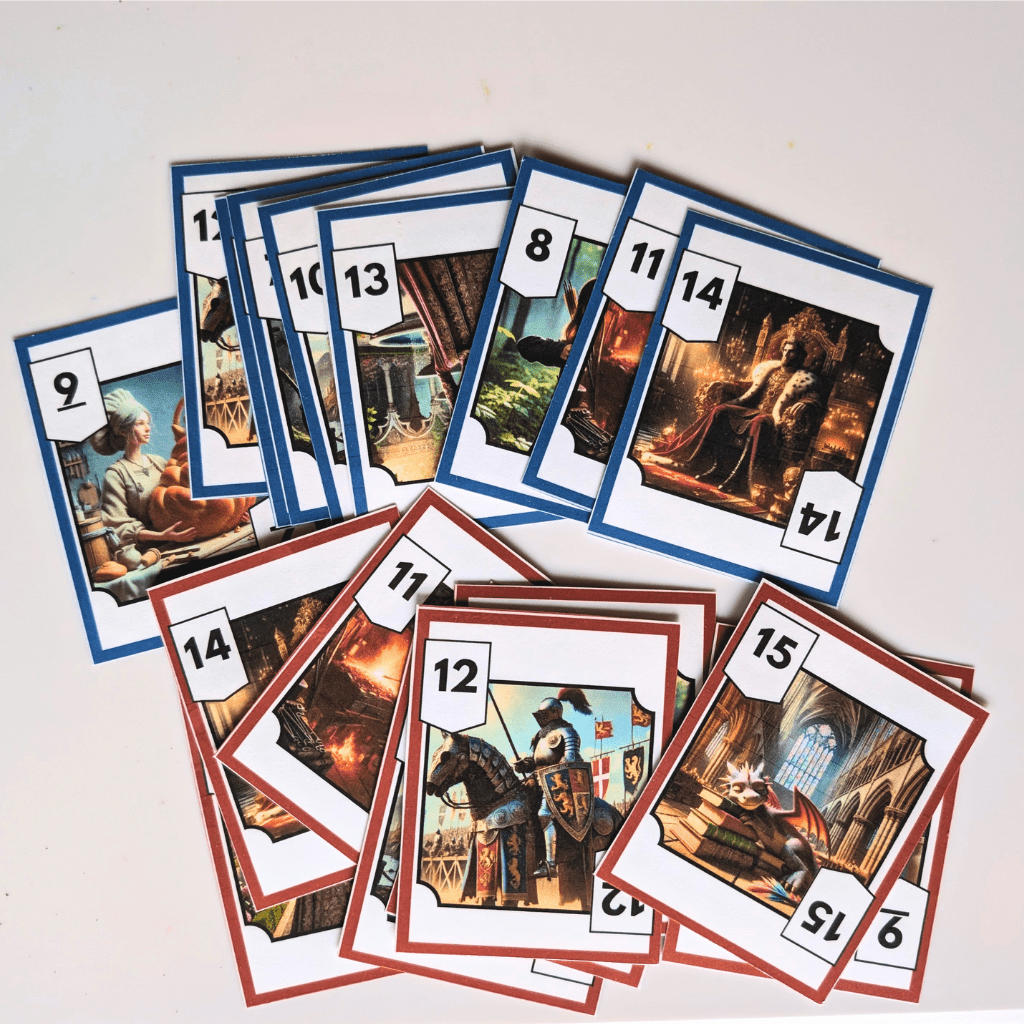
But back to math, this whole number personification thing has made math discussions in class and at home so much more interesting. I was listening to the math map podcast and Dr. Gilpin recommended making your own number cards for quick arithmetic games…it’s hard sometimes to remember what numbers kings and queens are and if we decided aces were high or low. Plus, it would be nice if the cards went up to 15 like we do with skip counting.

Soooo, thanks to the power of the internet and a little late-night insomnia, here are some personified number cards for all your little creative math geniuses (or right-brained ADHD-prone kids). If you want four suites like regular playing cards, print two sets. (make sure you select “fit to page” otherwise your printer will chop off the color). You can make blue cards negative numbers and red cards positive numbers…you can add the red and minus the blues…or multiply and divide. The sky is the limit! (I included a whole list of quick, fast medieval-themed math games that will tempt even the most dysgraphic sensitive kid into doing math…perhaps even liking it)
Enjoy.

(and if you’re looking for other screen-free homeschooling help like Challenge A survival Latin or Cartography, you can find them here.)

Types of Dyslexia and a Freebie Spelling Poster

Why oh why, does Spelling (it looks more doomful with a capital letter) feel like an unsolvable riddle sometimes? The word “dyslexia” has to be one of the most discouraging entries in the dictionary. Besides being just an ugly word to look at, the poor word conjures up visions of kids staring at pages like they’re written in ancient Sumerian with a lone tear trickling down their cheek. Meanwhile, we parents are over here googling “reading therapy” at 2 a.m. and wondering if a fish oil supplement will help. To make matters worse, there isn’t just one type of dyslexia, and it isn’t just “words wiggling” or letter reversals. It’s a whole Easter basket of struggles in (sometimes) hilarious ways. Here are some of the types we struggle with around here:

1. Phonological Dyslexia: The Sound Scrambler

This is the classic, most well-known type. Kids with phonological dyslexia struggle to connect sounds to letters. They can hear the difference between “bat” and “but,” but when it comes time to spell them, it’s like trying to remember the 400-digit Wi-Fi password at a hotel

2. Orthographic (surface) Dyslexia: The Rule Breaker’s Nightmare

English is a mostly phonetic language, but not entirely. (Looking at you, “colonel.”) People with surface dyslexia can sound out words just fine—until they hit an irregular word like “yacht.” Then their brains short-circuit. When they can’t rely on phonics, they get frustrated. If you’ve got a kid writing a word five times in a row… and still spelling it differently each time, you might be dealing with this one.

3. Rapid Naming Deficit: The Brain’s Slow Typist

Ever tried to recall someone’s name and your brain just gives you elevator music? That’s what happens to kids with a rapid naming deficit all the time. Their brains take a beat too long to retrieve letters and sounds, making reading feel like wading through molasses in January.

I’m not sure what the answer is. We’ve had great success with vision exercises, right-brained strategies, and a heavy emphasis on the science of reading/Orton-Gillingham (so there are as few exceptions as possible). I’m currently neck deep (mid-year deep?) in writing my own spelling curriculum that combines all my favorite things and cuts out the things I think are dumb. But I have to admit that was rather ambitious and cocky. Turns out what works for one kid, doesn’t work for the other kid, and despite all my attempts to make it fun and manageable, I still have kids hitting brick walls.

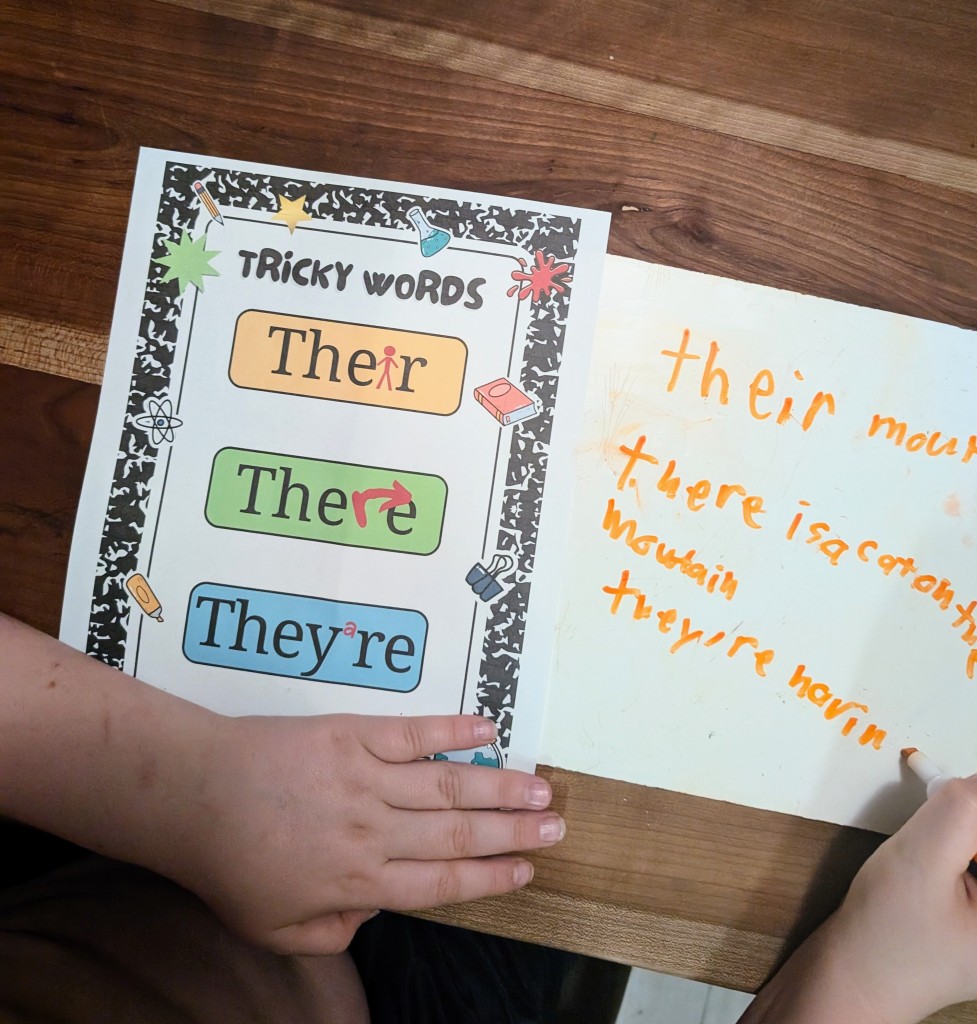
But we are making progress! It helps to put all the spelling rules to music. I have hope that we will figure it out, but in the meantime, if you have a child mixing up “their, there and they’re”, here’s a little visual memory hook to help. You can download it here.

This image has an empty alt attribute; its file name is pxl_20250228_035153719.jpg

The Secret Hack To Getting Your Kids Through Their Schoolwork

I’m loathed and embarrassed to even use such a clickbaity title, but I stumbled upon this method quite by accident and either it’s an anomaly for my kids/friends kids/students or it really is magical.

In all my spare time, I (try to) read books on neuroscience and listen to podcasts on all the latest cognitive strategies (hello Huberman), but there’s a difference between absorbing parasympathetic systems and dopamine receptors, and the real strategies for down-in-the-trenches help. So if I were to analyze this method dispassionately, I would say it’s the adrenaline and dopamine receptors that are kept guessing, that make this strategy so effective, but enough of the navel-gazing…. what is this?

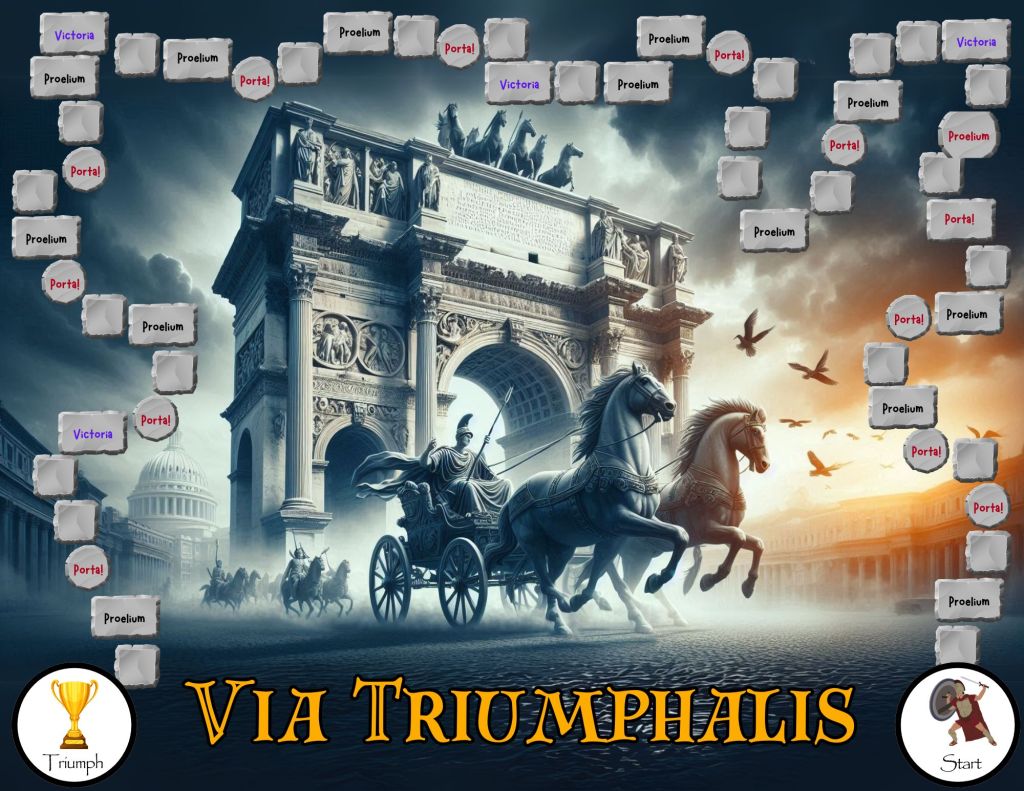
A printable board game and a few dice. I’m not joking. I can literally get my kids and my cottage school kids to do anything with this game. Math? done. Latin? done. Spelling? done. If you only have one kid, you’ll have to play with them as you need at least two players. Sometimes I do their work alongside them to show that even moms have to do school too, and sometimes I have them assign me my own “school work” like switching the laundry or starting lunch. After all, fair is fair, and if I’m asking them to do half a math worksheet, then they can assign me peanut butter and jelly sandwiches (little do they know, that I need the ADHD motivation hack too).

I named it “Via Triumphalis” which means “The Road of Triumph” in Latin. But don’t worry, you don’t need to understand Latin to play this game beyond knowing that “Proelium” means battle, and “Porta” means gate. You also need dice, and dry-erase markers (or a penny or something to move across the board…we use dry-erase markers). I have two versions, a simple one for younger kids, and a more complex one with character cards if your older kids get bored of the simpler version.

Word of caution though, don’t use it too much….act reluctant…only pull it out every two or three times they ask for it, otherwise (like with all things) the novelty wears off.

Here is the simple one, and here is the more complex one with character cards. Enjoy! Hopefully it’s not one of those things that only works magically for me.

P.S.
Not just for homeschooled kids, works great for getting any kid through homework.

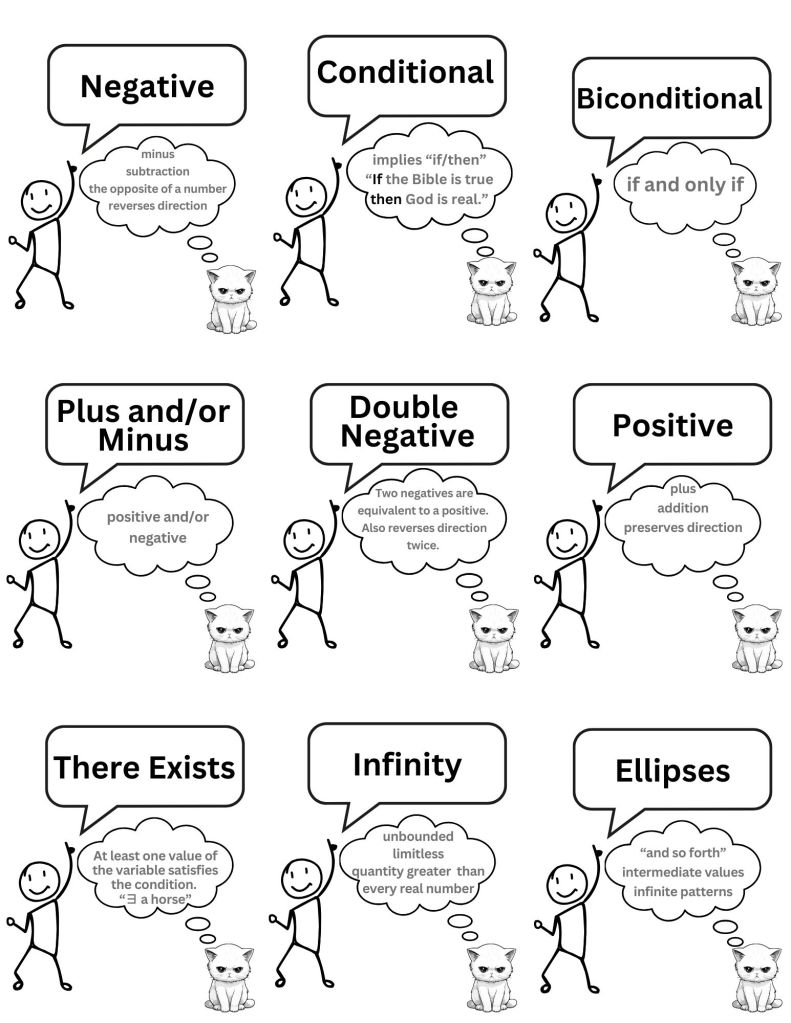
Math Notation Flashcards

We’re on winter break, “enduring” the prettiest, gentlest snowstorm, and enjoying everything being canceled. Back last Summer when it was 100 degrees with 100% humidity I started (what I thought) was going to be the simple task of making math notation flashcards for myself and my kids. I got about halfway through when the school year officially started and we all feel like we’ve been tipped off a cliff or tossed off a high dive. Since then it feels like it’s been a thousand years with a few battles with the Balrog, but finally, I came face to face with enough time to finish those soul-sucking math notation flashcards. Definitely a labor of love. Ten out of ten do not recommend. Trying to figure out how to make logarithms and formulas on Canva is definitely not my idea of a good time. The only thing that kept me going was that I couldn’t use the normal ones. The ones CC sells are double double-sided, i.e. they put answers and questions on both sides, so both sides of the card criss-cross and contain both a question and an answer to the other side. It’s brilliant really. Nobody wants to carry around an enormous stack of flashcards and this cuts the stack in half. They’re great flashcards, well done…high quality…fit perfectly in the little flashcard boxes at Walmart/Target. You can purchase them here.

My eyeballs literally can’t handle them though. No matter how many times I tell myself this x has nothing to do with the “geometric mean”, it’s like my brain takes a picture and it’s stuck in there permanently the wrong way.

So for those who are also visual learners…have ADHD…or dysgraphia, here is a PDF of all the flashcards with just one notation and answer(s) on each card. I made them humorous and satirical with a grumpy cat and an over-enthusiastic stick figure. I also added some Latin explanations (couldn’t help myself)

Please, for the love of all the things that got neglected in my house to make these (the mud tracked in, wood shavings everywhere, cats hiding behind water heaters), use them if you need them. Hopefully, they do someone else some good too.

Now I’ll return to working on writing, spelling, and Latin curriculum, where letters mean their actual letters and not points of an angle.

It’s February, and it’s ok to feel like Frodo on the side of Mt. Doom, right? Right. (Also, can you tell what Snowday books/movies we’ve been consuming?) ahem.

If you’re looking for other neuro-helpful stuff:
Here’s a fun, electronic-free, comic-book style Latin workbook that goes along with Henle and Challenge A.
Here are some colorable Latin Flashcards that use mnemonics and puns to help them stick.
Here’s a simplified Anatomy workbook with body systems and guided research that is more accessible for dysgraphia/dyslexia.

My Summer Math Hack

We only have three weeks of school left, the green baby leaves have finally outnumbered the gray tones, and I’m sitting in my living room wallowing in jello-like humidity (which I know is only a whisper of what’s to come, but in comparison, it’s for sure a hearkening). Clearly, Summer is almost here.

I’ve been mulling over what we want to do this summer: Hopefully, lots of gardening, river floating, and playing football or basketball in the morning after we’ve slept in, eaten homemade crepes, and read books together (one can dream, right?). But when I was thinking back to what has worked in previous summers I realized there is a clear winner that has threaded its way through all of our summers since my oldest was a wee lad.

Xtra Math

Yeah, I know it’s kind of old school at this point, but I swear it really does painlessly teach fast arithmetic facts. I’ve always called it their “summer vitamin” and no one has really balked at it much, although that may be because it takes less than 10 minutes and has a clear beginning and end.

I don’t like to use it during the school year because Saxon takes so long that even ten more minutes feels like a duel-worthy insult, but I like to pull Xtra Math out in the summer just to keep everyone’s minds sharp.

And if we don’t get to it because we’re camping or picking ticks off, well then…that’s ok too.

How To Have Fun And Learn Things On Field Trips (Bonus: Everyone Survives)

I think I’ve finally hacked it….maybe.

Taking uninterested children to museums and field trips is BRUTAL. On one side you tell yourself that your children need to be educated and cultured and have their horizons expanded, on the other side you have the students/children themselves who are loudly protesting how much they hate said field trip. And then you have all the older responsible folk who are all “when I was a kid, we didn’t complain about…”.

And while you’re trying to internally juggle all the things, you’re also trying to pretend that you have nothing else in the world to do than make everyone happy. You’re not also wondering how you’re going to grade papers, get dinner on, feed the dog, schedule the orthodontist appt etc. I mean, I don’t know about you, but I live for bridging the gap between cranky docents who think “children should be seen but not heard” and said children who are convinced the world is devoid of food and fun.

Now that I think about it, I’m not being sarcastic…that’s literally what I live for. I think I may genuinely enjoy bridging that gap between the old and the new.

But I digress.

I happen to so privileged as to live within bike-riding distance of where the Little House On the Prairie series was written. That’s right. The real Laura Ingalls Wilder herself, wrote the famous books not a stone’s throw away from my house. Consequently, my children have been once…or twice…or several…ok many times to the original homestead tours and museum. So when our CC group had a field trip there, I knew I was going to walk that fun tightrope between the out loud “of course we’re going!” and the intense hushed “yes we are going and you are going to be polite and listen to the tour guide and say “yes ma’am and thank you”.

As I was agonizingly doing math with the youngest beforehand, in an attempt to get school done “early”, I realized I was going to need a backup plan. Having been before, I was mentally imagining a bunch of elementary-aged boys (and girls) trying to squeeze into the tiny 120-year-old kitchen filled with priceless artifacts. AND they were successfully supposed to not move or touch anything. Lord have mercy. So I came up with a “scavenger hunt”.

Now granted, I know this is harder to do if you’re traveling and don’t know what you’re getting into, but I think it’s really a fantastic plan. Kids like goals. Kids like tangible things. Sometimes their brains are too underdeveloped to match the grammar with the rhetoric, so they need a bridge. The bridge in this case was an orange wet-erase marker and a laminated sheet of notebook paper. I scribbled down 15 things for them to find and answer, and I evenly divided the tasks between the exhibits and the museum. The reward was a stick of “Penny candy” that now costs 40 cents. Ho hum. Economics lesson aside, I would happily pay 40 cents per kid in order to not get permanently banned from a museum. Of course, the plan did backfire on me when the kids were SO EXCITED to see Pa’s fiddle and to see where Laura lost the money for her homestead, that they went in like a drove of invasive grasshoppers, and promptly got their butts set down by an elderly docent. By the time I sauntered in (a few moments behind them), she was already wrapping up the “don’t make noise, don’t touch anything, don’t breathe on anything” lecture and was ready to launch into the “how to be a responsible chaperone lecture.” What she didn’t know, was that I am happy to take one for the team, in fact, I’d be happy to have her come lecture my children every morning, but she didn’t seem interested in that. Shocking.

After the field trip was over, my kids said it was the best field field trip ever. So. much. fun.

The key really was the “scavenger hunt” (and maybe the presence of their friends, but who’s counting). Everyone needs a job or a mission, and I totally get it! When I was in Paris, I had a mental checklist of everything I wanted to see, and learn, and understand. Why would kids be any different? They just need a little abstract hand-holding.

I’m going to start doing this every time I find myself chaperoning a field trip where I know I’m going to be in over my head. However next time I’m going to have a chat with the Gift Shop Lady first, and I’m also not going to forget all my scavenger hunt stuff on the table. I’m wondering, should I go back and get my pens and paper? Cut my losses? Save face? or chalk it up to a good laugh?

Also, if you ever come to visit, I will happily show you where Laura and Almanzo’s secret cold spring is, and tell you all the “exclusive conspiracy theory” stories.

Donuts and Crystals: An Economics Lesson for Highschoolers

I am loving this school year so much. 9th graders are so much easier than 7th graders (although full confession, I feel like middle school is probably my calling in life). Middle schoolers are like the toddlers of the teenage years. They’re so cute, but kind of a lot.

However… (and that’s a big however). I don’t know if it’s post-covid, or a Gen Z thing or what, but I guarantee you your average high schooler has the ability to break any object lesson or activity that has worked for decades. There is nothing Gen X or Millenial teachers and parents can come up with that Gen Z can’t hack in a nanosecond.

Case in point: We did an “Inflation Game” today with very specific instructions. I was supposed to use beans and candy, but beans are boring and candy is for kids, so I took some floral rock-crystal-things I had and a cheap bag of hostess donuts (don’t judge). I handed out 5 crystals to each student and then offered to “sell” a donut for 10 crystals. This is supposed to be unsuccessful. According to my instructions no one is supposed to be able to buy a donut, thus proving that when money supply is low, inflation is low. You can imagine how well that went.

When I was prepping this activity a few days ago, I dryly predicted to Jim that it would take less than a second for two kids to combine their “money” and buy a donut since a half donut is better than none. I was correct. What I didn’t predict was that kids would start trading their snacks with each other for crystals, thus creating a bartering system outside of my controlled system (I feel like there’s a lesson there).

But it didn’t stop there. For the second part of the activity, I was instructed to give each student several handfuls of “money” (without counting to see who got more or less) and then start an auction for the donuts. As expected (and carefully explained in the directions), the extra money supply drove up inflation. What I didn’t expect is that monopolies quickly formed and two kids were in danger of getting absolutely every single one of the donuts before anyone else got a single one. So the rest of the class banded together and blocked them.

Strong feelings and opinions flew back and forth. At one point they discussed mobbing me and just taking the bag of donuts. I felt the weight of a thousand dictators weighing on my soul. It was dicey for a few moments.

All that to say, I think we learned more about economics in fifteen minutes than we have from any book. And if you try this…don’t say I didn’t warn you.

Cycle 3 Latin/English John 1

Putting this here to prove to my future self I’m not crazy when (if) it changes again.

You know you’ve been in Classical Conversations a long time when they’ve switched the memory work on you multiple times, and you feel gaslit by an otherwise charming and lovely curriculum. lol

It’s not CC’s fault… well it is, but it’s understandable. They occasionally update their curriculum and it’s not their fault I was in my 20s and had two kids when I started CC and I’m now in my 40s with four kids (and the kid who started CC as a 5-year old is now an adult). There were some good old days back there when I was a Foundations tutor and pregnant with my third and would have to run for the nearest trashcan while a kind mom took over my class for a minute. Now I’m just a cranky old Challenge director giving highschoolers the stink eye when they eat snacks through a heart-rending discussion about the Scarlet Letter.

All that to say, Andria and I could NOT figure out the Cycle 3 Latin this year. We wrote an entire workbook to make Latin accessible for ready-to-quit families, but couldn’t figure out the English translation for Foundations. Thankfully the Vulgate never changes, so at least we got that part right.

We printed these sheets, laminated them, and we sing them every morning of Cottage School so the kids have them down pretty good by now although the English is so different from the regular translations we’re used to, that we’re still messing that part up. I think the idea was to pick a translation that more matched the Latin, but if you’re a Challenge director, you will find yourself explaining that half the words are wrong from what they’ll be told in Challenge A, but whatcha gonna do. This is why people have dedicated their whole lives to translating Scripture.

…also we included some tracing sheets for fun.