Every year, I try to put myself in the head of a middle schooler and figure out new ways to help them wrestle with geography and cartography. It’s no easy task to memorize drawing and labeling the whole world by heart. Some might even question the necessity (and sanity) of doing so (since let’s be honest, most kids are probably going to forget a lot of it anyway… and what are they going to use it for, answering a Jeopardy question at 40?), but I had to memorize and draw the world by heart as a young teenager, and not only did it make history and politics much easier to follow, it was also like an executive function super course. Taking a big project, breaking it down into chunks, and figuring out ways to remember everything is a huge skill that transfers over to so much of adulthood.
That said, there are certain “hacks” to help information stick in your brain…colors, novelty, music, pegging, mnemonics etc. I try to have my kids and students brainstorm with me, and so here’s this year’s fresh crop of new ideas. Homeschoolers these days have so many more creative tools at their fingertips than I did in the 90s. It’s not fair!
What we’ve come up with for helping to memorize Canada’s provinces and territories:
Big Alps Sing Many Quiet Old Nursery Poems Near Naptime to Young Northern Nomads. British Columbia, Alberta, Saskatchewan, Manitoba, Quebec, Ontario, Newfoundland, Prince Edward Island, Yukon, Northwest Territories, and Nunavut.
Save, print, laminate, cut into cards, and keep around the table while you’re drawing and labeling. Try memorizing and chanting to jump rope, cups, clapping, hop scotch, tango dancing or…you get the idea.
So that helps with the visual working memory, but it doesn’t include the capitals. For that we need a good old fashioned sea shanty. Here’s a song with all of Canada’s provinces, territories and capitals, including Ottawa! (for some reason, kids seem to skip that one).
It very intentionally matches the same order as the acrostic mnemonic, but be careful! The Canadian provinces and capitals might get stuck in your head.
As always, you can find my other Cartography resources here:
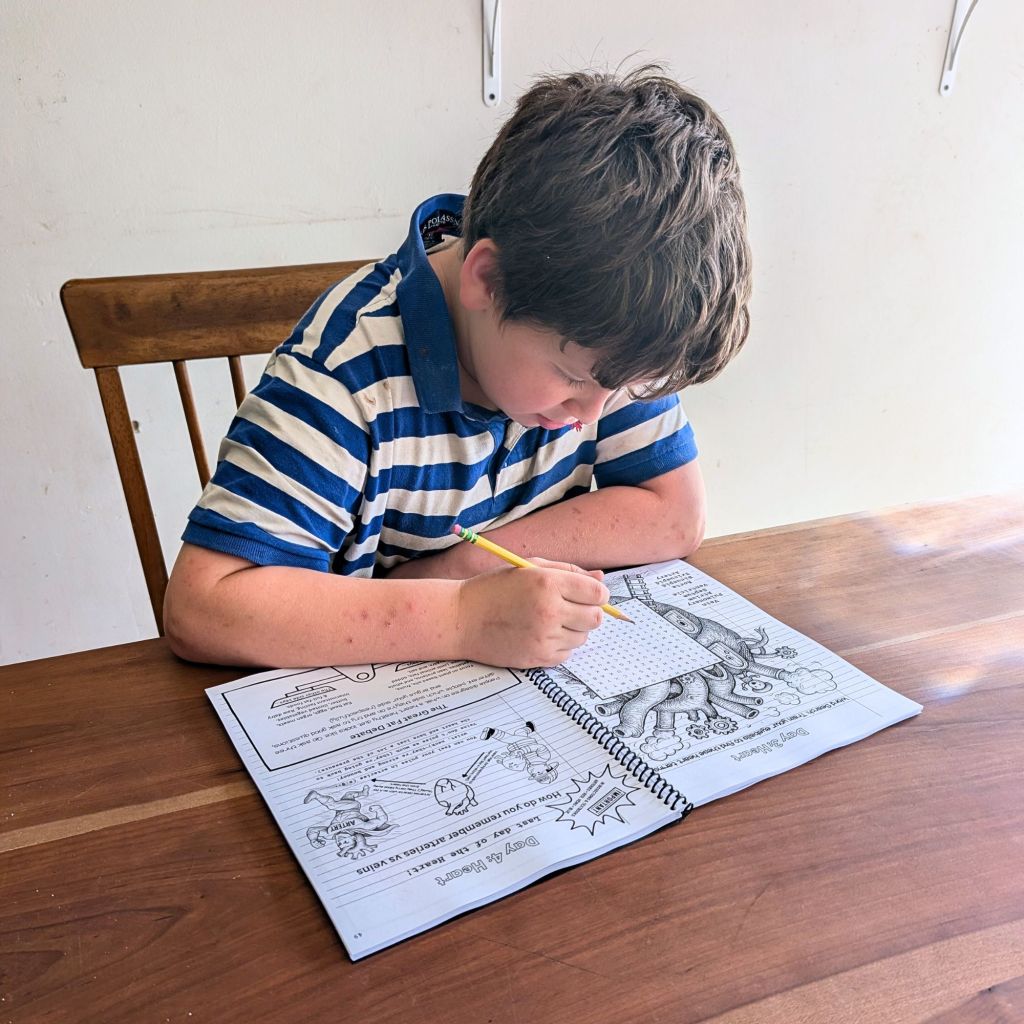
I should have done this a long time ago. I wrote a whole Anatomy Workbook/Curriculum! Between four kids who love science, a mom who is a nurse and loves human anatomy, and my years as a Challenge A Director, I’ve spent the last several months compiling all of my favorite experiments, dialectic questions, simpler drawings, and all the crazy memory hacks my mom used when I was little to help us memorize everything. It was one of those projects where I felt like I could have kept writing it forever, adding new interesting research and information I dug up, but I also wanted to make it doable. An independent, open-and-go curriculum with an easy answer key that wasn’t online and was screen-free. I also tried to tap into middle schoolers’ natural desire to form opinions and argue with everyone around them. Ahem.
You can find the printable digital version here. Or… You can find the printed and mailed-to-you version here.
And now, on to the thing that sparked this whole adventure. I think THE TALK is a universally dreaded conversation to have with your kids, and it always seems to be in capital letters in one’s head. And the worst part (at least in our family) is that when you finally muster up the courage to have the conversation, you forget that your kid has an auditory processing problem, and you make it so low-key and chill that they promptly forget the whole thing, leaving you to experience Groundhog Day. Good times. The internet is chock-full of all kinds of books, instructional material, and helpful advice, but it can be daunting and overwhelming, and thus we disassociate until another day and hope we don’t wait too long, or heaven forbid, give it too soon (where are my pearls to clutch).
So don’t take this as advice or a strong opinion, but if you’re looking for a plain, factual lesson, I’ve got you covered. For those who have visual learner kids, but don’t want something super graphic and are looking for a more science-friendly approach, here’s the Reproductive System Lesson from the workbook. A freebie science printable, as they say. You can hand it over, or do it alongside them, or edit it, or use it as a starting point to build with more information as they get older and more mature (or perhaps less mature in the case of middle schoolers). Enjoy!
Or you know, you can always go the super expensive route and buy a homestead and have animals, and then the reproductive education (mostly) takes care of itself!
Do numbers have personality and gender to you? Fueds, family trees, romances…sibling squabbles? Or are they just numbers?
This question came up in my Challenge A class, and out of six kids and a few adults, only one kid and one mom didn’t do this. Since I’ve done this for as long as I can remember…involuntarily with both notes/music notation and math/numbers, I sort of assumed everyone did it to some extent (except for Jim because he’s one of those weird spreadsheet people). Obviously, 0 is the patriarch and 1 is his firstborn son who’s been such a disappointment to him. 2 is the matriarch… 7 is the perfect child who drives his siblings crazy because he really shouldn’t be…etc etc etc.
Turns out that’s an actual thing called Ordinal-Linguistic Personification, which is a form of synesthesia. A large percentage of kids do it, but they usually outgrow it. Only 1% of the adult population has Ordinal-Linguistic Personification, so I guess Jim’s not the weird one after all. There are other types of synesthesia too! Some of them I’ve never even heard of:
Grapheme-color synesthesia – associating letters or numbers with specific colors.
Ordinal-linguistic personification (OLP) – attributing personalities or genders to numbers, letters, or days of the week.
Chromesthesia – hearing sounds and involuntarily seeing colors.
Lexical-gustatory synesthesia – associating words with specific tastes.
Auditory–Tactile Synesthesia – Hearing a sound causes a feeling somewhere on your body.
So now I’m super curious about who else is a closet synesthete. 👀
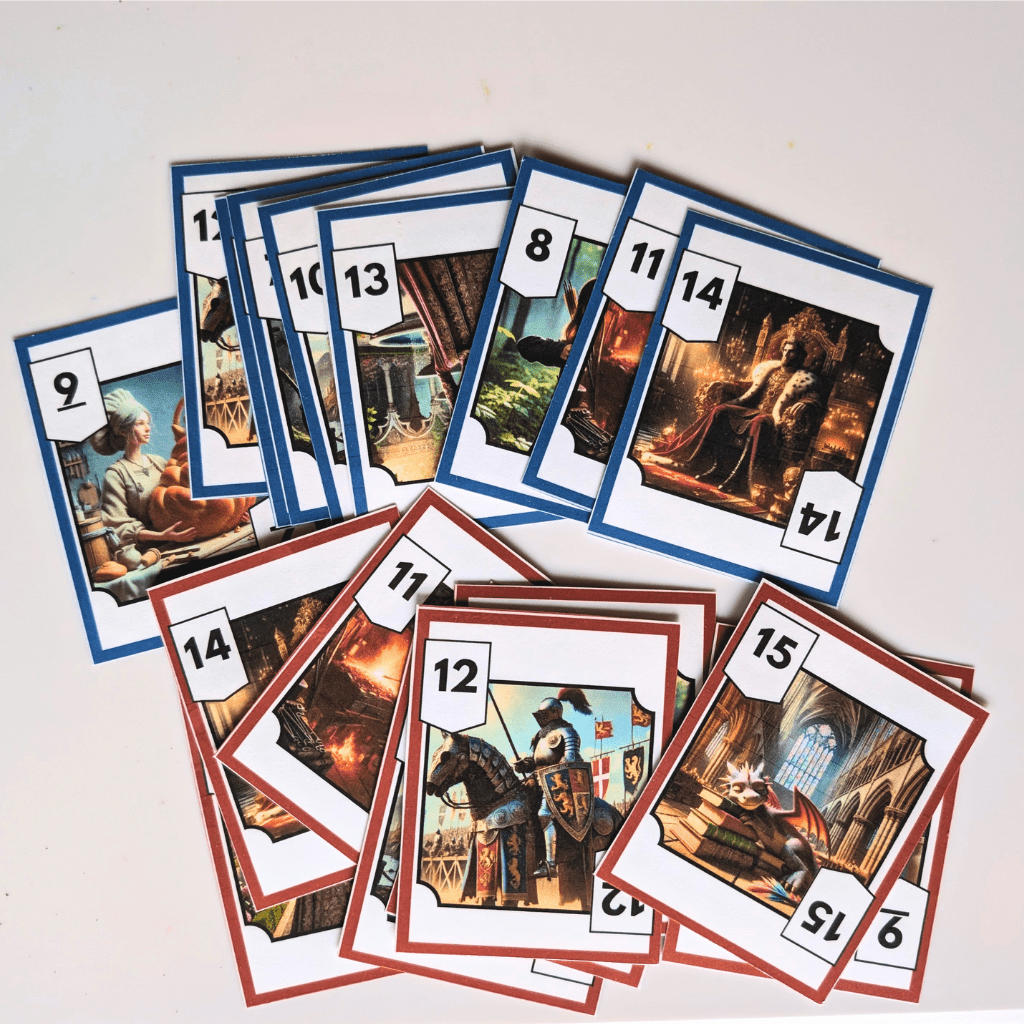
But back to math, this whole number personification thing has made math discussions in class and at home so much more interesting. I was listening to the math map podcast and Dr. Gilpin recommended making your own number cards for quick arithmetic games…it’s hard sometimes to remember what numbers kings and queens are and if we decided aces were high or low. Plus, it would be nice if the cards went up to 15 like we do with skip counting.
Soooo, thanks to the power of the internet and a little late-night insomnia, here are some personified number cards for all your little creative math geniuses (or right-brained ADHD-prone kids). If you want four suites like regular playing cards, print two sets. (make sure you select “fit to page” otherwise your printer will chop off the color). You can make blue cards negative numbers and red cards positive numbers…you can add the red and minus the blues…or multiply and divide. The sky is the limit! (I included a whole list of quick, fast medieval-themed math games that will tempt even the most dysgraphic sensitive kid into doing math…perhaps even liking it) Enjoy.
(and if you’re looking for other screen-free homeschooling help like Challenge A survival Latin or Cartography, you can find them here.)
The world right now feels a bit like a flamingo trying to put on pantyhose in the dark. Lots of staggering involved. Maybe it’s because I have one kid going through the Fallacy Detective right now, or maybe we’re just in a new season of family dinners where varying opinions, debates, and conversations are flying on a more “oh hey look my kids are actually mini adults now” level and not the old days of “Please put your underwear back on, and no you cannot stick beans up your nose.”
So all that to say, we’re on a logical fallacy kick around here. We find them in movies and ads, we catch each other doing them and we find them in spades on the internet and news. Whether your kids are homeschooled, private schooled, public schooled, or meet under a waterfall in some Waldorf-inspired space, I think it’s safe to say raising discerning thinkers is a high priority for all of us. Equipping them with the tools to think, discern, and pursue truth is like a broken record on the to-do list.
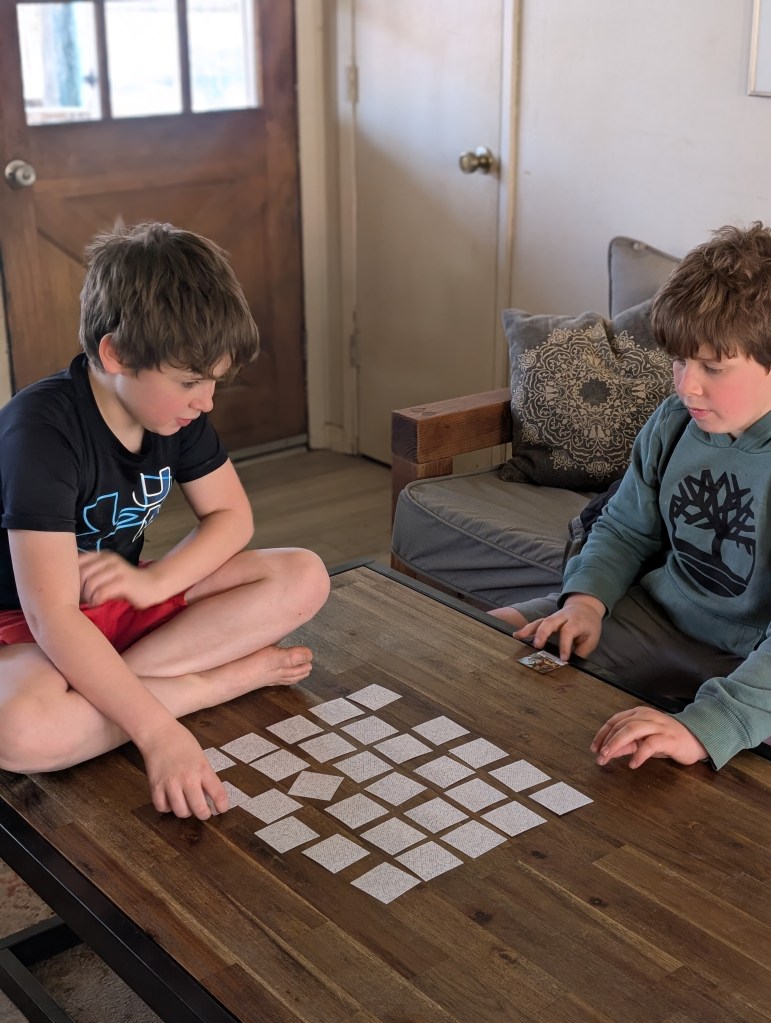
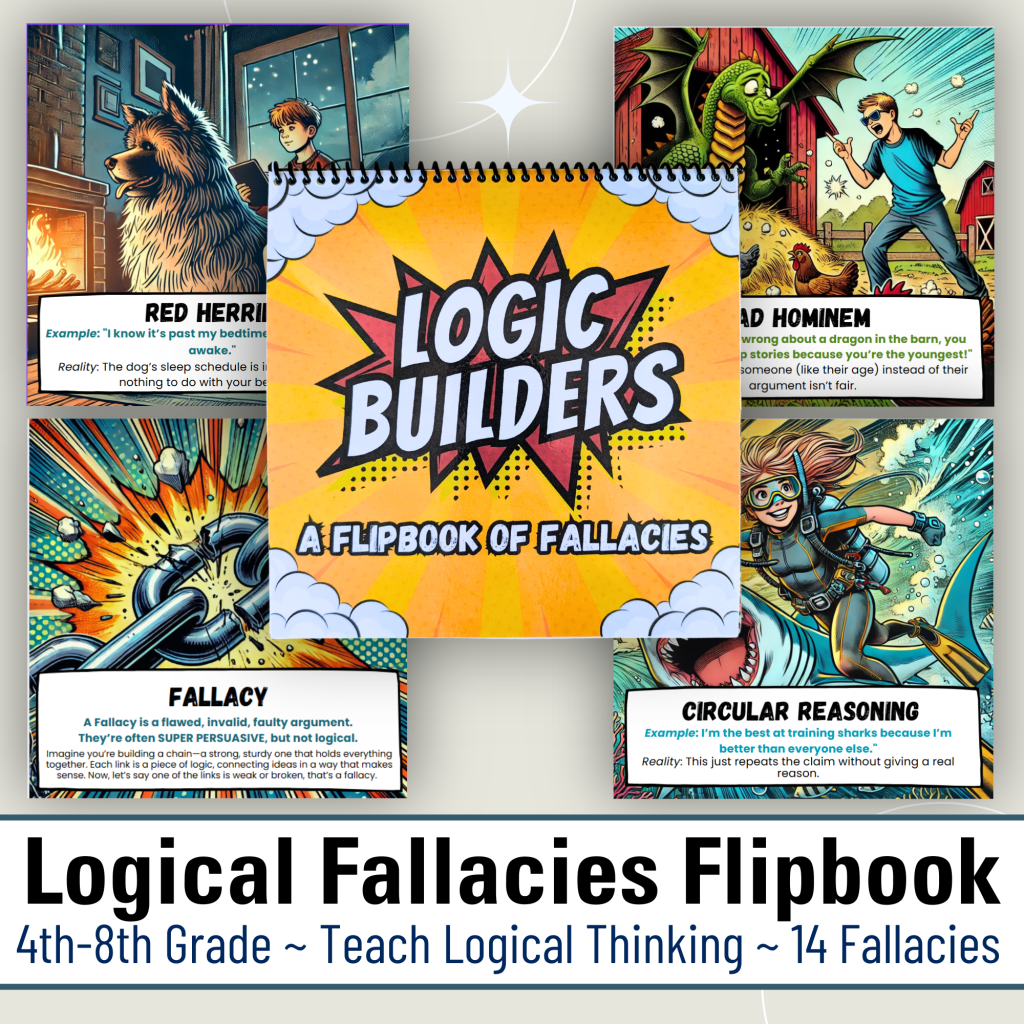
Not that I have anything remotely close to the answer, since persuasive rhetoric is supercharged these days, and we’re just as susceptible as the next person. So this is not a promise for “life-changing” results, but we’ve been enjoying these cards and matching game which you can download here. It’s led to lots of great conversations and I like that the youngest is catching up quicker than his older siblings did.
Or if you feel like supporting a small business, (mine!) you can download the full flipbook for a few dollars here. I made them to be neuro friendly and brain “sticky” in all the ADHD/Dyslexia ways. Even my older kids are picking it up and reading through them….which….let’s just say I’ll take that as a win!
I’m loathed and embarrassed to even use such a clickbaity title, but I stumbled upon this method quite by accident and either it’s an anomaly for my kids/friends kids/students or it really is magical.
In all my spare time, I (try to) read books on neuroscience and listen to podcasts on all the latest cognitive strategies (hello Huberman), but there’s a difference between absorbing parasympathetic systems and dopamine receptors, and the real strategies for down-in-the-trenches help. So if I were to analyze this method dispassionately, I would say it’s the adrenaline and dopamine receptors that are kept guessing, that make this strategy so effective, but enough of the navel-gazing…. what is this?
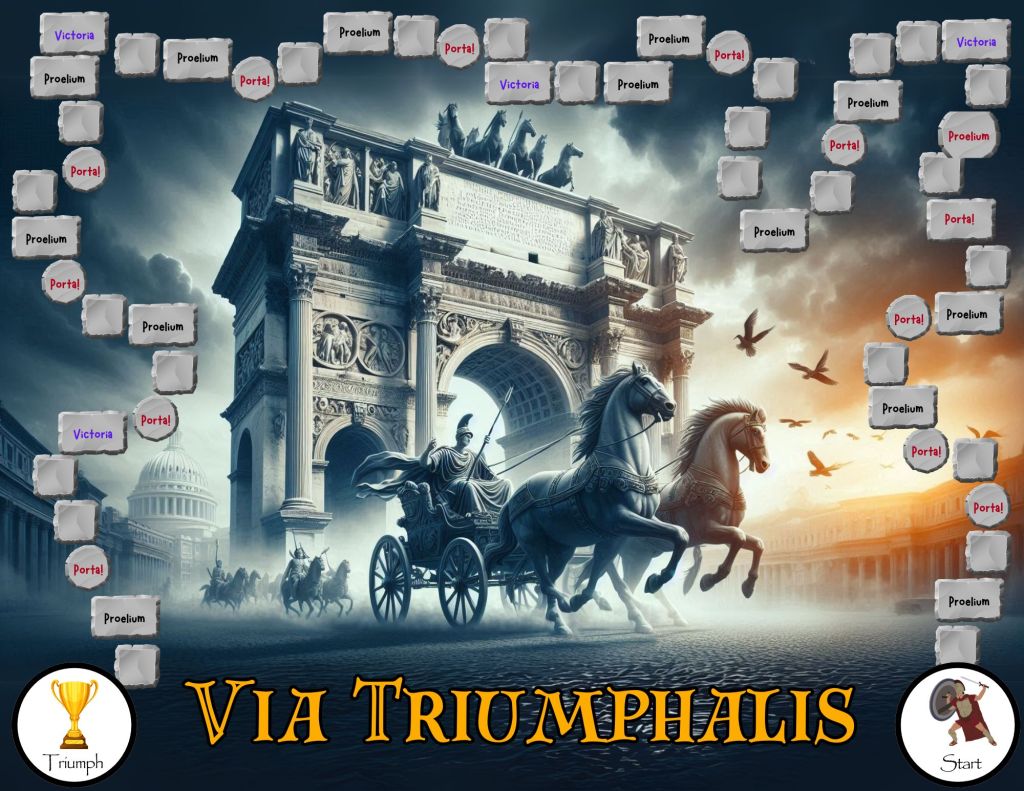
A printable board game and a few dice. I’m not joking. I can literally get my kids and my cottage school kids to do anything with this game. Math? done. Latin? done. Spelling? done. If you only have one kid, you’ll have to play with them as you need at least two players. Sometimes I do their work alongside them to show that even moms have to do school too, and sometimes I have them assign me my own “school work” like switching the laundry or starting lunch. After all, fair is fair, and if I’m asking them to do half a math worksheet, then they can assign me peanut butter and jelly sandwiches (little do they know, that I need the ADHD motivation hack too).
I named it “Via Triumphalis” which means “The Road of Triumph” in Latin. But don’t worry, you don’t need to understand Latin to play this game beyond knowing that “Proelium” means battle, and “Porta” means gate. You also need dice, and dry-erase markers (or a penny or something to move across the board…we use dry-erase markers). I have two versions, a simple one for younger kids, and a more complex one with character cards if your older kids get bored of the simpler version.
Word of caution though, don’t use it too much….act reluctant…only pull it out every two or three times they ask for it, otherwise (like with all things) the novelty wears off.
Full disclosure, I was one of those kids. Notice I said ‘was”, because along with my black thumb, and fear of talking to strangers, time really does heal all things (or most things). While I won’t be winning any Nobel prizes in astro physics, nor becoming a horticulturist or the next Malcolm Gladwell, I have mastered all those things to the point where I don’t start panicking and breaking out in hives when I have to do trinomial equations or save the butternut squash from the vine borers. (Well mostly there’s no panicking, I do still occasionally turn bright red when talking to strangers).
Part of it is some kids just don’t like numbers, or maybe it would be more accurate to say, that numbers don’t like them (I’m looking at you Dyscalculia). I mean, there’s nothing wrong with their brains, numbers are just slippery bits of squiggly lines that go in one ear and fall right out the other. I didn’t realize I could do math until I met geometry and propositional logic. Put interesting concepts and theories in His Royal Majesty the King’s English and suddenly it all makes sense.
But now that I’ve taught math both in the classroom and at home for fourteen years now, I’ve made some observations. There’s a group of kids who seem like they’re bad at math, or maybe it takes them forever to get through a lesson, but it’s not because they have the aforementioned Houdini number problem. They usually have really good number sense…too good. And that’s their hangup. For kids who have more abstract brains (Ne or Ni for the Myers Briggs nerds), their mind has to do a lot of sorting and thinking and connecting while they’re doing math. They can’t just be told how to do something. They tend not to trust it, and they second guess themselves constantly because nobody gave them all the puzzle pieces and they’re missing connector pieces that would bring the whole picture together. Now obviously there is a brand of math lover who is both abstract, loves arithmetic, is good with numbers, and is super fast…but we’re not talking about those unicorns. We hate those people (just kidding…and if any of my brothers are reading this, no I really am jealous proud of your ridiculously impressive math skills). For the math sloths, the problem isn’t that they can’t do math, the problem is they’re climbing a mountain in their head where you can’t see, and then having a meltdown like Mt. St. Helens because they’re sure they’re the worst math student the world has ever seen and they’re never going to understand it (middle schoolers are especially dramatic about math…ask me how I know).
At this point, I think I have bought and tried every math curriculum on the market, including but not limited to Singapore, Math U See, Saxon, Horizon, Bob Jones, Abeka, Rod and Staff, The Good and The Beautiful, Teaching Textbooks, Life of Fred, Right Start, Houghton Mifflin, Beast Academy, and Shormann. Whew.
The only one I truly hate is Saxon, which ironically is also the one we are currently using. I only hate it because it’s what I used as a kid and spent too many hours fantasizing about ways to burn it, but my kids seem to be thriving with it, so here we are (Mom, you can feel very vindicated right now).
If I had to pick my favorite combinations, it would be to use RightStart for the younger years (love that program). But it’s pretty teacher-intensive, so I like to use it alongside Rod&Staff which has very simple black-and-white consumable workbook pages. Perfect for days when you need to help the older ones more or you just can’t fit the raison d’etre RIghtStart in your day (seriously, the thing is a beast). Then for the older kids, I used to recommend Shormann, until I figured out that most teenagers can hack that thing with their eyes shut and get an “A” without actually learning a blessed thing. So now I prefer Nicole the Math Lady, who uses Saxon but actually explains everything like a normal person.
But my biggest piece of advice for the slow-hiking, Mt. St. Helen math kids, is to set a timer and scale. Acknowledge and praise them for the invisible rabbit burrows they’ve dug all through their brain. Encourage them that they are good at math (because they truly are). Set a timer for 60 min, and assign odds or evens. But don’t let them stay at camp happy-go-lucky. They really do need to get to a normal speed eventually. I mean, I don’t know what project engineers do when a bridge needs to be finished and everyone is waiting on them, but I imagine nobody is happy to sit around wasting money while their engineer gazes off into the distance making math connections. So at home, while you still have the chance, make some achievable goals for speeding up and pushing themselves a little.
Easy + One is what I always say.
And hug a kid who says they hate math, chances are they will eventually love it.
Sometimes I feel like Wendy with the lost boys around here. Homeschooling on most days feels like a battle, but somehow we tarry on. One of the main reasons I chose Classical Education was because it focuses on teaching kids how to learn, instead of what to learn. Sounds great, but turns out teaching a house full of wild boys how to learn, is way easier said than done. If you’ve hung around Classical education circles at all, then you’ve read or heard about Dorothy Sawyer’s essay titled “The Lost Tools Of Learning”. (it’s a quick read and I highly recommend it). In it, she basically does her version of “Back in the good ol days…”. But I’ll admit, it’s a compelling if laughably unattainable goal. I first read it when my kids were in diapers, and so incredibly naively optimistic that I mentally raised my hand and said “Yes! Pick me! Let’s do this!”. She’s a very persuasive lady. Ahem.
Then I had one boy after the other who struggled with writing, reading and everything in between…basically poster children for those who do NOT do Classical education. My personality gravitates more naturally to the Charlotte Mason school of thought (and I still like it in theory and intuitively teach that way), but I was too unstructured of a mom to use it well. Classical Conversations is where we ended up, which is like the McDonald’s of the Classical education world. Franchised and systematized. Not going to lie though, it’s been a struggle. Nothing about homeschooling has come easy. When one of my kids memory-mastered for the first time, it was a whole ordeal. The kind of ordeal that includes blood, sweat, and tears. I googled ways to make things stick, I sat with him for hours, we tried all of the tricks. Over the years I’ve read enough books to fill a library on how to utilize working memory, how to work with kids with dyslexia, apraxia, auditory processing disorder, ADHD etc. One of these days maybe I’ll write my own curriculum with all of the things I’ve picked up from a hundred therapists, books, and research, but for now… if anyone feels like they try to explain a concept to their child a dozen times and it’s not sticking, or if you’re in CC and have a kid who is struggling to memorize their grammar work, here are a few things that work around here.
Flashcards with stick figures and pictures. This was the game-changer last year. Last year I had to sit down and figure out where all of the holes and struggles were and then make up silly mnemonics and draw them onto flashcards or whiteboards. The three rules are: It has to be colorful. It has to be silly/funny. It has to be IN and ON the words themselves and not above it or beside it (i.e. “The Progressive Era” gets turned into a car with a giant ear riding on it).
Laminate things that need to be memorized. Homeschooling moms are like Monica Gellar when it comes to laminators. We will laminate anything. We love laminating. It’s more satisfying than picking dried glue off your hands. Add some wine and a few friends and it’s my ideal party. Laminating memory work was the game changer this year. Then my kids can take it outside, on a skateboard, in the mud, in the shower or in a box with a fox. Since my kids are all super active, this is really what made a difference. Once kids learn how to memorize, everything in life becomes easier (and not just school things, it’s like their working memory and prefrontal cortex can function a lot better across the board).
Cross the mid line. With younger kids you can do this with hand motions. With older kids, you either have to sit down with them and learn a bunch of Fortnite dance moves, or do those hand slappy things… or bribe them. Whatever the case, taking a drink of water then breaking memory work into moves that cross the mid line really works. And don’t ask me why the water thing is really important, but it’s a scientific thing. Those youtube kids yoga videos work great too. It’s like it unlocks something and the right brain and left brain stop fighting each other and start working together.
I’m so proud of my kids and their small victories. I remember when my oldest finally figured out how to teach himself things and it’s almost better than the moment a kid is truly potty trained…almost.





 Scholar Forge