
Kindergarteners, Sensory Input and the Story of Mr. Thomas of a CC

Sometimes teaching life feels like an episode of Iron Chef, but instead of making tacos out of shrimp, manzanita berries, and Irish peas, it’s trying to keep your class fun and educational on thrift store donations, calcifying craft supplies, and a packet of dry-erase makers. 

I recently read Stories That Stick by Kindra Hall, which isn’t meant for educators, but I’ve found that the business world often has the best (not new) but reframed ideas for home and classroom. It reminded me of back in my Foundations days, when I was an Abecedarian tutor (the little guys in the Classical Conversations world). Homeschooling always attracts a mixture of kids who run the gamut from reciting the entire periodic table of elements at four, to hiding under their desks at co-op or class days pretending to be a gorilla (and oftentimes they’re the same kid). And not that I’m not totally on board with CC’s policy of having the moms in the room on class days, but to be honest, kids listen a lot better when their Nannie McPhee teacher tries to get them to skip count the threes, than when their mom tries to cajole them into participating…at least that was my experience with the younger ages. Honestly, though, I loved every minute of it. I think four and five-year-olds are hilarious, even when they’re painting their neighbor’s frilly pink dress in black shoe polish from their Dore art projects. 

But I digress… Our CC campus at the time also happened to be my home church, and so I sometimes helped clean things out or went through stuff people donated for the nursery, and that’s how I stumbled across Mr. Francis of a CC. He was one of those giant teddy bears kind of like the ones they used to sell at Costco. He was very much not disinfectable for the nursery, but I couldn’t bear to let him go (pun intended…ha). He had so much potential! So I moved him to my CC classroom and I’m telling you, I’ve never had so much success getting preschoolers and kindergarteners to do stuff!

 “Let’s sing the Latin Noun Declensions more loudly and see if we can wake Mr. Francis up!” 

“Mr. Francis is waiting for everyone to sit down quietly before he can chant irregular verbs with us”

“Having a meltdown? Go lay on the giant stuffed teddy bear and give him the tightest hug you can”

“Can’t sit still or keep your hands to yourself? Go jump on the giant teddy bear.”  

 The kids loved him. We created all sorts of make-believe stories and narratives about him and used him for all types of pretend play. It was my best Abecedarian year ever. 

I was sad when I moved on to the older kids the next year and didn’t take Mr. Francis with me.  I don’t know whatever happened to him, I think he ended up finally retiring to a thrift store where I’m now imagining all kinds of Toy Story endings for him. But I think the magic of Mr. Francis lives on and can be recreated in an infinite variety of ways, one just needs two things. 

Sensory input and stories. 

The very large nature of Mr. Francis and the proprioceptive input kids got from jumping on something or falling into something big and soft, was very calming, and the stories and characterization made him real and gave them a reason to not eat their boogers, or helped them stand up tall and straight for their presentations. But really anything works. At that age, you can take playdough and stick googly eyes on it and name it Mr. Slimy Pants or something. Teenagers are a bit harder because they still need the sensory input and stories, but they’re not quite as willing to look silly, but that’s a different blog post for a different day.  

For now, I would just like to say “Rest in peace Mr. Frances of a CC you were well loved, and may your life lessons live on.“

Also, I need a giant Appa in my life. Like this, but way way bigger.

In Defense of kids who don’t like math 

Full disclosure, I was one of those kids. Notice I said ‘was”, because along with my black thumb, and fear of talking to strangers, time really does heal all things (or most things). While I won’t be winning any Nobel prizes in astro physics, nor becoming a horticulturist or the next Malcolm Gladwell, I have mastered all those things to the point where I don’t start panicking and breaking out in hives when I have to do trinomial equations or save the butternut squash from the vine borers. (Well mostly there’s no panicking, I do still occasionally turn bright red when talking to strangers). 

Part of it is some kids just don’t like numbers, or maybe it would be more accurate to say, that numbers don’t like them (I’m looking at you Dyscalculia). I mean, there’s nothing wrong with their brains, numbers are just slippery bits of squiggly lines that go in one ear and fall right out the other. I didn’t realize I could do math until I met geometry and propositional logic. Put interesting concepts and theories in His Royal Majesty the King’s English and suddenly it all makes sense. 

But now that I’ve taught math both in the classroom and at home for fourteen years now, I’ve made some observations. There’s a group of kids who seem like they’re bad at math, or maybe it takes them forever to get through a lesson, but it’s not because they have the aforementioned Houdini number problem. They usually have really good number sense…too good. And that’s their hangup. For kids who have more abstract brains (Ne or Ni for the Myers Briggs nerds), their mind has to do a lot of sorting and thinking and connecting while they’re doing math. They can’t just be told how to do something. They tend not to trust it, and they second guess themselves constantly because nobody gave them all the puzzle pieces and they’re missing connector pieces that would bring the whole picture together. Now obviously there is a brand of math lover who is both abstract, loves arithmetic, is good with numbers, and is super fast…but we’re not talking about those unicorns. We hate those people (just kidding…and if any of my brothers are reading this, no I really am jealous proud of your ridiculously impressive math skills). For the math sloths, the problem isn’t that they can’t do math, the problem is they’re climbing a mountain in their head where you can’t see, and then having a meltdown like Mt. St. Helens because they’re sure they’re the worst math student the world has ever seen and they’re never going to understand it (middle schoolers are especially dramatic about math…ask me how I know). 

At this point, I think I have bought and tried every math curriculum on the market, including but not limited to Singapore, Math U See, Saxon, Horizon, Bob Jones, Abeka, Rod and Staff, The Good and The Beautiful, Teaching Textbooks, Life of Fred, Right Start, Houghton Mifflin, Beast Academy, and Shormann.  Whew. 

The only one I truly hate is Saxon, which ironically is also the one we are currently using. I only hate it because it’s what I used as a kid and spent too many hours fantasizing about ways to burn it, but my kids seem to be thriving with it, so here we are (Mom, you can feel very vindicated right now).  

If I had to pick my favorite combinations, it would be to use RightStart for the younger years (love that program). But it’s pretty teacher-intensive, so I like to use it alongside Rod&Staff which has very simple black-and-white consumable workbook pages. Perfect for days when you need to help the older ones more or you just can’t fit the raison d’etre RIghtStart in your day (seriously, the thing is a beast). Then for the older kids, I used to recommend Shormann, until I figured out that most teenagers can hack that thing with their eyes shut and get an “A” without actually learning a blessed thing. So now I prefer Nicole the Math Lady, who uses Saxon but actually explains everything like a normal person. 

But my biggest piece of advice for the slow-hiking, Mt. St. Helen math kids, is to set a timer and scale. Acknowledge and praise them for the invisible rabbit burrows they’ve dug all through their brain. Encourage them that they are good at math (because they truly are). Set a timer for 60 min, and assign odds or evens. But don’t let them stay at camp happy-go-lucky. They really do need to get to a normal speed eventually. I mean, I don’t know what project engineers do when a bridge needs to be finished and everyone is waiting on them, but I imagine nobody is happy to sit around wasting money while their engineer gazes off into the distance making math connections. So at home, while you still have the chance, make some achievable goals for speeding up and pushing themselves a little. 

Easy + One is what I always say. 

And hug a kid who says they hate math, chances are they will eventually love it. 

3 Things Every Homeschooling Mom Needs

  1. A good printer that doesn’t cost an arm and a leg in ink. 
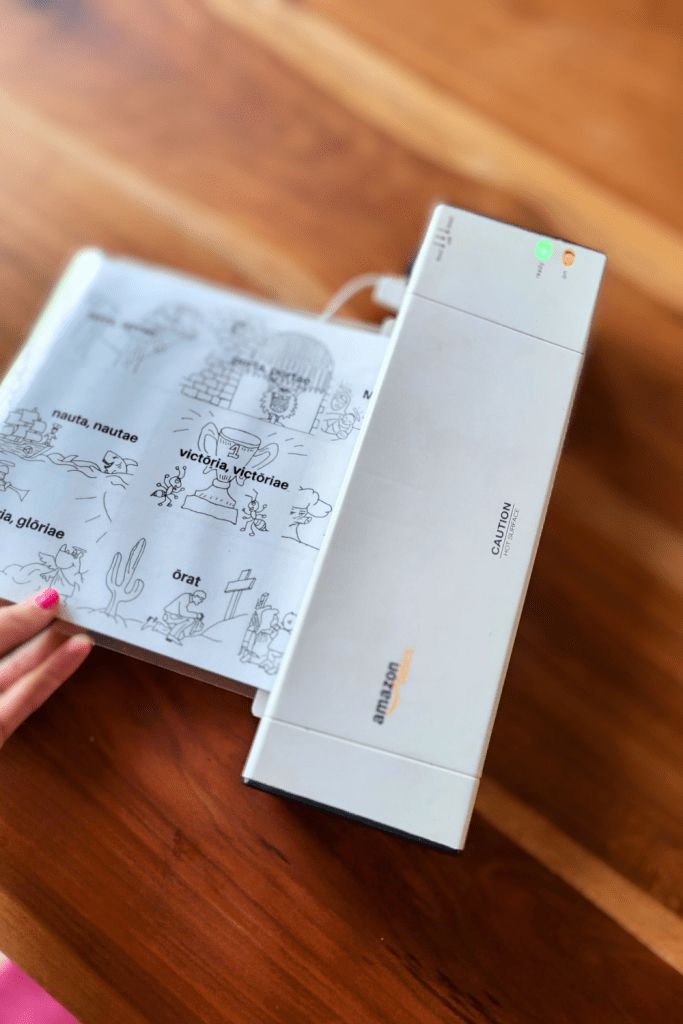
  2. A laminator that won’t “eat” your beautiful school stuff. 
  3. A shoe organizer repurposed as a flashcard holder so all the kids can find what they need. 

No lie, I think I love my printer more than I like some of my friends (I kid, I kid), but sometimes I feel like I need to put “Marked Safe From My Laminator”. That thing is going to be the death of me. I love it dearly but I never know when it’s going to mess up and destroy something…usually something I printed in color at Office Depot and drove over an hour to pick up. So if anyone has any suggestions for a laminator they love, please tell me. I need to break up with mine (It’s me, not you dear laminator, I promise…ahem). The shoe organizer was a brilliant stroke of genius (aka, I saw it on Pinterest). I probably need to get a new one, because this one is looking a little like it’s had a few too many late nights and days in the sun…or rather moved multiple times and been handled by dozens of children. But it’s lasted years and it’s one thing in our homeschool life we use constantly. I probably need two at this point.

What mom homeschooling things am I missing?

Homeschool laminator Classical Conversations Latin Henle

Teaching Kids How To Learn

Sometimes I feel like Wendy with the lost boys around here. Homeschooling on most days feels like a battle, but somehow we tarry on. One of the main reasons I chose Classical Education was because it focuses on teaching kids how to learn, instead of what to learn. Sounds great, but turns out teaching a house full of wild boys how to learn, is way easier said than done. If you’ve hung around Classical education circles at all, then you’ve read or heard about Dorothy Sawyer’s essay titled “The Lost Tools Of Learning”.  (it’s a quick read and I highly recommend it). In it, she basically does her version of “Back in the good ol days…”. But I’ll admit, it’s a compelling if laughably unattainable goal. I first read it when my kids were in diapers, and so incredibly naively optimistic that I mentally raised my hand and said “Yes! Pick me! Let’s do this!”. She’s a very persuasive lady. Ahem.

Then I had one boy after the other who struggled with writing, reading and everything in between…basically poster children for those who do NOT do Classical education. My personality gravitates more naturally to the Charlotte Mason school of thought (and I still like it in theory and intuitively teach that way), but I was too unstructured of a mom to use it well. Classical Conversations is where we ended up, which is like the McDonald’s of the Classical education world. Franchised and systematized. Not going to lie though, it’s been a struggle. Nothing about homeschooling has come easy. When one of my kids memory-mastered for the first time, it was a whole ordeal. The kind of ordeal that includes blood, sweat, and tears. I googled ways to make things stick, I sat with him for hours, we tried all of the tricks. Over the years I’ve read enough books to fill a library on how to utilize working memory, how to work with kids with dyslexia, apraxia, auditory processing disorder, ADHD etc. One of these days maybe I’ll write my own curriculum with all of the things I’ve picked up from a hundred therapists, books, and research, but for now… if anyone feels like they try to explain a concept to their child a dozen times and it’s not sticking, or if you’re in CC and have a kid who is struggling to memorize their grammar work, here are a few things that work around here. 

  1. Flashcards with stick figures and pictures. This was the game-changer last year. Last year I had to sit down and figure out where all of the holes and struggles were and then make up silly mnemonics and draw them onto flashcards or whiteboards. The three rules are: It has to be colorful. It has to be silly/funny. It has to be IN and ON the words themselves and not above it or beside it (i.e. “The Progressive Era” gets turned into a car with a giant ear riding on it). 
  2. Laminate things that need to be memorized. Homeschooling moms are like Monica Gellar when it comes to laminators. We will laminate anything. We love laminating. It’s more satisfying than picking dried glue off your hands. Add some wine and a few friends and it’s my ideal party. Laminating memory work was the game changer this year. Then my kids can take it outside, on a skateboard,  in the mud, in the shower or in a box with a fox. Since my kids are all super active, this is really what made a difference. Once kids learn how to memorize, everything in life becomes easier (and not just school things, it’s like their working memory and prefrontal cortex can function a lot better across the board).
  3. Cross the mid line. With younger kids you can do this with hand motions. With older kids, you either have to sit down with them and learn a bunch of Fortnite dance moves, or do those hand slappy things…  or bribe them. Whatever the case, taking a drink of water then breaking memory work into moves that cross the mid line really works. And don’t ask me why the water thing is really important, but it’s a scientific thing. Those youtube kids yoga videos work great too. It’s like it unlocks something and the right brain and left brain stop fighting each other and start working together.

I’m so proud of my kids and their small victories. I remember when my oldest finally figured out how to teach himself things and it’s almost better than the moment a kid is truly potty trained…almost.  

We’re still in the trenches though.

3 Different Ways to Get Your Kids Off Of Electronics

I actually shouldn’t be writing about this, I should be reading about this. Somewhere in my desire to not raise legalistic kids, we developed an electronics addiction in this house. It’s bad, as in I probably need a step by step AA level-esque game plan to kick the habit that doesn’t include never using electronics, and isn’t full of inspirational quotes. I need it to be practical and pragmatic. Does it exist?

In the meantime, this is what works thus far.

  1. Put them to work. Trying to lure my children off of electronics never works. All of their toys are boring, there’s nothing to do and it feels like they sort of wade through life waiting for the next opportunity to get on electronics…even if that’s five days away. But if I assign mopping the floor, scrubbing the toilet and raking leaves in the backyard, they all do their jobs and then magically find plenty of things with which to entertain themselves.
  2. Play by yourself. Adults don’t usually sit on the floor in a batman mask and start building a giant zoo out of magnatiles and play animals. So when we do sit on the floor and start playing with toys, it’s like catnip. The same mom radar that allows babies to sense when a parent is trying to lay them down in a crib, is still alive and kicking at the older ages. If you build it, they will come. Good luck trying to sneak away.
  3. Turn off the router. Preferably have your husband turn off the router remotely from an app for the best Deus Ex Machina effect. If they start to read the instruction manual for the router, crawl under the house to see if the Cat5 cable is still intact, and hypothesize with each other on ways to fix the internet, then at least they’re getting language arts, PE and Socratic discussions done.

How I started Homeschooling (Against My Will)

Jim and I were both homeschooled. Of course, hindsight being 20/20 we’ve forgiven our parents the cruel cruel torture of not going to public school, and can now laugh at the fact that we were homeschooled in the 80s and 90s. That was back when you had to hide from truant officers and lie to the grocery cashier (kidding not kidding). But when we were newly married and still going through our “We’re not going to do anything like our parents” stage, we were both determined that our son would get to play high school football, and our son would get to have an actual GPA and real transcripts to go to college, and our son would get to take the cheerleader to prom. Hahahah…ahem. Then that son made his debut… early…and lived in the NICU.  Then those NICU days turned into endless appointments with specialists and therapists and those dreams of high school football, turned into dreams of just surviving toddlerhood. I remember talking to a therapist and his early intervention preschool teacher, and they asked if we’d considered homeschooling. The audacity.  They said they thought he’d thrive better with one-on-one attention than he would in the public school system. You’ve never seen such flummoxed parents. We had to give up all that angst and start over from scratch.

How were we going to homeschool? We were from the era of homeschooling where you got to choose between Abeka or Bob Jones, and Saxon was what all the new cool moms were using. We knew how to play in a homeschool band, quote large swaths of the Bible in Old King James, and wear a denim jumper (well that was just me), but we’d never even heard of Charlotte Mason, Classical Conversations, or Unschooling. So glad though, in the end, we wouldn’t trade it for anything. Even four boys and a host of learning challenges later, we’re so grateful for that early intervention preschool teacher for not seeing our child as a cog in the system, but as someone who deserved something different.