
Do numbers have personality and gender to you? Fueds, family trees, romances…sibling squabbles? Or are they just numbers?
This question came up in my Challenge A class, and out of six kids and a few adults, only one kid and one mom didn’t do this. Since I’ve done this for as long as I can remember…involuntarily with both notes/music notation and math/numbers, I sort of assumed everyone did it to some extent (except for Jim because he’s one of those weird spreadsheet people). Obviously, 0 is the patriarch and 1 is his firstborn son who’s been such a disappointment to him. 2 is the matriarch… 7 is the perfect child who drives his siblings crazy because he really shouldn’t be…etc etc etc.
Turns out that’s an actual thing called Ordinal-Linguistic Personification, which is a form of synesthesia. A large percentage of kids do it, but they usually outgrow it. Only 1% of the adult population has Ordinal-Linguistic Personification, so I guess Jim’s not the weird one after all. There are other types of synesthesia too! Some of them I’ve never even heard of:
Grapheme-color synesthesia – associating letters or numbers with specific colors.
Ordinal-linguistic personification (OLP) – attributing personalities or genders to numbers, letters, or days of the week.
Chromesthesia – hearing sounds and involuntarily seeing colors.
Lexical-gustatory synesthesia – associating words with specific tastes.
Auditory–Tactile Synesthesia – Hearing a sound causes a feeling somewhere on your body.
So now I’m super curious about who else is a closet synesthete. 👀
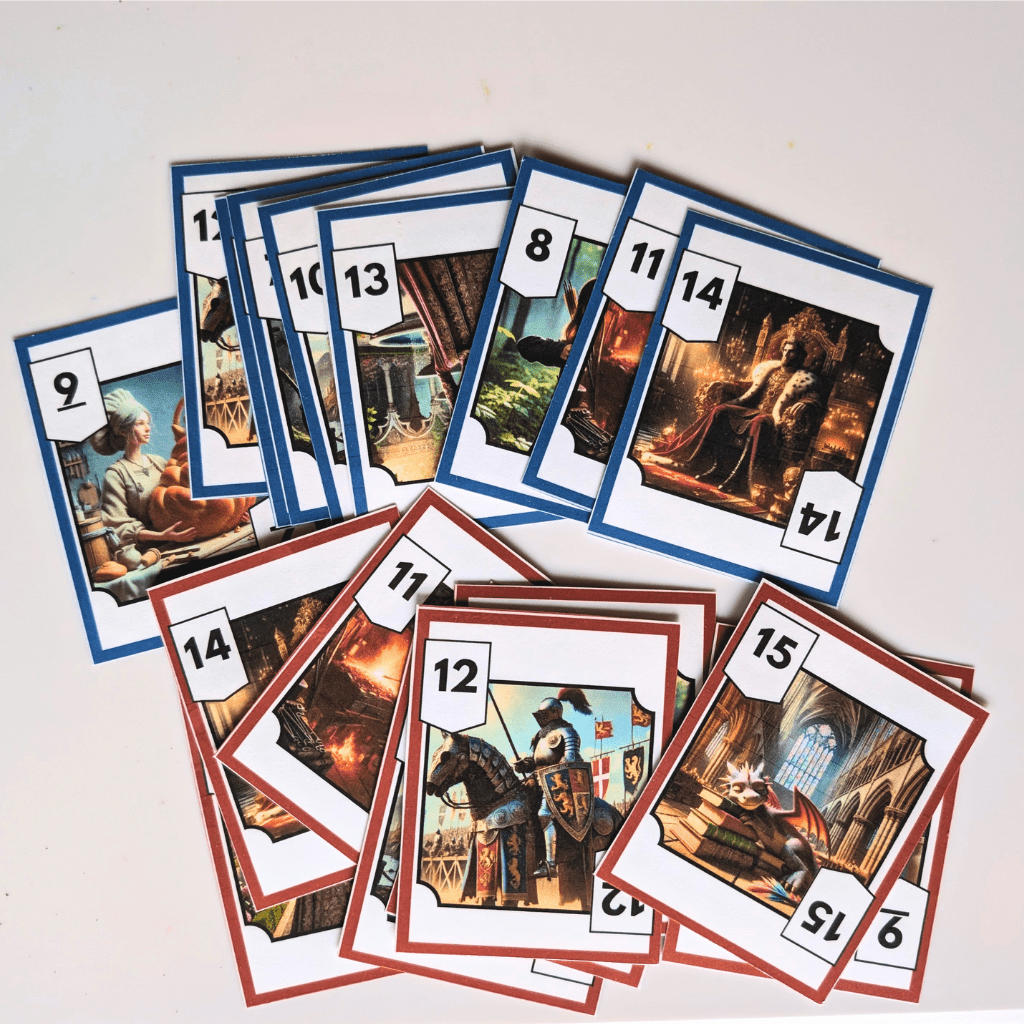
But back to math, this whole number personification thing has made math discussions in class and at home so much more interesting. I was listening to the math map podcast and Dr. Gilpin recommended making your own number cards for quick arithmetic games…it’s hard sometimes to remember what numbers kings and queens are and if we decided aces were high or low. Plus, it would be nice if the cards went up to 15 like we do with skip counting.
Soooo, thanks to the power of the internet and a little late-night insomnia, here are some personified number cards for all your little creative math geniuses (or right-brained ADHD-prone kids). If you want four suites like regular playing cards, print two sets. (make sure you select “fit to page” otherwise your printer will chop off the color). You can make blue cards negative numbers and red cards positive numbers…you can add the red and minus the blues…or multiply and divide. The sky is the limit! (I included a whole list of quick, fast medieval-themed math games that will tempt even the most dysgraphic sensitive kid into doing math…perhaps even liking it)
Enjoy.
(and if you’re looking for other screen-free homeschooling help like Challenge A survival Latin or Cartography, you can find them here.)

 Scholar Forge