Freebie: Medieval Math Cards and Synesthesia

Do numbers have personality and gender to you? Fueds, family trees, romances…sibling squabbles? Or are they just numbers?

This question came up in my Challenge A class, and out of six kids and a few adults, only one kid and one mom didn’t do this. Since I’ve done this for as long as I can remember…involuntarily with both notes/music notation and math/numbers, I sort of assumed everyone did it to some extent (except for Jim because he’s one of those weird spreadsheet people). Obviously, 0 is the patriarch and 1 is his firstborn son who’s been such a disappointment to him. 2 is the matriarch… 7 is the perfect child who drives his siblings crazy because he really shouldn’t be…etc etc etc.

Turns out that’s an actual thing called Ordinal-Linguistic Personification, which is a form of synesthesia. A large percentage of kids do it, but they usually outgrow it. Only 1% of the adult population has Ordinal-Linguistic Personification, so I guess Jim’s not the weird one after all. There are other types of synesthesia too! Some of them I’ve never even heard of:


Grapheme-color synesthesia – associating letters or numbers with specific colors.

Ordinal-linguistic personification (OLP) – attributing personalities or genders to numbers, letters, or days of the week.

Chromesthesia – hearing sounds and involuntarily seeing colors.

Lexical-gustatory synesthesia – associating words with specific tastes.

Auditory–Tactile Synesthesia – Hearing a sound causes a feeling somewhere on your body.

So now I’m super curious about who else is a closet synesthete. 👀


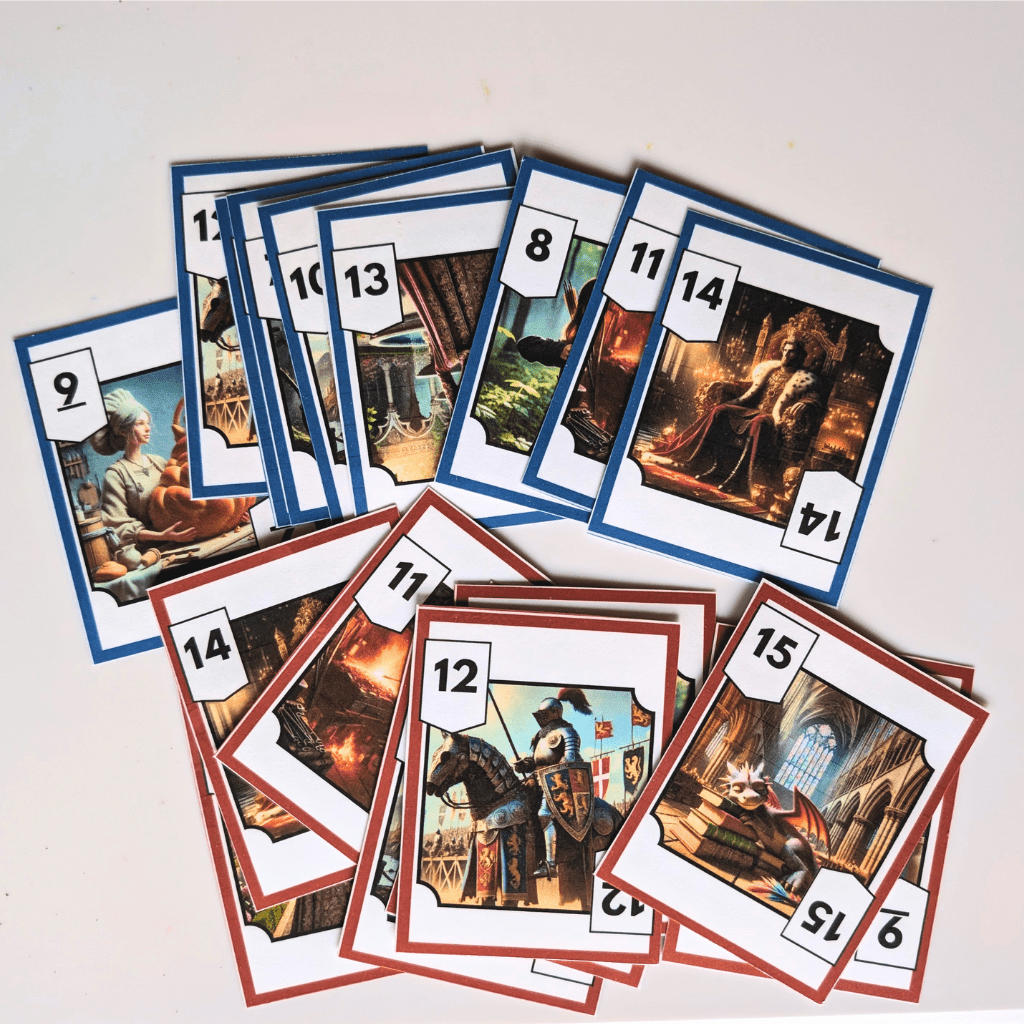
But back to math, this whole number personification thing has made math discussions in class and at home so much more interesting. I was listening to the math map podcast and Dr. Gilpin recommended making your own number cards for quick arithmetic games…it’s hard sometimes to remember what numbers kings and queens are and if we decided aces were high or low. Plus, it would be nice if the cards went up to 15 like we do with skip counting.

Soooo, thanks to the power of the internet and a little late-night insomnia, here are some personified number cards for all your little creative math geniuses (or right-brained ADHD-prone kids). If you want four suites like regular playing cards, print two sets. (make sure you select “fit to page” otherwise your printer will chop off the color). You can make blue cards negative numbers and red cards positive numbers…you can add the red and minus the blues…or multiply and divide. The sky is the limit! (I included a whole list of quick, fast medieval-themed math games that will tempt even the most dysgraphic sensitive kid into doing math…perhaps even liking it)
Enjoy.
(and if you’re looking for other screen-free homeschooling help like Challenge A survival Latin or Cartography, you can find them here.)

Math Notation Flashcards

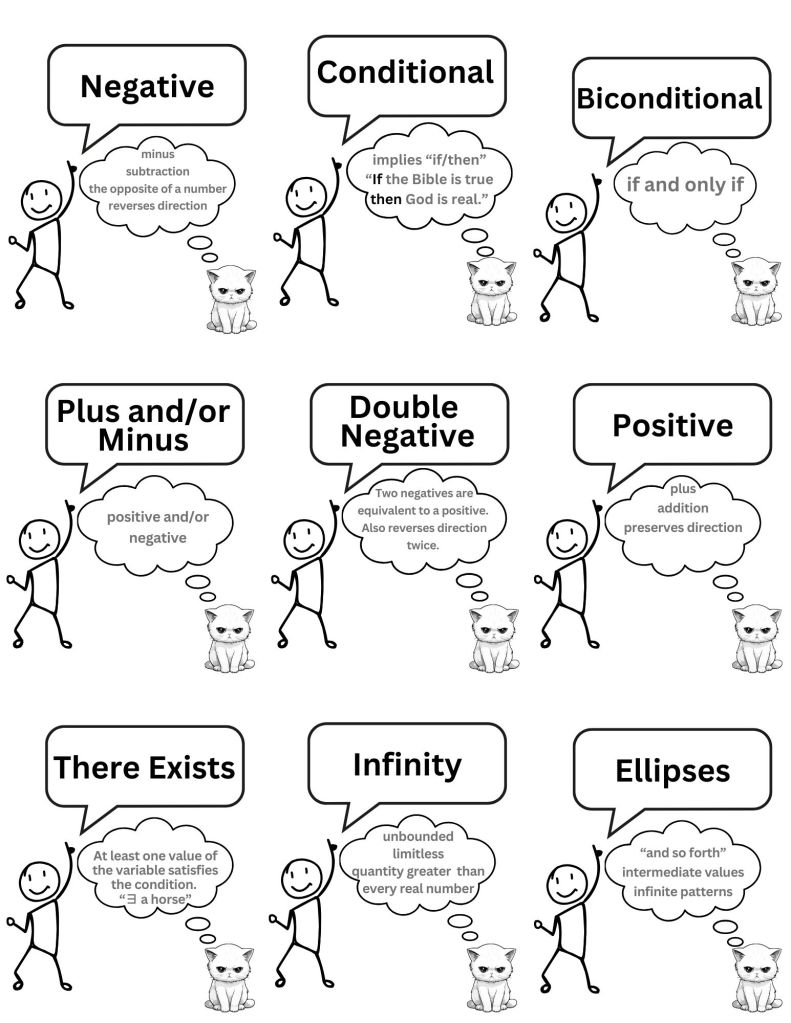
We’re on winter break, “enduring” the prettiest, gentlest snowstorm, and enjoying everything being canceled. Back last Summer when it was 100 degrees with 100% humidity I started (what I thought) was going to be the simple task of making math notation flashcards for myself and my kids. I got about halfway through when the school year officially started and we all feel like we’ve been tipped off a cliff or tossed off a high dive. Since then it feels like it’s been a thousand years with a few battles with the Balrog, but finally, I came face to face with enough time to finish those soul-sucking math notation flashcards. Definitely a labor of love. Ten out of ten do not recommend. Trying to figure out how to make logarithms and formulas on Canva is definitely not my idea of a good time. The only thing that kept me going was that I couldn’t use the normal ones. The ones CC sells are double double-sided, i.e. they put answers and questions on both sides, so both sides of the card criss-cross and contain both a question and an answer to the other side. It’s brilliant really. Nobody wants to carry around an enormous stack of flashcards and this cuts the stack in half. They’re great flashcards, well done…high quality…fit perfectly in the little flashcard boxes at Walmart/Target. You can purchase them here.

My eyeballs literally can’t handle them though. No matter how many times I tell myself this x has nothing to do with the “geometric mean”, it’s like my brain takes a picture and it’s stuck in there permanently the wrong way.

So for those who are also visual learners…have ADHD…or dysgraphia, here is a PDF of all the flashcards with just one notation and answer(s) on each card. I made them humorous and satirical with a grumpy cat and an over-enthusiastic stick figure. I also added some Latin explanations (couldn’t help myself)

Please, for the love of all the things that got neglected in my house to make these (the mud tracked in, wood shavings everywhere, cats hiding behind water heaters), use them if you need them. Hopefully, they do someone else some good too.

Now I’ll return to working on writing, spelling, and Latin curriculum, where letters mean their actual letters and not points of an angle.

It’s February, and it’s ok to feel like Frodo on the side of Mt. Doom, right? Right. (Also, can you tell what Snowday books/movies we’ve been consuming?) ahem.

If you’re looking for other neuro-helpful stuff:
Here’s a fun, electronic-free, comic-book style Latin workbook that goes along with Henle and Challenge A.
Here are some colorable Latin Flashcards that use mnemonics and puns to help them stick.
Here’s a simplified Anatomy workbook with body systems and guided research that is more accessible for dysgraphia/dyslexia.

My Summer Math Hack

We only have three weeks of school left, the green baby leaves have finally outnumbered the gray tones, and I’m sitting in my living room wallowing in jello-like humidity (which I know is only a whisper of what’s to come, but in comparison, it’s for sure a hearkening). Clearly, Summer is almost here.

I’ve been mulling over what we want to do this summer: Hopefully, lots of gardening, river floating, and playing football or basketball in the morning after we’ve slept in, eaten homemade crepes, and read books together (one can dream, right?). But when I was thinking back to what has worked in previous summers I realized there is a clear winner that has threaded its way through all of our summers since my oldest was a wee lad.

Xtra Math

Yeah, I know it’s kind of old school at this point, but I swear it really does painlessly teach fast arithmetic facts. I’ve always called it their “summer vitamin” and no one has really balked at it much, although that may be because it takes less than 10 minutes and has a clear beginning and end.

I don’t like to use it during the school year because Saxon takes so long that even ten more minutes feels like a duel-worthy insult, but I like to pull Xtra Math out in the summer just to keep everyone’s minds sharp.

And if we don’t get to it because we’re camping or picking ticks off, well then…that’s ok too.

In Defense of kids who don’t like math 

Full disclosure, I was one of those kids. Notice I said ‘was”, because along with my black thumb, and fear of talking to strangers, time really does heal all things (or most things). While I won’t be winning any Nobel prizes in astro physics, nor becoming a horticulturist or the next Malcolm Gladwell, I have mastered all those things to the point where I don’t start panicking and breaking out in hives when I have to do trinomial equations or save the butternut squash from the vine borers. (Well mostly there’s no panicking, I do still occasionally turn bright red when talking to strangers). 

Part of it is some kids just don’t like numbers, or maybe it would be more accurate to say, that numbers don’t like them (I’m looking at you Dyscalculia). I mean, there’s nothing wrong with their brains, numbers are just slippery bits of squiggly lines that go in one ear and fall right out the other. I didn’t realize I could do math until I met geometry and propositional logic. Put interesting concepts and theories in His Royal Majesty the King’s English and suddenly it all makes sense. 

But now that I’ve taught math both in the classroom and at home for fourteen years now, I’ve made some observations. There’s a group of kids who seem like they’re bad at math, or maybe it takes them forever to get through a lesson, but it’s not because they have the aforementioned Houdini number problem. They usually have really good number sense…too good. And that’s their hangup. For kids who have more abstract brains (Ne or Ni for the Myers Briggs nerds), their mind has to do a lot of sorting and thinking and connecting while they’re doing math. They can’t just be told how to do something. They tend not to trust it, and they second guess themselves constantly because nobody gave them all the puzzle pieces and they’re missing connector pieces that would bring the whole picture together. Now obviously there is a brand of math lover who is both abstract, loves arithmetic, is good with numbers, and is super fast…but we’re not talking about those unicorns. We hate those people (just kidding…and if any of my brothers are reading this, no I really am jealous proud of your ridiculously impressive math skills). For the math sloths, the problem isn’t that they can’t do math, the problem is they’re climbing a mountain in their head where you can’t see, and then having a meltdown like Mt. St. Helens because they’re sure they’re the worst math student the world has ever seen and they’re never going to understand it (middle schoolers are especially dramatic about math…ask me how I know). 

At this point, I think I have bought and tried every math curriculum on the market, including but not limited to Singapore, Math U See, Saxon, Horizon, Bob Jones, Abeka, Rod and Staff, The Good and The Beautiful, Teaching Textbooks, Life of Fred, Right Start, Houghton Mifflin, Beast Academy, and Shormann.  Whew. 

The only one I truly hate is Saxon, which ironically is also the one we are currently using. I only hate it because it’s what I used as a kid and spent too many hours fantasizing about ways to burn it, but my kids seem to be thriving with it, so here we are (Mom, you can feel very vindicated right now).  

If I had to pick my favorite combinations, it would be to use RightStart for the younger years (love that program). But it’s pretty teacher-intensive, so I like to use it alongside Rod&Staff which has very simple black-and-white consumable workbook pages. Perfect for days when you need to help the older ones more or you just can’t fit the raison d’etre RIghtStart in your day (seriously, the thing is a beast). Then for the older kids, I used to recommend Shormann, until I figured out that most teenagers can hack that thing with their eyes shut and get an “A” without actually learning a blessed thing. So now I prefer Nicole the Math Lady, who uses Saxon but actually explains everything like a normal person. 

But my biggest piece of advice for the slow-hiking, Mt. St. Helen math kids, is to set a timer and scale. Acknowledge and praise them for the invisible rabbit burrows they’ve dug all through their brain. Encourage them that they are good at math (because they truly are). Set a timer for 60 min, and assign odds or evens. But don’t let them stay at camp happy-go-lucky. They really do need to get to a normal speed eventually. I mean, I don’t know what project engineers do when a bridge needs to be finished and everyone is waiting on them, but I imagine nobody is happy to sit around wasting money while their engineer gazes off into the distance making math connections. So at home, while you still have the chance, make some achievable goals for speeding up and pushing themselves a little. 

Easy + One is what I always say. 

And hug a kid who says they hate math, chances are they will eventually love it.