Yes, it’s every mother’s favorite type of project: Something that includes hundreds of tiny pieces. Perler beads.
Somehow I have managed to avoid these little monsters for years. They fall into the same category as “Toddlers with Fruit” in my book i.e. the fun stage of life when your three-year-old asks for a banana and then promptly has a meltdown because you peeled it… or didn’t peel it, or they peeled it and saints preserve us it broke in half. Perler beads are similar in that they are prone to all kinds of catastrophe, someone bumps the table, a sibling jostles an elbow, or they don’t iron right, and holy Batman the drama and meltdowns ensue. The only difference is that Perler beads don’t contain important nutrients like potassium so at least you don’t have to feel guilty if you refuse to stock them in the house.
It’s my own fault really. I was hoisted on my own petard. One of my children who shall remain nameless, was making future plans to be an electrician and I took the opportunity to mention, and encourage oh-so-kindly, that he ought to work on his fine motor skills if he wanted to go into a profession that is basically the art of harnessing magic traveling in various amounts of strengths (and speeds) in waves across various intricate mediums. Convince me I’m wrong.
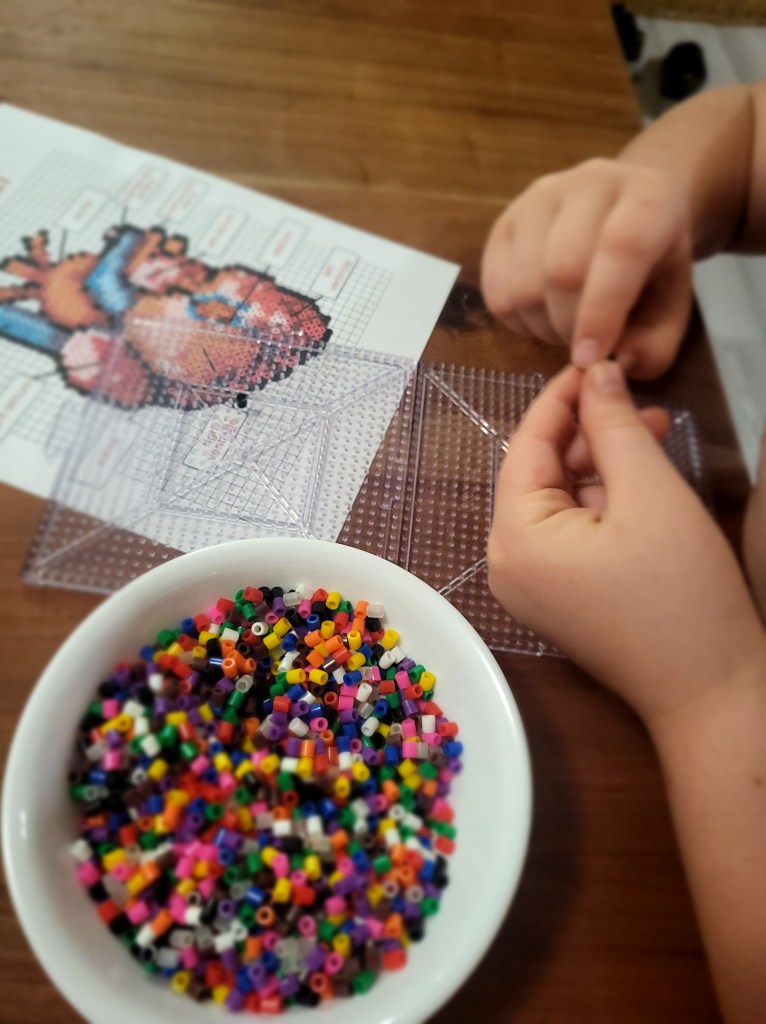
And that is how I found myself the proud owner of an 1100-piece bag of Perler beads. I mean we must work on said fine motor skills. And of course he remembers the activity that most helped his fine motor skills was the few times I allowed Perler beads into the house. And he would have no problem sitting still and focusing for long periods if only he had something like Perler beads to work on. The thing is, he’s right. They did really help his fine motor skills last time. And he did super focus. Bah.
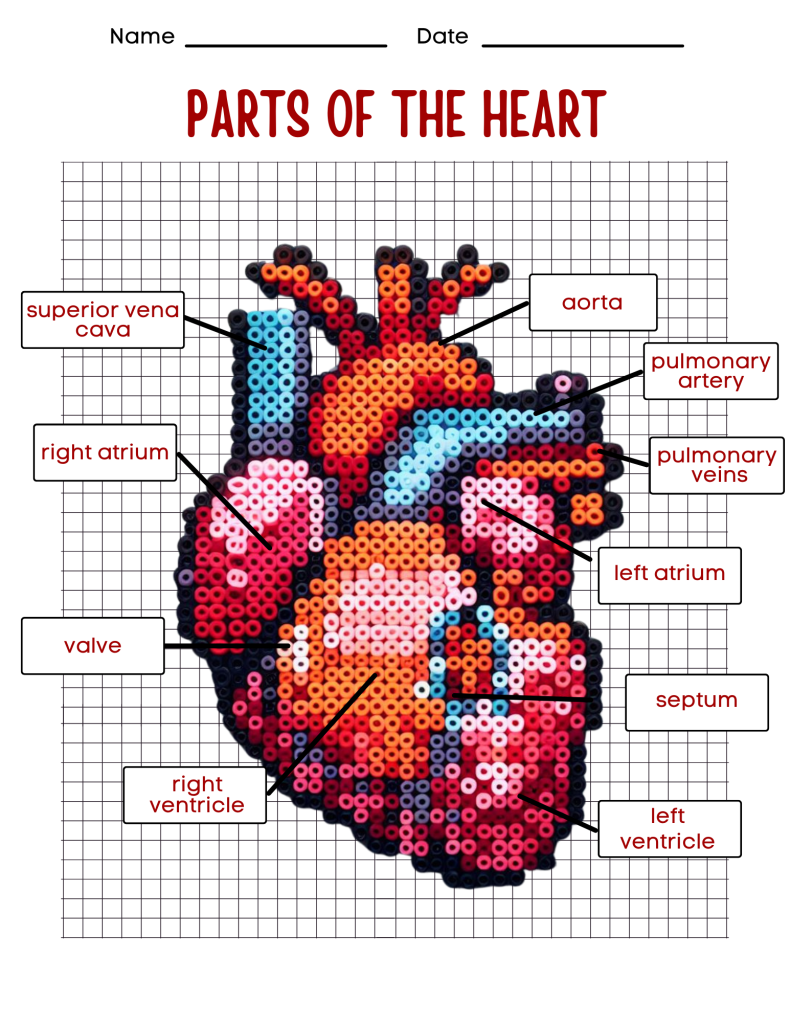
But in the end, we compromised. We’re wrapping up our unit study on human anatomy right now, so I figured if we’re going to do this, we’re going to gosh-darn do it right with a (mostly) accurate anatomical heart made entirely out of Perler beads.
I gift you with the tutorial/pattern/worksheet below. You’re welcome…er… I’m sorry. Pass on my apologies to your vacuum cleaner.
Full disclosure, I was one of those kids. Notice I said ‘was”, because along with my black thumb, and fear of talking to strangers, time really does heal all things (or most things). While I won’t be winning any Nobel prizes in astro physics, nor becoming a horticulturist or the next Malcolm Gladwell, I have mastered all those things to the point where I don’t start panicking and breaking out in hives when I have to do trinomial equations or save the butternut squash from the vine borers. (Well mostly there’s no panicking, I do still occasionally turn bright red when talking to strangers).
Part of it is some kids just don’t like numbers, or maybe it would be more accurate to say, that numbers don’t like them (I’m looking at you Dyscalculia). I mean, there’s nothing wrong with their brains, numbers are just slippery bits of squiggly lines that go in one ear and fall right out the other. I didn’t realize I could do math until I met geometry and propositional logic. Put interesting concepts and theories in His Royal Majesty the King’s English and suddenly it all makes sense.
But now that I’ve taught math both in the classroom and at home for fourteen years now, I’ve made some observations. There’s a group of kids who seem like they’re bad at math, or maybe it takes them forever to get through a lesson, but it’s not because they have the aforementioned Houdini number problem. They usually have really good number sense…too good. And that’s their hangup. For kids who have more abstract brains (Ne or Ni for the Myers Briggs nerds), their mind has to do a lot of sorting and thinking and connecting while they’re doing math. They can’t just be told how to do something. They tend not to trust it, and they second guess themselves constantly because nobody gave them all the puzzle pieces and they’re missing connector pieces that would bring the whole picture together. Now obviously there is a brand of math lover who is both abstract, loves arithmetic, is good with numbers, and is super fast…but we’re not talking about those unicorns. We hate those people (just kidding…and if any of my brothers are reading this, no I really am jealous proud of your ridiculously impressive math skills). For the math sloths, the problem isn’t that they can’t do math, the problem is they’re climbing a mountain in their head where you can’t see, and then having a meltdown like Mt. St. Helens because they’re sure they’re the worst math student the world has ever seen and they’re never going to understand it (middle schoolers are especially dramatic about math…ask me how I know).
At this point, I think I have bought and tried every math curriculum on the market, including but not limited to Singapore, Math U See, Saxon, Horizon, Bob Jones, Abeka, Rod and Staff, The Good and The Beautiful, Teaching Textbooks, Life of Fred, Right Start, Houghton Mifflin, Beast Academy, and Shormann. Whew.
The only one I truly hate is Saxon, which ironically is also the one we are currently using. I only hate it because it’s what I used as a kid and spent too many hours fantasizing about ways to burn it, but my kids seem to be thriving with it, so here we are (Mom, you can feel very vindicated right now).
If I had to pick my favorite combinations, it would be to use RightStart for the younger years (love that program). But it’s pretty teacher-intensive, so I like to use it alongside Rod&Staff which has very simple black-and-white consumable workbook pages. Perfect for days when you need to help the older ones more or you just can’t fit the raison d’etre RIghtStart in your day (seriously, the thing is a beast). Then for the older kids, I used to recommend Shormann, until I figured out that most teenagers can hack that thing with their eyes shut and get an “A” without actually learning a blessed thing. So now I prefer Nicole the Math Lady, who uses Saxon but actually explains everything like a normal person.
But my biggest piece of advice for the slow-hiking, Mt. St. Helen math kids, is to set a timer and scale. Acknowledge and praise them for the invisible rabbit burrows they’ve dug all through their brain. Encourage them that they are good at math (because they truly are). Set a timer for 60 min, and assign odds or evens. But don’t let them stay at camp happy-go-lucky. They really do need to get to a normal speed eventually. I mean, I don’t know what project engineers do when a bridge needs to be finished and everyone is waiting on them, but I imagine nobody is happy to sit around wasting money while their engineer gazes off into the distance making math connections. So at home, while you still have the chance, make some achievable goals for speeding up and pushing themselves a little.
Easy + One is what I always say.
And hug a kid who says they hate math, chances are they will eventually love it.


 Scholar Forge