Freebie: Medieval Math Cards and Synesthesia

Do numbers have personality and gender to you? Fueds, family trees, romances…sibling squabbles? Or are they just numbers?

This question came up in my Challenge A class, and out of six kids and a few adults, only one kid and one mom didn’t do this. Since I’ve done this for as long as I can remember…involuntarily with both notes/music notation and math/numbers, I sort of assumed everyone did it to some extent (except for Jim because he’s one of those weird spreadsheet people). Obviously, 0 is the patriarch and 1 is his firstborn son who’s been such a disappointment to him. 2 is the matriarch… 7 is the perfect child who drives his siblings crazy because he really shouldn’t be…etc etc etc.

Turns out that’s an actual thing called Ordinal-Linguistic Personification, which is a form of synesthesia. A large percentage of kids do it, but they usually outgrow it. Only 1% of the adult population has Ordinal-Linguistic Personification, so I guess Jim’s not the weird one after all. There are other types of synesthesia too! Some of them I’ve never even heard of:


Grapheme-color synesthesia – associating letters or numbers with specific colors.

Ordinal-linguistic personification (OLP) – attributing personalities or genders to numbers, letters, or days of the week.

Chromesthesia – hearing sounds and involuntarily seeing colors.

Lexical-gustatory synesthesia – associating words with specific tastes.

Auditory–Tactile Synesthesia – Hearing a sound causes a feeling somewhere on your body.

So now I’m super curious about who else is a closet synesthete. 👀


But back to math, this whole number personification thing has made math discussions in class and at home so much more interesting. I was listening to the math map podcast and Dr. Gilpin recommended making your own number cards for quick arithmetic games…it’s hard sometimes to remember what numbers kings and queens are and if we decided aces were high or low. Plus, it would be nice if the cards went up to 15 like we do with skip counting.

Soooo, thanks to the power of the internet and a little late-night insomnia, here are some personified number cards for all your little creative math geniuses (or right-brained ADHD-prone kids). If you want four suites like regular playing cards, print two sets. (make sure you select “fit to page” otherwise your printer will chop off the color). You can make blue cards negative numbers and red cards positive numbers…you can add the red and minus the blues…or multiply and divide. The sky is the limit! (I included a whole list of quick, fast medieval-themed math games that will tempt even the most dysgraphic sensitive kid into doing math…perhaps even liking it)
Enjoy.
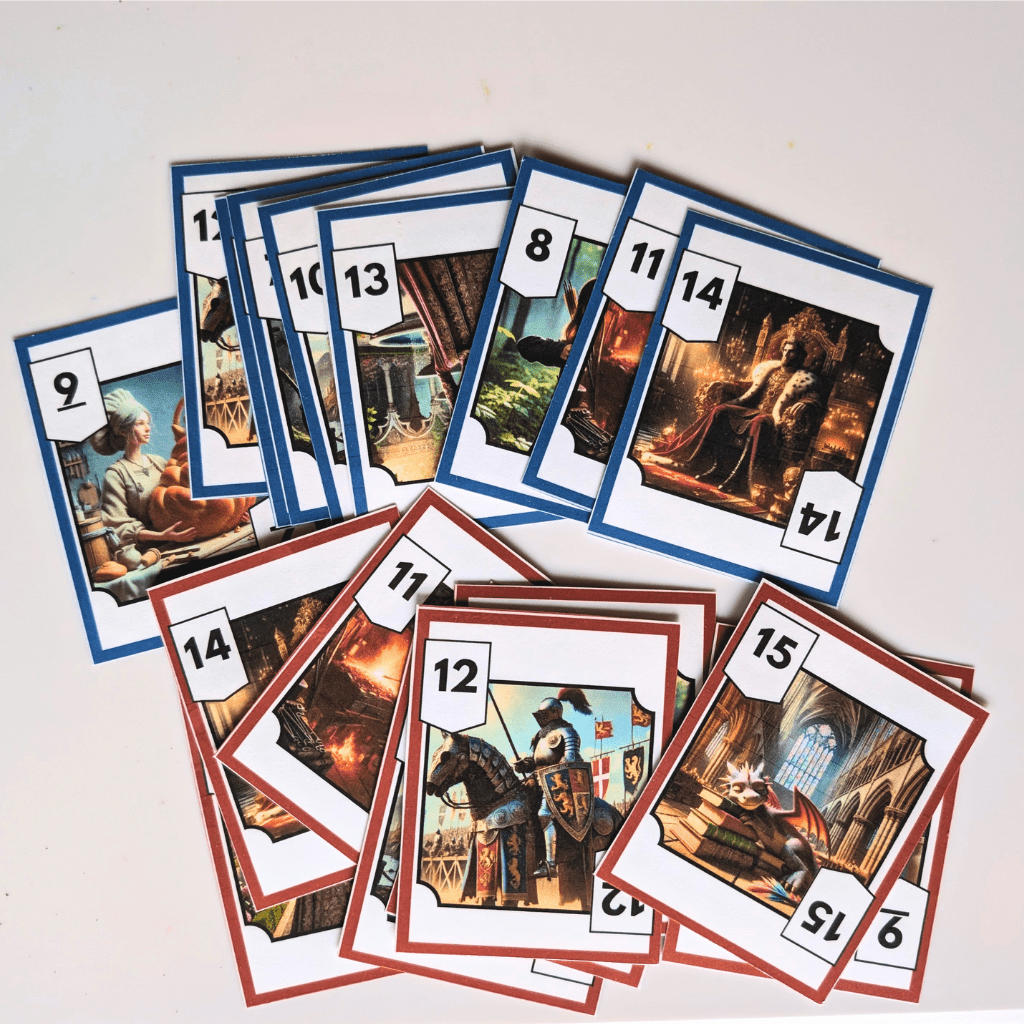
(and if you’re looking for other screen-free homeschooling help like Challenge A survival Latin or Cartography, you can find them here.)
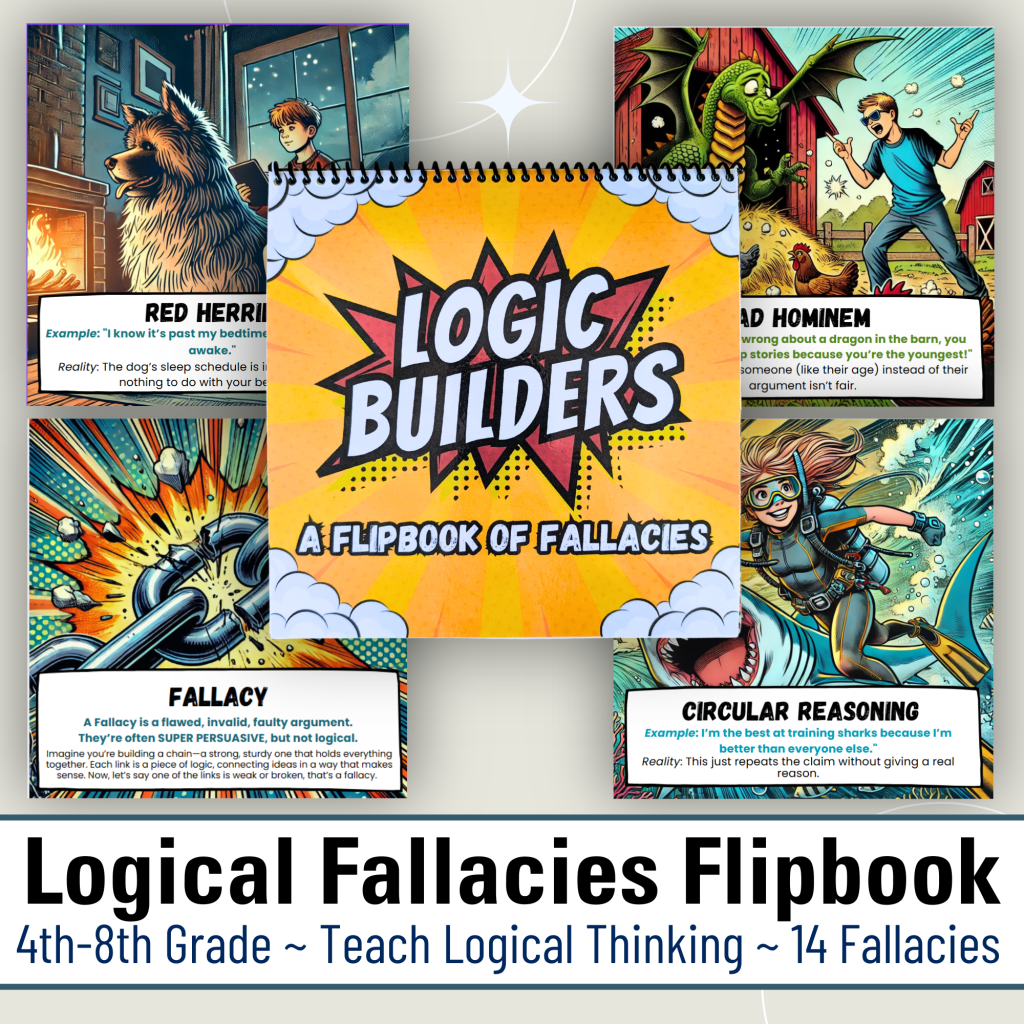
Teaching kids to be thinkers: Fallacy Flipbook

The world right now feels a bit like a flamingo trying to put on pantyhose in the dark. Lots of staggering involved. Maybe it’s because I have one kid going through the Fallacy Detective right now, or maybe we’re just in a new season of family dinners where varying opinions, debates, and conversations are flying on a more “oh hey look my kids are actually mini adults now” level and not the old days of “Please put your underwear back on, and no you cannot stick beans up your nose.”

So all that to say, we’re on a logical fallacy kick around here. We find them in movies and ads, we catch each other doing them and we find them in spades on the internet and news. Whether your kids are homeschooled, private schooled, public schooled, or meet under a waterfall in some Waldorf-inspired space, I think it’s safe to say raising discerning thinkers is a high priority for all of us. Equipping them with the tools to think, discern, and pursue truth is like a broken record on the to-do list.

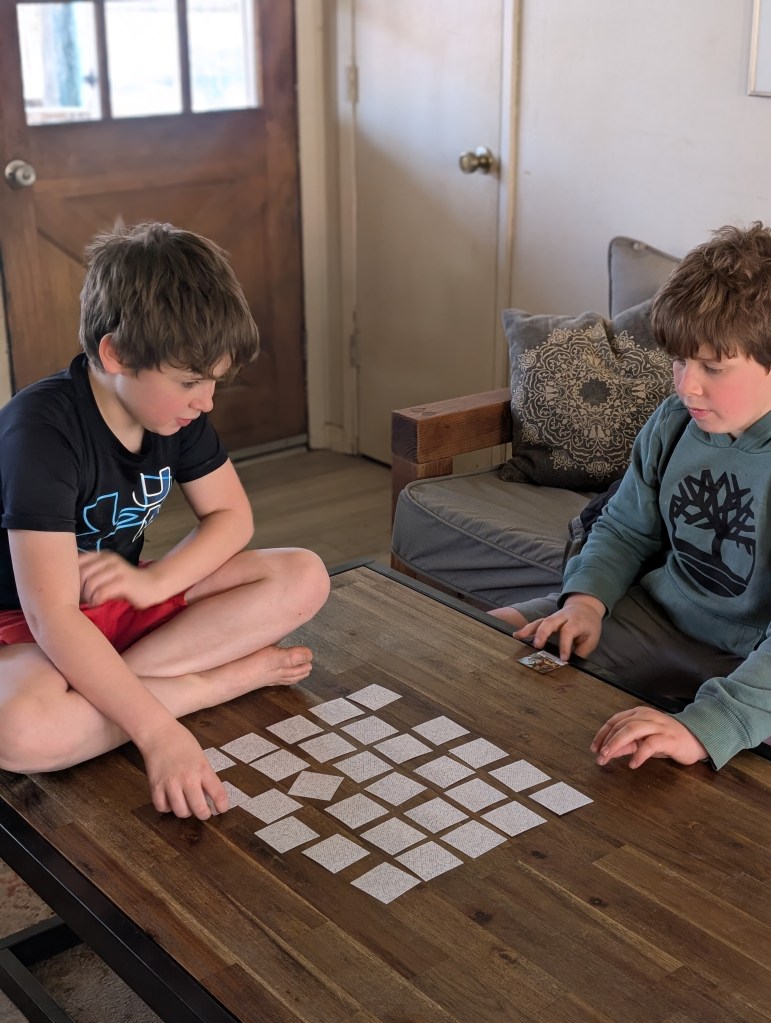
Not that I have anything remotely close to the answer, since persuasive rhetoric is supercharged these days, and we’re just as susceptible as the next person. So this is not a promise for “life-changing” results, but we’ve been enjoying these cards and matching game which you can download here. It’s led to lots of great conversations and I like that the youngest is catching up quicker than his older siblings did.

Or if you feel like supporting a small business, (mine!) you can download the full flipbook for a few dollars here. I made them to be neuro friendly and brain “sticky” in all the ADHD/Dyslexia ways. Even my older kids are picking it up and reading through them….which….let’s just say I’ll take that as a win!

The Secret Hack To Getting Your Kids Through Their Schoolwork

I’m loathed and embarrassed to even use such a clickbaity title, but I stumbled upon this method quite by accident and either it’s an anomaly for my kids/friends kids/students or it really is magical.

In all my spare time, I (try to) read books on neuroscience and listen to podcasts on all the latest cognitive strategies (hello Huberman), but there’s a difference between absorbing parasympathetic systems and dopamine receptors, and the real strategies for down-in-the-trenches help. So if I were to analyze this method dispassionately, I would say it’s the adrenaline and dopamine receptors that are kept guessing, that make this strategy so effective, but enough of the navel-gazing…. what is this?

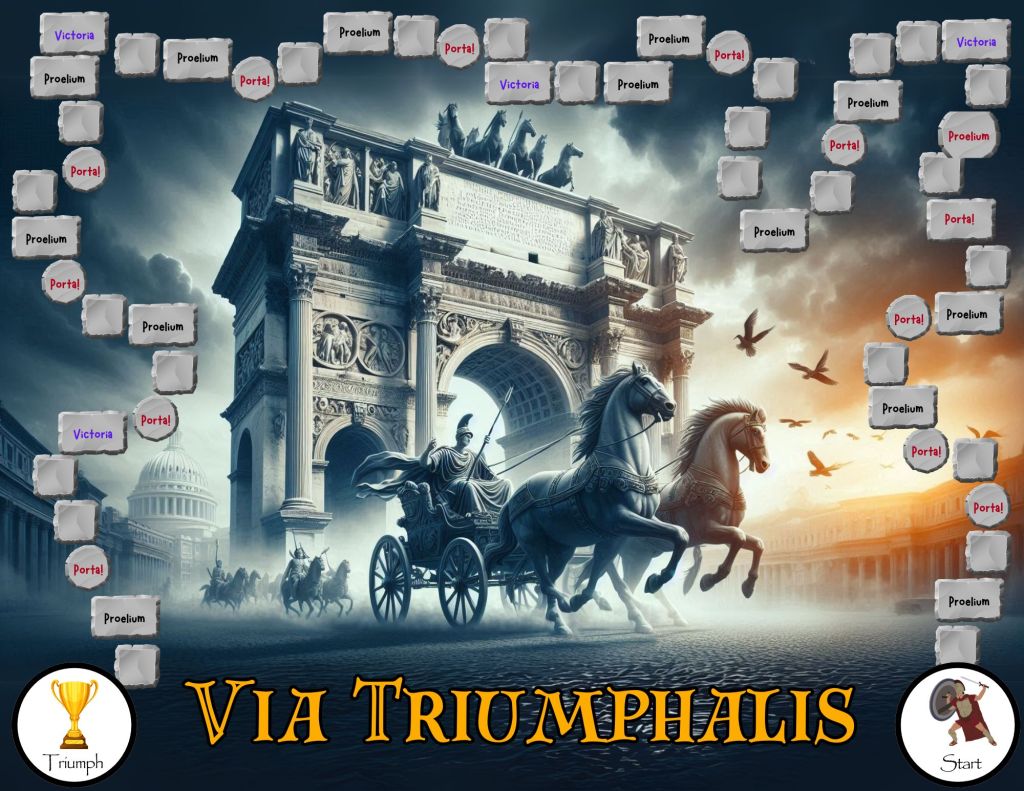
A printable board game and a few dice. I’m not joking. I can literally get my kids and my cottage school kids to do anything with this game. Math? done. Latin? done. Spelling? done. If you only have one kid, you’ll have to play with them as you need at least two players. Sometimes I do their work alongside them to show that even moms have to do school too, and sometimes I have them assign me my own “school work” like switching the laundry or starting lunch. After all, fair is fair, and if I’m asking them to do half a math worksheet, then they can assign me peanut butter and jelly sandwiches (little do they know, that I need the ADHD motivation hack too).

I named it “Via Triumphalis” which means “The Road of Triumph” in Latin. But don’t worry, you don’t need to understand Latin to play this game beyond knowing that “Proelium” means battle, and “Porta” means gate. You also need dice, and dry-erase markers (or a penny or something to move across the board…we use dry-erase markers). I have two versions, a simple one for younger kids, and a more complex one with character cards if your older kids get bored of the simpler version.

Word of caution though, don’t use it too much….act reluctant…only pull it out every two or three times they ask for it, otherwise (like with all things) the novelty wears off.

Here is the simple one, and here is the more complex one with character cards. Enjoy! Hopefully it’s not one of those things that only works magically for me.

P.S.
Not just for homeschooled kids, works great for getting any kid through homework.

Math Notation Flashcards

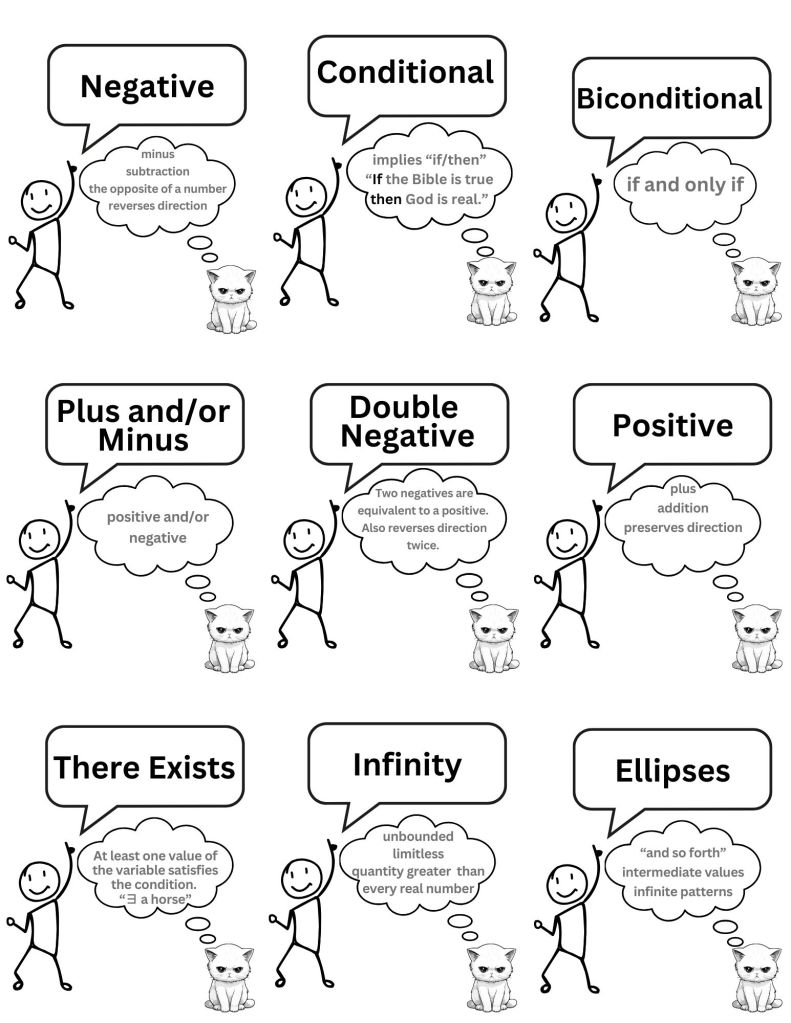
We’re on winter break, “enduring” the prettiest, gentlest snowstorm, and enjoying everything being canceled. Back last Summer when it was 100 degrees with 100% humidity I started (what I thought) was going to be the simple task of making math notation flashcards for myself and my kids. I got about halfway through when the school year officially started and we all feel like we’ve been tipped off a cliff or tossed off a high dive. Since then it feels like it’s been a thousand years with a few battles with the Balrog, but finally, I came face to face with enough time to finish those soul-sucking math notation flashcards. Definitely a labor of love. Ten out of ten do not recommend. Trying to figure out how to make logarithms and formulas on Canva is definitely not my idea of a good time. The only thing that kept me going was that I couldn’t use the normal ones. The ones CC sells are double double-sided, i.e. they put answers and questions on both sides, so both sides of the card criss-cross and contain both a question and an answer to the other side. It’s brilliant really. Nobody wants to carry around an enormous stack of flashcards and this cuts the stack in half. They’re great flashcards, well done…high quality…fit perfectly in the little flashcard boxes at Walmart/Target. You can purchase them here.

My eyeballs literally can’t handle them though. No matter how many times I tell myself this x has nothing to do with the “geometric mean”, it’s like my brain takes a picture and it’s stuck in there permanently the wrong way.

So for those who are also visual learners…have ADHD…or dysgraphia, here is a PDF of all the flashcards with just one notation and answer(s) on each card. I made them humorous and satirical with a grumpy cat and an over-enthusiastic stick figure. I also added some Latin explanations (couldn’t help myself)

Please, for the love of all the things that got neglected in my house to make these (the mud tracked in, wood shavings everywhere, cats hiding behind water heaters), use them if you need them. Hopefully, they do someone else some good too.

Now I’ll return to working on writing, spelling, and Latin curriculum, where letters mean their actual letters and not points of an angle.

It’s February, and it’s ok to feel like Frodo on the side of Mt. Doom, right? Right. (Also, can you tell what Snowday books/movies we’ve been consuming?) ahem.

If you’re looking for other neuro-helpful stuff:
Here’s a fun, electronic-free, comic-book style Latin workbook that goes along with Henle and Challenge A.
Here are some colorable Latin Flashcards that use mnemonics and puns to help them stick.
Here’s a simplified Anatomy workbook with body systems and guided research that is more accessible for dysgraphia/dyslexia.

Thoughts About Geography, Cartography, Therapy and Homeschooling

“Let me count the ways I love thee…”

Geography is one of those lost arts that is so smothered in a sea of fake/unhelpful/wannabe books, games, workbooks, and curriculum that sometimes you can’t see the forest for the trees.  It’s one of those instantly marketable items. Slap a map and the word “Geography” or “Educational” on the front of it, and we parents are quick to snap them up off of Amazon, library clean-out sales, hand-me-downs, or the thrift store like they’re desperate promises to our future selves (I mean, surely I’m not the only one with visions of perfectly curated themed bookshelves and travel themed unit studies). And don’t even get me started on the geography-themed games and flashcards…

But all that geography stuff usually is so colorful and well-designed, that you don’t realize it’s kind of shallow and unengaging (and oftentimes downright full of errors). Consequently, the problem isn’t that there aren’t tons of options for Geography, but that it’s a struggle to find stuff you’ll actually use.

And Geography is one of those subjects that packs so much bang for its buck. Not only is it math, history, art, and science all in one parcel, but it’s also visual processing, concrete/abstract processing, spatial processing, executive functioning… all the things. It’s basically a custom-designed torpedo pod of academics and therapy all tied up into one perfect package.  The only thing that might beat it at all those things is the violin, but that’s a post for another day. 

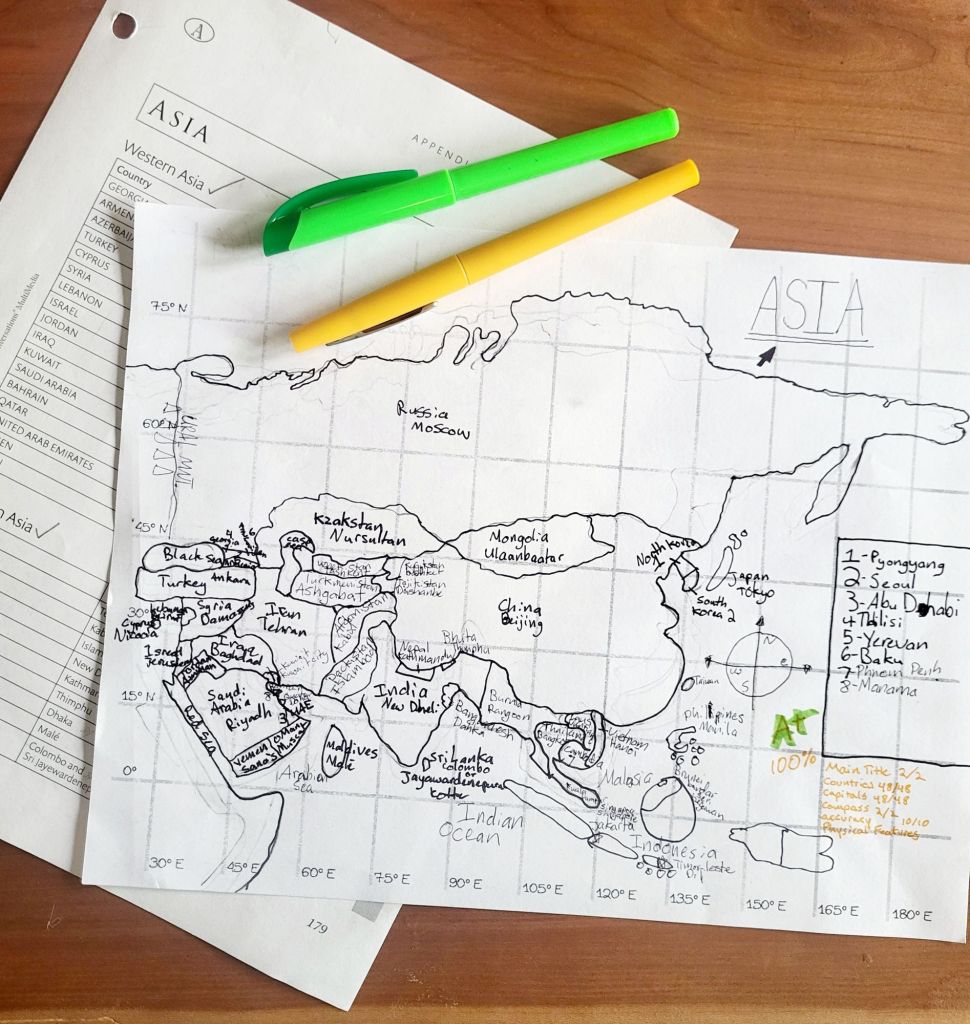
The problem is if you dive in and dig deep and engage with it…drawing and pronouncing, and wrestling with longitude and latitude, various sizes and projections, and whatnot, it’s hard. Sometimes extraordinarily hard, depending on how your kid’s brain is wired (or your brain), but I’ve seen profoundly dyslexic eyes thrive, and dysgraphia fingers map the whole world from heart (I can’t read it, but still…). Not going to lie, I’ve also seen kids cry and I’m not above bribes (and paint…and music…but mostly lots of paint). But seeing their minds grow and the connections made, I feel like it’s worth it to find your way through it. 

And I don’t just say that because I wrote a cartography workbook which you can find here (insert cheesy infomercial music).  Or made a bunch of fun, silly videos to help memorize and draw the world by heart which you can watch here (feel free to judge me, but don’t knock it til you try it…it works). 

In the end, it doesn’t matter, pull out the colorful Costco Walmart Geograph specials, and just have fun with it…but maybe Google fact-check the stuff that doesn’t pass the sniff test. Really, this is an ode to how much I love geography. 😍

Kindergarteners, Sensory Input and the Story of Mr. Thomas of a CC

Sometimes teaching life feels like an episode of Iron Chef, but instead of making tacos out of shrimp, manzanita berries, and Irish peas, it’s trying to keep your class fun and educational on thrift store donations, calcifying craft supplies, and a packet of dry-erase makers. 

I recently read Stories That Stick by Kindra Hall, which isn’t meant for educators, but I’ve found that the business world often has the best (not new) but reframed ideas for home and classroom. It reminded me of back in my Foundations days, when I was an Abecedarian tutor (the little guys in the Classical Conversations world). Homeschooling always attracts a mixture of kids who run the gamut from reciting the entire periodic table of elements at four, to hiding under their desks at co-op or class days pretending to be a gorilla (and oftentimes they’re the same kid). And not that I’m not totally on board with CC’s policy of having the moms in the room on class days, but to be honest, kids listen a lot better when their Nannie McPhee teacher tries to get them to skip count the threes, than when their mom tries to cajole them into participating…at least that was my experience with the younger ages. Honestly, though, I loved every minute of it. I think four and five-year-olds are hilarious, even when they’re painting their neighbor’s frilly pink dress in black shoe polish from their Dore art projects. 

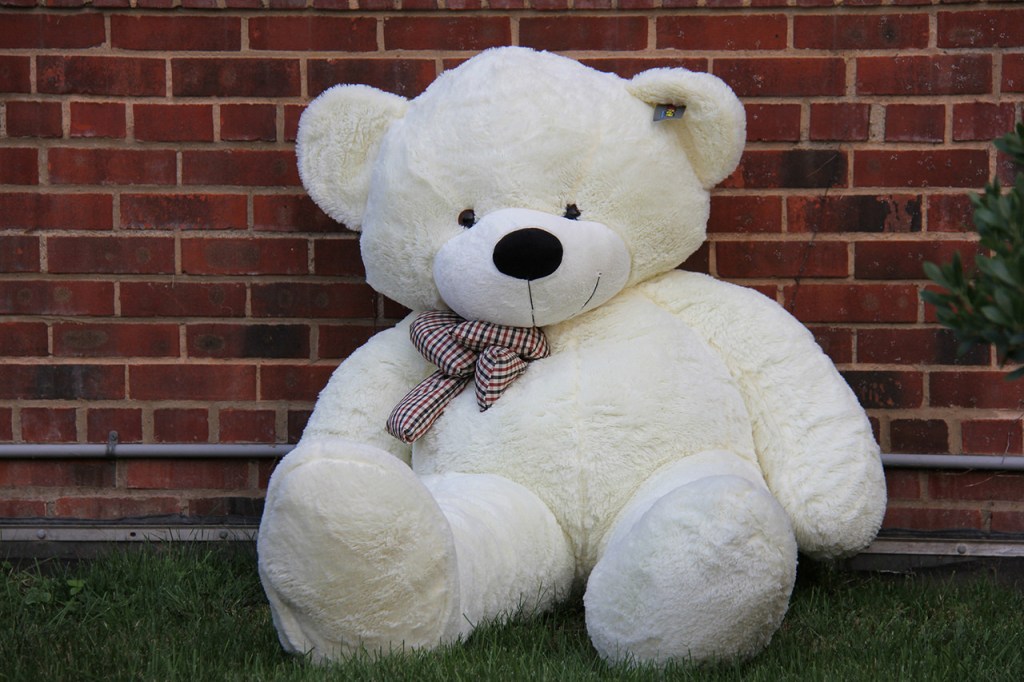
But I digress… Our CC campus at the time also happened to be my home church, and so I sometimes helped clean things out or went through stuff people donated for the nursery, and that’s how I stumbled across Mr. Francis of a CC. He was one of those giant teddy bears kind of like the ones they used to sell at Costco. He was very much not disinfectable for the nursery, but I couldn’t bear to let him go (pun intended…ha). He had so much potential! So I moved him to my CC classroom and I’m telling you, I’ve never had so much success getting preschoolers and kindergarteners to do stuff!

 “Let’s sing the Latin Noun Declensions more loudly and see if we can wake Mr. Francis up!” 

“Mr. Francis is waiting for everyone to sit down quietly before he can chant irregular verbs with us”

“Having a meltdown? Go lay on the giant stuffed teddy bear and give him the tightest hug you can”

“Can’t sit still or keep your hands to yourself? Go jump on the giant teddy bear.”  

 The kids loved him. We created all sorts of make-believe stories and narratives about him and used him for all types of pretend play. It was my best Abecedarian year ever. 

I was sad when I moved on to the older kids the next year and didn’t take Mr. Francis with me.  I don’t know whatever happened to him, I think he ended up finally retiring to a thrift store where I’m now imagining all kinds of Toy Story endings for him. But I think the magic of Mr. Francis lives on and can be recreated in an infinite variety of ways, one just needs two things. 

Sensory input and stories. 

The very large nature of Mr. Francis and the proprioceptive input kids got from jumping on something or falling into something big and soft, was very calming, and the stories and characterization made him real and gave them a reason to not eat their boogers, or helped them stand up tall and straight for their presentations. But really anything works. At that age, you can take playdough and stick googly eyes on it and name it Mr. Slimy Pants or something. Teenagers are a bit harder because they still need the sensory input and stories, but they’re not quite as willing to look silly, but that’s a different blog post for a different day.  

For now, I would just like to say “Rest in peace Mr. Frances of a CC you were well loved, and may your life lessons live on.“

Also, I need a giant Appa in my life. Like this, but way way bigger.